Tuesday, April 17, 2012

4/17/72 Copenhagen, Part II: Jack Straw, Justice, & Saison


When: Monday, April 17, 1972
Where: Tivoli Concert Hall, Copenhagen, Denmark
Setlist: (In order of the released CDs. The concert was broadcast on Danish TV - links below are single-song selections, or check out the entire show here.)
  1. Cold Rain & Snow, Me & Bobby McGee, Chinatown Shuffle, China Cat Sunflower > I Know You Rider, Jack Straw, He's Gone, Next Time You See Me, Black-Throated Wind
  2. Casey Jones, Mr. Charlie, Playing In The Band, Sugaree, One More Saturday Night, Hurts Me Too, Ramble On Rose, El Paso, Big Railroad Blues, Truckin'
  3. Dark Star > Sugar Magnolia > Caution (Do Not Stop On The Tracks) > Johnny B. Goode
As always, personal highlights are in bold.

After a quick detour to Aarhus, the Dead returned to the Tivoli Theatre for a concert recorded for a TV broadcast. One section was aired live, while two other components were aired in August, 1972. In order to accommodate the broadcast, the show was split into three (relatively) short sets. The first set is solid, though it starts and stops for the TV broadcast and monitor issues. (Thankfully much of the Dead air is edited out on the release.) I think the logistics of the broadcast may have made it difficult for the band to find a groove in the first set, and may of the songs are played at a particularly slow tempo. No major performance issues, but at some points the performance is a bit low-energy. However....

Great opener!! The ever-elusive "Cold Rain & Snow" finally makes an appearance on the tour, and it's fantastic. Keith is all over the piano from start to finish, and the rest of the band responds. There is some great jamming through "China Cat" > "Rider," and the "Jack Straw" has excellent harmonies. I actually think the set's slower tempo is best suited for "Black-Throated Wind," in which the deliberate pace highlights the plodding narrator's heartbroken journey out of St. Louis.

Phil plays Bozo, if only for a song.
(He preferred napping on the Bolo bus.)
The "Casey Jones" that opens the second set is odd, and not just for it's position as set opener rather than closer. Again, it starts off slowly, but there is a section that sounds like Phil's bass is completing Jerry's guitar runs. They get amped by the end of the song, though, and the rest of the set is blistering. Before starting "Big Railroad Blues," the Bozos take over the stage!! Bobby dons cartoonish Groucho Marx glasses, while Phil, Keith, Bill, and Pigpen follow suit bald-and-rainbow masks, and even Jerry gets into the mix. What follows is a strong "Big Railroad Blues" that showcases their chops on their odd-ball circus show.

With the cameras off, they start the third set with another great rendition of "Dark Star." I'll spare you the play-by-play, but this is yet another great version. It contains patient explorations of the main theme and a mildly spooky space segment early on. The middle features Jerry leading the band with up-beat, virtuosic runs to an exultant jam before plunging them through the rabbit-hole and into darkness, this time closer to the edge of terror. Keith and Phil are all to glad to come along for the ride, providing perfectly-suited rhythm and counterpoint. I can't get enough of these '72 "Dark Stars!"

Catch it while you can: Jerry dons his mask, if briefly.
Eventually, a rockin' version of "Sugar Magnolia" emerges, at the end of which Phil insists upon another show-stopping "Caution" for Copenhagen. Those Danes didn't know how lucky they were! Phil drives this one with his power chords and counterpoint to Jerry's stellar guitar leads. However, Pigpen does not reprise the varied and energetic raps of the version three nights earlier. He seems tired and maybe a bit off - understandable considering the state of his health. But the rest of the band picks up the slack, and we're treated to the driving locomotive rhythms this song was built around. The set concludes with a respectable version of "Johnny B. Goode" without any time left for an encore. Unless, of course, you consider the whole third set an encore, in which this stands as probably the most epic encore the Dead ever played.


Worth mentioning:
  • Be sure to check out the video of "Chinatown Shuffle" linked to in the setlist above. It's great to see Pigpen behind his Hammond. Apparently the third set was not recorded for TV.
  • This is the debut performance of "He's Gone," and the arrangement isn't yet finalized. As Blair Jackson comments in the notes, "Now, that's fearless - introducing a song on TV!"
  • "Hurts Me Too" showcases a rare slide solo from Mr. Garcia, the nine-fingered man.
  • The "Playin'" is solid and succinct (again), and to me the jamming on "Sugaree" is stronger than other versions on the tour (so far).
  • This is the only version of "Johnny B. Goode" on the tour.

Song of the Day: "Jack Straw"

This concert features an excellent version of one my favorite Dead songs, "Jack Straw." Part of what I like so much about it as a song is that Bobby and Jerry sing it as a duet, telling a story steeped in several of Robert Hunter's favorite motifs: cowboys, gamblers, and the wild West. However, the early versions of this song (including this one and the rest performed on the first half of this tour) were sung entirely by Bobby, who wrote the music. The first time Jerry sings the "I just jumped the watchman" line, trading couplets with Bobby in the middle section, is 5/10/72 in Amsterdam. In fact, they both jump in on the line eight days later in Munich, only for Bobby to back off and wait his turn.

We learn from the annotations that the historical and literary roots of "Jack Straw" are varied and interesting. As an historical figure, Jack Straw was first mentioned as a participant in England's Peasant Revolt of 1381, though there is some controversy to his true identity. He is also mentioned in passing during the first act of Tennessee Williams's Cat on a Hot Tin Roof. "Jackstraw" has many other uses in England: it can connote a straw-stuffed effigy, an alternate name for the game pick up sticks, one of several small European birds, or a flower spike of the common ribwort plant.

The opening ("We can share the women / We can share the wine"*) conjures the motto of comrades on the road, sharing what little they have and keeping each other moving. The story that follows begins with a prison break, with the primary narrator running for his life in an ever more dangerous game. We come to learn the only guarantee is failure, at least in part: "There ain't a winner in this game / Who don't go home with all." We then find another voice riding the rails from across the southwest desert, heading for Tulsa to settle a score. In this game, "Ain't no bed will give us rest, man, / You keep us on the run." From there, the crescendo rises for the finale, which happens to be the first mention of the title character:
Jack Straw from Wichita
Cut his buddy down
Dug for him a shallow grave
And laid his body down 
Half a mile from Tucson
By the morning light
One man gone and another to go
My old buddy, you're moving much too slow
And the musical tension is released as we return to the opening line, bringing the story full circle. This ending recalls Bob Dylan's line, "To live outside the law you must be honest," and famous Baltimore stick-up man Omar Little's motto, "A man got to have a code!" Clearly, there are consequences for Jack Straw's turning on his buddy and denying him a proper burial.

I can recall so many memorable versions of this song, which is unusual considering that the band always played it pretty straight, as opposed to the varied instrumental improvisations of some of their jam vehicles like "Playin'" or "Dark Star." It's the composition of this song that makes it so interesting to me: It starts with the duet vocals and continues with the surging tension towards the end. Finally, the tension is resolved as the tune and lyrics gently return to the original beat and melody of the opening lines. We don't have a lot of Weir/Hunter collaborations, but the ones we do have - like this one - are a treat.

*     *     *     *     *

Civic Duty: My Week as a Juror in the Philadelphia Court of Common Pleas, Part I

This is more timely for my own personal experiences than it relates to the concert or the song of the day, but in the name of consistency (and to suggest a line of logic may be drawn between virtually anything), I will try to connect my juror experience in a criminal trial to "Jack Straw." In the song, Jack Straw is the target of vigilante justice as the story's primary narrator enforces the moral code of criminals upon him for his transgressions against a comrade. In our mainstream society, justice is designed to be meted out by "a jury of your peers" in a court of law, where everyone is "judged equally before the law."


I recently served as a juror in a criminal trial in Philadelphia. The case was a murder/conspiracy trial that came out of a turf war between drug dealers. As a big fan of the HBO show The Wire, it was fascinating to see how “the game” plays out in the justice system with “civilians” judging the merit of the cases made in court. I don’t care to explore the details of the case made against and in defense of the accused, but I do want to share some of my thoughts about the process.

First of all, the initial pool of 60 jurors pulled for possible selection appeared to me to look much like our city, with men and women of all ages, races, and classes you find in Philly. Those jurors who felt serving on the jury would be a hardship or who had some other sort of conflict were returned to the main pool for potential selection on another jury. The faces that were left were far less representative of the city, with a disproportionate number of white faces and people dressed in professional attire. Surprisingly, one of the potential jurors not dismissed by the judge had identified herself in nearly every one of the disqualifying questions. We later learned that she works in the District Attorney's Office as a prosecutor in a different division (not homicide).

I was in the second group of 16 potential jurors to be questioned by the judge. We had completed a simple questionnaire of about 15 or so yes/no questions. While copies went to the judge, the prosecuting attorney, and the defense attorney, only the judge asked clarifying questions: Where did you attend high school? What type of business do you work for? Would any experiences relating to crime, the police, and the law interfere with your ability to decide the case impartially?

It surprised me that the attorneys were not allowed to directly question the individual jurors, as they had been allowed the previous time I was summoned to the courthouse for jury duty. A vast majority of the jurors had either witnessed a crime or had themselves personally (or someone close to them) been the victim of a crime. After each juror had been questioned, the court crier passed a juror list between the attorneys, and it appeared they were striking certain individuals from the list. Eventually, I was one of the five jurors in my panel informed that we were selected to sit on the jury.

The following day the twelve jurors and two alternates were finally selected, though the testimony did not begin until the following day. The second day, however, all the jurors were in the jury room for approximately 30 minutes. Seven of us were professionals under the age of 40, and five of those were white. Of the other seven, two were Hispanic and the other five were black, with a mix of what I can guess were working class and professionals. Nine women and five men made up the jury. I believe the court officer wanted to ensure that we had an opportunity to all see one another before sending us home for the day.

Our court officer was very friendly and gregarious, setting the tone for the jurors’ interactions outside of the jury box. By the next day when the trial finally began, we had begun to develop a rapport between one another in the jury room. After we began hearing testimony, we were unable to discuss the details of the case with anyone, including one another. During down-time in the jury room (and there was plenty in the beginning), we got to know a bit about one another’s interests and played cards to keep the time moving. The details of a murder case can be emotionally challenging to say the least, so we did what we could to joke around and keep the interactions light.

I will continue to discuss my experiences on the jury during the actual trial and deliberation in posts to come, but in the interest of keeping this post succinct, I’ll leave you with these impressions of my preliminary juror experiences:
  • A “jury of your peers” is quite subjective, particularly in a drug-murder/conspiracy trial. While the initial pool of 60 potential jurors “looked like Philadelphia” (roughly, and in my opinion), none of the selected jurors (and at most one or two of those in the final panel of 16 that I was a part of) shared the race, class, and age of the defendant. I’m still somewhat conflicted as to how important this is. On the one hand, I wouldn’t say the defendant’s peers were chosen to decide guilt or innocence, but on the other hand each of us on the jury consider Philadelphia to be our city. It’s an open question in my mind.
  • When spending an extended period of time listening to the raw details of an unpleasant experience with 11-13 other people whom you have never met before, it's best to find ways to relate to them. If possible, try passing the downtime with games, jokes, and basic getting-to-know-you conversation; it'll only help you maintain a respectful and honest tone when you need to make a very real, difficult, and consequential decision.
  • Treat the court staff with patience and respect. If they could, they would most certainly speed the process up, but the delays are usually tending to details intended to ensure fairness in the process. While the court staff doesn't have to make a decision on the facts of the case, they hear every detail the jury hears - and likely more that were not admitted as evidence - and still have to go home to their neighborhoods and families at night. It was difficult for me to put the trial aside to enjoy my home life and a good night's sleep while I was on the jury, and I can only imagine the staff need to find ways to leave their work at the office, no matter how difficult that may be. On top of it all (in Philadelphia, at least), they are not allowed to be a part of any union.


- Morning Brewer


PS (Pairing Suggestion): 

The weather has gotten HOT here in Philadelphia (like summer yesterday), so the beer in today's PS is simple and refreshing: saison. This is one of the Belgian (and French) farmhouse styles, which means it was historically brewed on a farm with whatever ingredients were locally available.** As a result, it is a broadly defined style, often incorporating non-barley grains like wheat, oats, rye, and sorghum. The style typically has light color and body, moderate hoppiness (which is high for a Belgian style), and very effervescent. Its dominant flavors come from flavor chemicals called esters that are imparted by the yeast. Esters are often described as spicy, fruity, or even funky, and in a saison they are most commonly associated with pepper and citrus, particularly lemon. Occasionally, additional spices such as coriander, dried orange peel, peppercorns, or tart fruits (passion fruit, pomegranate, etc.) are added to the beer to complement the esters. Saisons finish dry and refreshing, without strong flavors lingering on the palate. Some examples, particularly strong, aged versions, often exhibit moderate to strong acidity, which tastes sour.

The prime example of the style is the Saison DuPont. As this is a broad style, it cannot approach defining the style, but it captures the finest attributes of a saison. If you haven't had one, it's very approachable for non-beer drinkers, exhibiting some wine-like characteristics.*** For beer drinkers, it's clean and dry, as refreshing as anything you can find on a hot summer day - but with far more flavor than your average "lawnmower beer!" Once you're familiar with the DuPont, try some of the many other versions from Belgium and the US easily found across the country.

The simplicity, effervescence, and dry finish pairs nicely with the cool acidity of a gazpacho soup. Still hungry? Open another bottle with an arugula salad topped with fresh herbs, toasted pine nuts, warmed goat cheese, and a lemon-honey vinaigrette dressing. Fresh, sweet, and herbal strikes a perfect balance with the my favorite saisons.


---------------------------------


* Obviously, this line is fraught with misogynistic implications, as I explored briefly in a prior post.
** Saisons get their name for being seasonally produced beer in Wallonia (French-speaking Belgium), brewed in the winter for consumption in the summer. Historical versions typically had low alcohol content, as the seasonal workers would drink saison instead of water for its refreshing qualities and health. Unlike the water, beer wouldn't get them sick, owing to the fact that it was boiled during production. Over time, the strength has increased, but DuPont makes Avril, a lower-alcohol "table beer" version of the saison.
*** Some brewer-microbiologists (zymurgists) even claim the farmhouse yeast used in brewing saisons developed from a mutated wine yeast from nearby Walonia.

Monday, April 16, 2012

4/16/72 Aarhus: Tennessee Jed's Beginner Smoke Pit


When: Sunday, April 16, 1972
Where: Stakladen, Aarhus University, Aarhus, Denmark
Setlist: (In order of the released CDs, can't find the AUD online, sorry.)
  1. Greatest Story Ever Told, Sugaree, Chinatown Shuffle, Black-Throated Wind, Tennessee Jed, Mr. Charlie, Beat It On Down The Line, China Cat Sunflower > I Know You Rider, Mexicali Blues, Loser, Next Time You See Me, Playing In The Band, Dire Wolf
  2. Good Lovin', Cumberland Blues, El Paso, Deal, Truckin' > Jam > The Other One > Me & My Uncle > The Other One > Not Fade Away > Goin' Down The Road Feeling Bad > Not Fade Away
As always, personal highlights are in bold.

If I were to judge from the setlist, I would assume this is just another typical Dead show from 1972 (which, of course, entails tight performances of classic songs and superb jamming and exploration deep in the second set). Upon a close listening, however, this is definitely the most unusual show of the tour so far, and of all the '72 shows I'm familiar with, this is easily the most unique. 


Setting the scene in the liner notes is Palle Lykke, the official historian of Aarhus University, who was in attendance. Imagine a standard-sized university cafeteria, able to hold about 400 diners, but with bare, arching wood-beam frames giving way to the bare underside of the arched roof. (Stakladen is a combination of the Danish words for "barn" and "storeroom," as in for straw and grain. Excellent acoustics, I'm sure....) Now image all the tables and chairs pushed to side and about 700 Danes crammed into the space, sitting on every surface possible and climbing up onto the beams for a better view. Now imagine the Dead on stage, with an unreasonable amount of audio and lighting gear and dozens of crew and "family" along for the ride, not to mention that the band just came from Copenhagen and would pack up and turn around that very night for the next show back in the capital.

While well played and without any obvious issues, the first set gets of to a bit of a slow start. "Greatest" is fine, but a bit uninspired, and the same can be said until the second half of "Black-Throated Wind." It may just be my own listening state at the time - or the atypical acoustics and setting - but "Beat It On Down The Line" sounds like it could be straight out of 1966-7. Something about the tenor of Bobby's voice, some of Jerry's guitar tone, and maybe a bit quicker tempo than the rest of the tour, but it's got that raw, primal quality.

"Mexicali Blues" and "Loser" are both well performed. On "Mexicali," Phil gets a little experimental, dropping some rare polka-funk, and Bobby is spot on, though oddly laid back and seemingly relaxed. Jerry steps it up with a soulful "Loser," and I can't help but think they are competing with each other over who can sing the best cowboy/gambler song (more on that later).

Pigpen starts off the second set with an inspired rendition of "Good Lovin'" with all the regular (for the time) raps: he pulls the "bitch-dog in heat" routine, the "jump in the saddle and ride" rant, and of course the "turn your damper down" supplication. However, the rest of the band's playing is anything but routine. Phil and Jerry consistently push new grooves to the forefront, and as a testimony to the musical synergy of 1972, the rest of the band dares to challenge convention and explore unusual beats and tempos. There are so many great versions of "Good Lovin'" over the years, but this one stands out for its atypical grooves.

After Pigpen does his thing, Jerry and Bobby both pitch in vocals on "Cumberland Blues," and then it's back to the cowboy-gambler sing-off with "El Paso" and "Deal." I would have loved to have been able to hang out with the two guitar players from the end of the Copenhagen set on Friday night until the beginning of this show two nights later. It's pure speculation, but I'd like to think something went down that they're trying to settle by going back an forth on these motifs. However, both versions are fine but nothing special, leaving it a draw so far.

Not from the tour (you can tell from Jerry's guitar it's likely earlier), but it's something!
The massive jam at the end of this set is truly remarkable and holds with the weirdness of the night's performance. It starts out inauspiciously enough, with Bobby flubbing the words early in "Truckin'" only for Phil and then Jerry to almost hijack the in-song jam in favor of "The Other One." Bobby takes control for the second verse, and an interesting melodic improvisation leads to the final round of vocals. Then, it's on!! The tension/release duality starts again, typically subdued to start, but as the familiar strains of "Truckin'" fade away, the band delves into a particularly raw jam that isn't particularly spacey but is thoroughly dark. About ten minutes in, the darkness collapses into spacey chaos. Eventually, hints of the beat from "The Other One" are discernible, but despite Phil pumping the familiar bass runs this one remains a mellow, amorphous exploration of the theme without dropping into the groove completely.

It doesn't take long for Bobby to suggest "Me & My Uncle," and everyone falls into their parts. Phil, however, isn't ready to forgo the psychedelic for another cowboy tune just yet, and he embellishes the familiar bass line for a powerful, lysergic lead intro. Truly, there was something going on in that room on this special night!! With that, Bobby undeniably settles the cowboy vs. gambler shoot-out, suitably with a song where the cowboy grabs the gold from his gambling uncle, shot dead, and rides off to safety.

"The Other One" groove returns immediately, and Bobby falls quickly into the lyrics at last. Just as quickly, the driving beat morphs into the unmistakable rhythm of "Not Fade Away," and we're treated to (another) stellar version of the classic sandwich to end the night with the crowd in a frenzy and no room for an encore.


Worth mentioning:
  • "China" > "Rider" is excellent, and the crowd response is stunning after the final "rollin' in your arrrrr-arrrrrr-Arrrrrrr-ARRRRRRMS!!!" Same thing after the "Good Lovin'" Something in the air? Indeed.
  • Another solid "Playin'" from everyone. Bravo!! I can't get enough of the song on this tour. Good thing, too, because there are plenty more to come. Can it be a highlight if it rocks every show?
  • Oddly, the first set concludes without "Casey Jones," as Jerry decides he'd rather play a death song about a gambler, "Dire Wolf." While rare to play this song on the tour, it's not a particularly captivating rendition, but it's nice to get a break from the repetition of a cocaine-locomotive-death rocker at the end of just about every first set.
  • The show-closing "NFA" > "GDTRFB" > "NFA" has another hidden gem: Jerry teasing the Allman Brothers' "Mountain Jam" for a few short bars before the band launches headlong into the rolling "GDTRFB" tune.

Song of the Day: "Tennessee Jed"

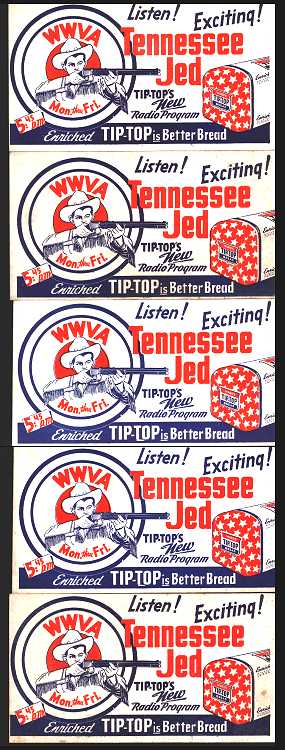
"Tennessee Jed" is a singalong song with the rhythm of a leisurely stroll and a bit of country twang. The narrator tells quick snippets about reading the signs that all point him back home to Tennessee. The annotations suggest several references to old-time and nascent bluegrass songs, and the name is likely being borrowed from the title character of a radio show (see right) that aired on ABC from 1945-7, and sponsored by Tip-Top Bread ("when you get up you better butter my bread"). In his book Box Of Rain, Robert Hunter explains penning this lyric (p 217):
"Tennessee Jed" originated in Barcelona, Spain. Topped up on vino tinto, I composed it aloud to the sound of a jaw harp twanged between echoing building faces by someone strolling half a block ahead of me in the summer twilight.
I can only guess the association Hunter had to get from an echoing jaw harp in Barcelona to a radio program in his childhood, but maybe the radio show's theme included the instrument.

The most vibrant line often elicited loud cheers when played to an arena full of Deadheads: "Drink all day and rock all night / Law come to get you if you don't walk right." Whether you see it as cautionary or celebratory depends largely on your perspective, I guess, but either way the lesson is the same: "You better head back to Tennessee, Jed." And the most hilarious line is when Charley Phogg punches the narrator in the eye and kicks his dog, prompting the dog to beg his owner, "Let's head back to Tennessee, Jed." You know it's a bad day when your dog is telling you it's time to go!

From all the stories I've heard of the Europe tour in 1972, I would be surprised if they were yearning to head back to the States. Nonetheless, they played this song at all but two of the concerts on the tour, and anyone who has travelled for long periods of time would tell you that no matter how much you're enjoying yourself, there are days (or maybe just moments) when you think about the comfort and familiarity of home.

*     *     *     *     *

Meat Smoking for Beginners

I love eating BBQ and smoked meats. The depth of flavor and succulent texture are a wonder to behold. Recently, I've learned that cooking your own BBQ and smoked meats is easier than I thought, and you don't need to go buy a designated smoker if you have a charcoal grill. Below are some basic instructions for setting up your charcoal grill. If you only have a propane grill, many manufacturers also sell a "smoker box" attachment or grill addition that can be used to impart the smoke flavors from smoldering hardwood chips in a safe, efficient manner. However, I am not personally familiar with this method. A simple barrel grill can be easily found for under $100, though some smokers are that cheap as well. I'm guessing the more expensive ones are more durable and may have other features.


Whether your charcoal grill is a barrel- or kettle-shaped, you can easily use it as a smoker. I recommend that you have the following items on-hand before getting started:
  • Charcoal - I avoid the self-lighting briquettes because I don't want my meats to taste like butane. I use a chimney to get them started and will add additional briquettes as needed to maintain the grill temperature. If you are willing to spend a bit more money, some people prefer lump charcoal (or "charwood") to briquettes because it burns hotter and creates a bit more smoke on its own. However, briquettes will burn more slowly, requiring fewer additions of charcoal. Advanced grillers often swear by pure hardwood, or "all-natural" charcoal that burn at high temperatures without any filler, though I'm sure these are even more expensive (and harder to find).
  • Chimney starter - In case you don't have one, this is a metal cylinder with a handle attached. There is a metal grate inside that gives you room to put wadded newspaper below the charcoal, and once the paper is lit, it allows the hot air to circulate through the coals. Be sure you have an oven/grill mitt, as the handle can get quite hot, even if it's made of wood or some other material.
  • Charcoal shovel or long-handled BBQ tongs - You can use one of these instruments to safely move hot coals to get the proper charcoal arrangement for the type of preparation you are using.
  • Wood chunks - Make sure they're hardwood (mesquite, oak, fruitwood, etc.), as soft woods like pine will burn too quickly and give you harsh flavors. You can find medium or large bags in the grilling section of a decent hardware store (or supermarket/big-box store if necessary). You may also use wood chips, though they need to be soaked prior to use and burn more quickly. They are best suited for smaller meats, fish, poultry pieces, and veggies.
  • Disposable metal pan - This will be partly filled with water to ensure consistent temperatures and indirect heat, so the size will depend on the size charcoal grate. You don't want it to take up much more than half of the space used for the charcoal, if avoidable. While they can be re-used, I usually buy several in case one gets punctured.
  • Meat thermometer - In order to ensure your meat is safe to eat yet still moist inside, you will need to know the internal temperature. I use a meat thermometer with a metal probe on the end of a three-foot lead, attached to a digital display. I can set this up so I can see it from the window, and it also has an alarm function to warn me when my meat hits the target temperature. I spent under $15 for it at the supermarket, and you can use it in your oven too.
"Low and slow" is the mantra of BBQ and smoked meats, and indirect heat is often necessary to coax the best flavors out of meat without drying it out or burning the outside. Sometimes, you will want to use direct heat (the food cooking directly above the heat source) for all or a portion of the time, but I've had the best success cooking larger meats (ribs, whole chickens, brisket, and roasts) over indirect heat, where the heat source is off to the side of the meat and heating the entire grill chamber like an oven. You can control the amount of smoke flavor in your final dish by more or less of the wood chunks (or chips) and how frequently you add more wood components. First, let's get set up:
  1. Always follow your grill manufacturer's instructions, particularly when it comes to safety. Set up your grill on flat ground, and be sure you have the ability to put out smoldering embers that may fall out of the grill, if necessary.
  2. Safely start your coals. I prefer using the chimney starter because it safely, quickly, and easily allows me to heat my coals and deposit them in the part of the grill I want them. Depending on my grilling temperature, I will start with different amounts of charcoal:
    • Low heat - fill the chimney about a third full with charcoal (approximately 25-30 briquettes)
    • Medium heat - fill the chimney about two-thirds full with charcoal (approximately 50-60 briquettes
    • High heat (more likely for direct heating than smoking) - fill chimney completely (approximately 80-100 briquettes)
  3. Place bunched newspaper in bottom of chimney, and set the chimney on a flat, non-flammable surface. Light the paper. Once the briquettes are covered with a grey dust, they are ready for the grill.
  4. There are many different charcoal arrangements you may use depending on the shape of your grill and what you're cooking, but I'm going to assume we're smoking some larger meats for now. Before pouring the coals into the grill, place the disposable metal pan to one side and fill it about half way with water. Then pour the coals beside the pan and use the shovel or tongs to arrange them, and place the cooking grate in place. If possible, leave a way to access the coals easily and safely. This is particularly important if your cooking time is over an hour or so, as you will need to add additional charcoal.
  5. Close the lid and allow the grill chamber and cooking grate to warm up, about 10-15 minutes. Test the heat of the grill. If you have a thermometer built into your grill, this is simple. If not, place your open hand about five inches above the cooking grate (about the height of a soda or beer can), and see how long it takes for the heat to make your palm uncomfortable.
    • 2-4 seconds is high heat (450°-550°F)
    • 5-7 seconds is medium heat (350-450°F)
    • 8-10 seconds is low heat (250°-350°F)
  6. Once you are in your desired cooking range, add one or two chunks of wood on top or just beside the coals (make sure they're touching). Wood chunks will take about an hour to burn on low or medium heat, and if you like strong smokey flavor you may add additional chunks for longer cook times. 
  7. You will also need to add coals to maintain the temperature of the grill. If you must remove the cooking grate to do so, be sure you have someone to help you and each person has oven mitts or thick hot pads. You may need to place the meat aside (or hold it in place) during this process, so be exceptionally careful. No matter how delicious the meat is, it's not worth a trip to the burn unit! My grill is barrel-shaped, with two cooking grates, so it is easy to remove one side for ease of access to the coals. If you have a kettle grill, you may consider investing in another cooking grate and modifying it to access the coals.
Now we're ready to smoke some meat!! I'm still a beginner, but I've been happy with the results from using a dry rub to season my meats. I've seen many recipes for BBQ rubs (they're easy to come by), but they usually have a significant portion (a quarter to a third) of brown sugar, several types of pepper (white, black, cayenne, paprika, ancho, chipotle, etc.), a generous portion of garlic and/or onion powder, and a savory herb (oregano, thyme, etc.). Hungarian paprika is new (and wonderful!) to me, as the peppers are smoked before they are ground to a powder. This is a quick and easy way to add a little smoke flavor if you're not using the method above. I leave the salt out, as I sometimes use my rubs to season meats overnight. Salt extracts moisture when left on the meat for more than a half-hour or so, and it's easy enough to sprinkle an addition onto the meat shortly before cooking.

Here's an example (from Elizabeth Karmel's Soaked, Slathered, and Seasoned - a gift from my sister!). You can easily modify it to suit your palate and spice cabinet, and it will still be delicious.

Grilling Guru Rub (makes 1.25 cups, good for poultry, pork, ribs, steaks, burgers, potatoes)

  • 3 tbsp sweet smoked Spanish paprika
  • 3 tbsp kosher salt (leave out if seasoning meat ahead of time to avoid trying it out, in which case add salt just ahead of cooking)
  • 3 tbsp sugar in the raw
  • 2 tbsp dark brown sugar
  • 1 tbsp ground cumin
  • 1 tbsp chili powder
  • 1 tbsp granulated garlic
  • 1 tbsp granulated onion
  • 1 tbsp Worcestershire powder (optional)
  • 1 tbsp celery salt
  • 2 tsp cayenne powder
  • 2 tsp dried oregano
Mix thoroughly (or use spice grinder - or clean coffee grinder - for a finer grind), and keep sealed for use over as much as 6 months. Sprinkle on chicken, other meats, potatoes, eggs, whatever!!

A good place to begin smoking meat is with beer-can chicken. Here's a simple recipe you can do on your grill or in your oven (though my mother says it's a bit messy for her oven!), and it leaves the chicken magnificently moist and tender!

  • Rinse whole, thawed roasting chicken (~5-7 lbs.) and discard liver, gizzards, etc. Pat dry with paper towels
  • Lightly coat with 1/4 cup of salt all over (including cavity), wrap in plastic wrap and refrigerate 90-120 minutes.
  • Rinse off salt, pat dry and coat outside with rub (add some salt if you left it out originally, and let the bird stand at room temperature for 20-30 minutes.
  • Prepare grill to for indirect medium heat (or preheat oven to 400°F). Add two hardwood chunks to coals just before the bird goes on the grill.
  • Open beer can, pour out half (into a glass and drink, of course!). Use a can opener to puncture the top of the can twice more. Slide the bird cavity over the top of the beer can, and use the legs to prop the bird upright like a tripod in a pan. Tuck the bird's wing tips behind its neck (as much as possible) to keep them from burning while cooking.
  • Cook over indirect medium heat on your smoker/grill (or bake at 400°F) for 75-90 minutes (or until the internal temperature at the thickest part of the thigh reaches 170°F).
  • Remove bird from the oven/grill. Have someone help you, it really takes at least three arms. Use a spatula under the beer can, and use an oven mitt or meat fork to place chicken with beer can still inside on a pan or plate. Allow the bird to cool for about 10 minutes before removing and discarding the beer can. Carve bird and serve while warm. (I also like to sprinkle some unsalted rub on top of the chicken on the platter for a bit of extra flavor.)
  • I will refrigerate the carcass and any bones/skin to later use in making my own tasty chicken stock. 
Voila!! Enjoy, and let me know how you like the recipe. If people want more or have their own recipe to share, please leave a comment or drop me an email.

- Morning Brewer


PS (Pairing Suggestion): 

We're going to need a beer to go with that BBQ chicken, huh? Before we get there, though, we should do some slow-cooked collards in the skillet. Once the bird is cooking, you can start the prep for the greens. As with all my favorite greens, start out by frying up 3-4 strips of bacon in a skillet. If you've got the time to cook the collards slowly, you can leave the stem attached and just cut the leaves into bite-sized pieces (after washing, of course). Once the bacon is nice and crispy, take it out and discard any excess fat from the skillet. It's helpful to have some for a good sauté base, but never pour it directly down the drain unless you want a visit from your favorite plumber. Add onion slivers and rough-chopped garlic, as well as crushed red pepper to taste. Chop the crispy bacon into small pieces and add them back to the skillet. While the onions are cooking to transparency, mix up about a third of a cup of sauce. The book the rub came from above has great sauce recipes, too, but lately I've just eyeball a fair amount of apple cider vinegar, quite a bit of yellow mustard, a dash of Worcestershire sauce, a generous amount of brown sugar, and several big pinches of the rub (or a mix of ground peppers - black, smoked paprika, ancho, etc. - I have on hand). Once the sauce is mixed, throw the sliced collards into the skillet with the onions, etc., and stir until they have all started to cook. Then add the sauce and cover. Turn down the heat very low (low and slow, remember?), and just let it cook till the bird's ready, stirring every 10 minutes or so.

Oh, yeah, we need a BEER to go with our fabulous BBQ meal!! Hmmmmm, I think I'll go with a standard American pale ale, or APA, on this one. As discussed in a previous post, this style was made possible by new hop hybrids created at Oregon State University, and the style's pioneer, the Sierra Nevada pale ale, spawned the craft beer movement in America. As the style and consumer palates have developed, it's a bit of a junior version of an IPA: hoppy but not overwhelming, supporting malt but overall light and dry, and "sessionable" (or lower alcohol). The hops will mesh well with the kick from the rub on the bird, but it's light-bodied enough that it won't overwhelm the lightest of light meat. Plus, it goes down easy!!

There are plenty of regional examples, so this one should be easy to find, and freshness makes a big difference here. Please don't feel constrained by the following suggestions:
  • Philly, I'm going to have to go with the Philadelphia Pale Ale. Just head to the tasting room and buy a case there - it's pretty much as fresh as you'll find. And when this beer is fresh, it's fantastic!! Same goes with the offering from Tröegs, so if you're in Harrisburg area, check out their new brewery in Hershey and grab a case.
  • For our friends in DC, grab a fresh case of the Public from the brewery when they have growler hours, typically on Saturdays. This one features the pine and citrus of Cascade (and likely other) hops.
  • In Chicago, stop in at the Half Acre Beer Company for a fresh batch of Daisy Cutter. Or you can take a road-trip to grab a fresh case of the Alpha King from Three Floyds in Indiana.
  • On the west coast, there are simply too many options to count. The Liberty Ale from Anchor is a favorite. And while it's from Colorado (not the coast), a fresh Dale's pale ale is an awakening, and it's worth a trip to the brewery the next time you head to Rocky Mountain National Park. And I can't let this style go without a special nod to the beer that got me into craft beer (thanks, Sam!): the Mirror Pond from Deschutes in Oregon.
  • If I didn't hit your locale, please let me know where you are, and I'll do my best to accommodate. 

Saturday, April 14, 2012

4/14/72 Copenhagen: Pigpen's Opus, Women in the Music, & Bourbon Barrel Beers


When: Friday, April 14, 1972
Where: Tivoli Concert Hall, Copenhagen, Denmark
Setlist: (In order of the released CDs, stream the AUD here)
  1. Bertha, Me & My Uncle, Mr. Charlie, You Win Again, Black-Throated Wind, Chinatown Shuffle, Loser, Me & Bobby McGee, Cumberland Blues, Playing In The Band, Tennesse Jed, El Paso, Big Boss Man, Beat It On Down The Line, Casey Jones
  2. Truckin', Hurts Me Too, Brown-Eyed Women^, Looks Like Rain, Dark Star > Sugar Magnolia > Good Lovin' > Caution (Do Not Stop On The Tracks) > Who Do You Love > Caution > Good Lovin', Ramble On Rose, Not Fade Away > Goin' Down The Road Feeling Bad > Not Fade Away  E: One More Satuday Night
As always, personal highlights are in bold.
^ Appears on Europe '72

This has long been one of my favorite shows from the tour not the least because of the ruthless jamming in the second set, but the first set is very well played, itself. Overall, it's an exceptional, high-energy show from start-to-finish, and if you haven't heard it before you should definitely check it out. Maybe it was just my mental state (and the volume on the stereo), but for me the "Black-Throated Wind," "Chinatown Shuffle," "Loser" section in the first set is played to perfection. We have Bobby, Pigpen, and Jerry all singing signature songs full of emotion, with tight rhythm and stellar lead play. Crank it up and let it rock, y'all!!
This one's from Copenhagen, but I'm not sure which night.
The rest of the first set and the beginning of the second are solid, but I want to focus on the meat of the second set. Not surprisingly, it starts with a ferocious "Dark Star" that features intense jamming throughout. Jerry kicks it off by throwing soaring, whining licks out there that remind me of Live/Dead. Absolutely dripping with psychedelia, and we're just three minutes in!

The jams on this version of "Dark Star" are special, with each band member on top of his game. It's truly a music-played-the-band improvisation, more melodic than spacey. Case in point: it's Billy on drums who steers this one into the stratosphere. About 20 minutes in, we are treated to a fast, powerful, energetic version of the "Mind Left Body Jam." Again, the tension is built through an exquisite combination of the instruments. While Jerry is in the "lead," you can't exactly say everyone else is following. After the mind has fully left the body, there is nowhere to go but the heart of darkness. The space that follows is frightening. Phil is up and down the fretboard, and Keith and Bobby play with dissonance. It's hard to describe drum contributions to space, but let me say simply that Billy is not just playing ambient cymbals here.

Once the band (and audience) have pieced together their groupmind, Jerry with a screaming effect on his guitar begins the theme from "Sugar Magnolia," and the rest of the band jumps in behind him. He's not ready to let go of that primal scream just yet, though, and his guitar rips the opening to shreds with just enough feedback to make you say, "Hallelujah!!" Needless to say, this "Sugar Mags" has it all!!
Just as you're shaking your head in wonder as you're showered with "Sunshine Daydream," up rises the original R&B intro to "Good Lovin'." You can tell from the first line Pigpen is on his game, howling and hooting his way through the opening verse. LOTS of energy from the band, with extremely competent backup vocals from Bobby. Jerry breaks it down with nasty blues licks, but it doesn't take long for Pigpen to let his presence known. What follows is easily the most raunchy, explicit piece of vocal improvisation in all of Dead-dom.*

Pigpen wants to know: Who do you love?
For those who aren't familiar with Pigpen's 1972 rants, there were a few sections he often repeated in one form or anther, including such classy classics as, "You're my sweet li'l mare, I'm gonna ride you everywhere / I'm gonna jump in the saddle and ride a while" and "If you can't turn your damper down, mama turn your oven around." But on this one, he goes off!! At various points he's being chased by the shotgun-toting father of a seventeen-year-old, a sheriff, and his wife. And the kicker:
All the boys in the neighborhood
Tell 'em that your bakery shop is good.
Let 'em try, some cherry pie
They go droppin' by, my my,
Yes I will, yes I will.
And with that, the band starts pumping the unmistakeable pulse of "Caution." The drums and rhythm pieces kick it into overdrive, while Jerry and Phil, in perfect counterpoint, run circles through the steam-locomotive rhythm. Scorching hot! Out of nowhere in the middle of "Caution" - with the tempo set to Ludicrous Speed - Pigpen steps back up to the mic and spits pure venom:
I walked 47 miles of barbed wire, got a cobra snake for a necktie
Built a new house by the roadside, made out of rattleskin hide
Brand new chimney set on top, made out of human skulls
Ask that woman, "Come on child, tell me who do you love?"
It takes less than a minute, but with those few lines Pigpen caps off his greatest vocal performance: planting a "Who Do You Love?" flag at the peak of a sexualized mountain of "Good Lovin'" > "Caution." Of course, there's still more left in the medley, including some more Pigpen vocal improv, but it's necessary resolution to the opus just laid out - like hiking down the mountain after taking in the expansive view from the summit.

The "NFA" > "GDTFRB" > "NFA" that ends the set is also played at breakneck speed. Before the initial "NFA" gives way, Bobby steers the jam and the entire band into a fully formed "China Cat" jam before the tempo drops and the rolling intro to "Goin' Down The Road" emerges. Needless to say, the set ends with huge fanfare and leaves the crowd in a frenzy.

Worth mentioning:
  • The entire show cooks from start to finish. I could say everything I said about the Newcastle show here, as well.
  • This is the final "Looks Like Rain" of the tour and, to my knowledge, the last with Jerry on pedal steel. What a sound!! I miss it already....
  • There was some hilarious banter on stage during set one:
    • After "Mr. Charlie," the crowd is clapping in rhythm, begging for more.
      • Phil (the Instigator): "You know what? We're gonna keep on playin', you don't have to clap like that."
      • Bobby (Mr. Positive): "But you can if you want to."
      • Phil (won't let it go): "I mean, go ahead, get it on. But we won't do one in that tempo, necessarily."
      • Jerry (the Peacemaker): "You can if you want to, but you don't have to if you don't want to. You can do whatever you want."
    • After "Cumberland:"
      • Bobby: "We have an equipment breakdown, and we're going to fix it shortly and be right with you. 
      • Guy in the audience: "Bullshit!"
      • Phil: "That guy must be from America."
      • Jerry (funny beatnik voice): "Hey well if we was to get high between songs, isn't that all right?"
      • Guy in audience: "Hell yeah!!"
      • Jerry: "Thank ya!"
  • Whose idea was it to squeeze "Ramble On Rose" between Pigpen's disgusting diatribe and the magnificent "NFA" sandwich? 

Song of the Day: "Me & My Uncle"

The Grateful Dead first played "Me & My Uncle" (not annotated, but read the lyrics here) in 1966, and it was a regular part of their rotation (and the most-played song in their repertoire) through the next 29 years. (The only years it was not played were 1968 and 1976.) Ostensibly, it's a gambler/cowboy tune about a man and his uncle traveling on horseback from South Colorado to West Texas. They stop in Santa Fe to "wash off some of that dusty dirt." After a while, the uncle's "friendly game" of pitch ("high-low-jacks and the winner take the hand") turns violent when the narrator's uncle is accused of cheating. They make off for Mexico with the gold, but not before the uncle is shot. The narrator, drawing on the lessons passed to him from his uncle, "left his dead ass there by the side of the road."

While the themes of this lyric fit with many of Robert Hunter's favorites, this one is actually a John Phillips original, though he was surprised to learn that fact. This amusing story is from the liner notes to his album Phillips 66 (via David Dodd's The Complete Annotated Grateful Dead Lyrics, pp 30-1):
John often used to tell the story behind "Me and My Uncle." Years ago he began receiving publishing royalties from a song on a Judy Collins record with which he was unfamiliar. It was titled "Me and My Uncle." He called Judy to let her know of the mistake because he hadn't written any such song. She laughed and told him that about a year before, in Arizona after one of her concerts, they had a "Tequila" night back at the hotel with Stephen Stills, Neil Young, and a few others. They were running a blank cassette and John proceeded to write "Me and My Uncle" on the spot. The next day, John woke up to the tequila sunrise with no recollection of the songwriting incident. Judy kept the cassette from that evening and then, without informing John, recorded the song for her own record. Over the years, the song was recorded by several people, and eventually became a standard of the Grateful Dead. John used to joke that, little by little, with each royalty check, the memory of writing the song would come back to him.
The Dead played this song regularly, and following the Europe tour, it was often coupled with another Weir-sung cowboy tune like "El Paso" or "Mama Tried." However, the versions of "Me & My Uncle" from Europe that appear in the depths of a second-set thriller like "Dark Star" or "The Other One" capture a rare moment in Grateful Dead history where they were able to transform a simple, Americana story-song into an adventurous exploration on the edge of convention.**

*     *     *     *     *

Forbidden Ground: The Role of Women in the Music of the Grateful Dead

When I was in college, I took a great course from Charlene Makely called "The Anthropology of Sex and Gender." Through an anthropological lens, we read about and discussed the role of sex (physical and genetic attributes of male and female) and gender (social constructs of man and woman) in contexts as divergent as impoverished landfill-squatters outside of Mexico City, sex workers in Brazil, transgenderism in the Polynesian family, and masculinity and homoeroticism in American professional wrestling. Sometimes, however, the readings and classroom discussions hit pretty close to home.

I remember meeting with Charlene privately in her office to discuss one of my personal moral crises after a particularly riveting conference discussion. I'm paraphrasing, but she said, "There are some areas of our lives we just can't analyze, or else the self-reflection paralyzes us. For instance, I absolutely love Tolkien's The Lord Of The Rings. But I can't analyze his portrayal of women; it would take all the enjoyment out of it." These are wise words I think we can all take to identify with in some area of our own lives, and I've carried the lesson with me ever since.

For me, the un-crossable bridge of self-reflection has been, of course, the Grateful Dead. However, in celebrating Pigpen's unbelievable rap from Copenhagen, it's important that I don't allow the underbelly of sexism and misogyny to go unaddressed. In his rant and many others, Pigpen treats women as alternately as sex objects worthy only of conquest and evil temptresses who use their sexuality to control him. I won't get into the details, but these sexual themes of domination and control (and the associated danger and emotion) essentially sum up the entire opus. These themes also dominate other quintessential Pigpen performances from the Acid Tests to the "Midnight Hour" from the Hollywood Bowl in '71 (see Fallout From The Phil Zone) through all his best versions of "Lovelight," and on and on.

It would be easy to dismiss this as a peculiarity of Pigpen and his musical influences and personal experiences, but he isn't alone in his sexism. The opening line to "Jack Straw" lumps women and wine into the same category: a source of pleasure (or escape) to be shared freely with your comrades. In "Let It Grow" Weir/Barlow celebrate "the love of women / the work of men." Even Brent Mydland in the '80s sang, "Never trust a woman / who wears her pants too tight." I could go on, but you get the point.****

The apologist may claim that the true Pigpen came out when singing, "This is a man's world / but it wouldn't be nothing without a woman or a girl." To me, that's a poor effort even if we give him the benefit of the doubt. Or that the rest of the band paid their penance in the '80s and '90s by asserting,
It ain't me, it's the people that say
The men are leading the women astray
But I say, it's the women today
Smarter than the man in every way.
That's right, the women are smarter.
Of course, Harry Belafante was singing these words a decade before the Grateful Dead even existed, yet the previous two paragraphs happened in the years that followed.*** Again, the most credit I can give for this single song is "too little, too late."

The 1960s are broadly considered today (for good or ill, depending your perspective) to be a time when social movements changed the way mainstream American culture viewed and treated race, American military adventurism, youth power, and identity politics (among others). There were exceptions, of course, but it is well documented that even within the civil rights, student, and anti-Vietnam War movements (and others), women were largely relegated to clerical roles rather than positions of leadership.***** In many ways, it was their struggles within their own movements for peace and justice that spurred politically active women to organize for rights over their bodies, in the workplace, in society, and even in the family. The feminist movement came into its own in the 1970s, and the hard work of dedicated, visionary women created a lasting impact through person-to-person organizing, often in the form of "consciousness raising" meetings of immediate friends and family.

Clearly the Dead weren't alone in their unenlightened treatment of women. Like the movements mentioned above (and countless other examples), they were all products of the larger society from which they grew. I still feel compelled to note the shortcomings of the band lyrically on this score, particularly in light of celebrating Pigpen's lyrical feats at this concert. Of course, in calling the band and Pigpen out for their misogyny, I'm not trying to condemn their music or them as people. In appreciating the things we love we must be honest with ourselves when they don't stand up to the moral standard we hold ourselves (and hopefully others) to in the rest of our lives. I enjoy this show for what it is - an incredible performance at a particular moment in time. But I also use it as a reminder of how far we've come and how far we still have to go to reach the moral standard of equality we individually and collectively hold as a goal.

- Morning Brewer


PS (Pairing Suggestion):

Seeing as this show highlights Pigpen, a lover of whiskey, I submit to you a range of beers aged in whiskey barrels. Belgian and French brewers have long repurposed oaken wine barrels to age some of their beers, typically sour ales. Relatively recently (roughly the past 10-15 years), American brewers have taken to re-using oaken whiskey barrels to impart wood and spirit characteristics into their aged beers, particularly dark and/or strong ales. Bourbon must be aged in fresh oak barrels, which are used only once, so brewers have a ready supply of barrels rolling out of distilleries from Kentucky to the Cascades. The base style can vary, but my favorite examples are based on big, strong beers like an imperial stout, a barleywine, or an American strong ale. The results are varied and interesting, with the wood contributing elements of vanilla and a light char, and the bourbon bringing heat and depth. Everyone's tastes are different, so try them out for what you enjoy!

If you don't like whiskey, you probably won't like these beers. However, I think whiskey-barrel aged beers pair nicely with the bold flavors of BBQ (what doesn't?) or a rich dessert that showcases dark flavors like plums, berries, or chocolate.
  • Here in Philly, I haven't had many stunning examples that are locally produced. However, we get plenty of beers from around the country that shouldn't be hard to track down. You can't go wring with the Burton Baton, an imperial IPA base blended with an oak-aged English-style old ale.
  • In DC, the Corruption goes with everything (even if it's not barrel-aged), just ask Dan and Sam!
  • In the upper Midwest, track down the Kentucky Breakfast Stout, but be careful since this one packs a major punch. At its base, it's an imperial stout with coffee, oats, and maple syrup. After a year in oak barrels, it's so much more.
  • Out West, try an oaked version of the ubiquitous Arrogant Bastard Ale. Its huge malt profile is not to be out-done by the generous hop bitterness. Somehow, I find the vanilla flavors from the oak soothing, considering the aggressiveness of the base beer. BONUS: From a request coming in from Fort Bragg, CA, check out the tenth anniversary version of Old Rasputin, a classic Russian imperial stout aged in bourbon barrels. This one's out of production, but it'll be worth tracking down.
  • In Alaska, I'm sure you'll be able to track something down, though I'm not familiar with any native examples. Try scoping the annual Great Alaska Beer & Barleywine Festival, usually held in January. I'm sure you'll find plenty of tongue-stripping examples to keep you warm through the dark months!
  • If I didn't hit your locale, please let me know where you are and I'll do my best to accommodate. 

---------------------------------


* It's transcribed in its entirety in Deadhead's Taping Compendium, Vol. 1, as well as re-published in one of those Deadhead magazines (Relix, I think) to promote the book's release in 1998. But it's best listened to in context of the instrumental improvisation behind it for a full appreciation.
** A prime example appears in the next show of the tour, 4/16/72 at the Stakladen in Aarhus.
*** This isn't to give Harry Belafante a pass. He was a high-profile civil-rights advocate and fundraiser for the movement, but that movement, like most of the subsequent progressive political movements, struggled to embrace women in roles of leadership.
**** For the purposes of this post, I'm limiting the discussion purely to song lyrics, though it amy be interesting to consider the band's staff and history at some other point.
***** A few examples I am familiar with include Doug McAdam's Freedom Summer, an oral history of SNCC's voter registration drive in Mississippi in 1964, and "Port Huron Statement" author and student/anti-war activist Tom Hayden's memoir Reunion. I'm sure there are plenty more examples from in feminist literature and history, so if you have any suggestions, please share them in the comments section so we can all learn more.

Wednesday, April 11, 2012

4/11/72 Newcasle: Mr. Charlie & Anglo-American Music & Beer


When: Tuesday, April 11, 1972
Where: City Hall, Newcastle upon Tyne, England
Setlist: (In order of the released CDs, can't find the AUD for a stream. While not as widely distributed as 4/8/72, it's out there. Worst case - one of the top shows of the tour, for sale here)
  1. Greatest Story Ever Told, Deal, Mr. Charlie, Black-Throated Wind, Tennessee Jed, Big Boss Man, Beat It On Down The Line, Sugaree, Jack Straw, Chinatown Shuffle, China Cat Sunflower > I Know You Rider, Playing In The Band, Next Time You See Me, Brown-Eyed Women, Looks Like Rain, Big Railroad Blues, Casey Jones
  2. Good Lovin', Ramble On Rose, Truckin' > Drums > The Other One > Comes A Time, Sugar Magnolia  E: Brokedown Palace, One More Saturday Night
As always, personal highlights are in bold.

WOW! Great show. Start-to-finish, one of strongest of the tour, and I could have easily highlighted the entire setlist above. From the liner notes, Rosie McGee describes the venue as "a dour concrete building in the midst of a grim industrial town," with "the warmth of a witch's teat." Truly, "an ostensibly 'hostile' environment." However, she describes a transformation of the crowd from cold and confused to "stunned and bemused" until "the concrete walls somehow turned into green pastures." She also recounts a story of encountering an older local woman trying to get backstage. Eventually she learns this is the mother of Eric Burdon from the Animals, and they take in the rest of the set from the balcony, where Mrs. Burdon notes, "They're very good, you know!"

One of the things I love about this era in Dead history is the on-stage banter. The Dead are strangers in a strange land, but they sure sound loose! For instance, after the "Black-Throated Wind" ends and they're preparing for "Tennessee Jed," we hear this exchange:
Bobby: "We're going to do our best to decide what to do next and then do it."
Jerry plays a lick from "Tennessee Jed"
Bobby: "Back home, that's what's known as telegraphing the next song. By playing a characteristic lick out of it, everyone in the audience knows what we're going to play next. But seeing as you've never heard it before, there's no problem."
Jerry: "Ha, ha! Well, sure."
Then they kick into a forceful "Tennessee Jed." To me, it's an indication of how intimate the venues were at on this tour and in '72 in general. The connection between audience and band - individually and collectively - comes through in the music, and this banter is just another example of how that connection overwhelms foreboding environs.

As I noted, nearly every version of every song is special. The performances in the first set are tight, but they find some room for exploration in "Sugaree" and the "China" > "Rider" transition. I'm not always a fan of "Big Railroad Blues," but this version rocks hard!! It's worth listening to the first set for comparison to the "first set" tunes off the released Europe '72 - they could have called it a wrap and ditched the recording equipment after this show. But then, what would I be listening to right now instead?!?!

The second set scorches from start to finish, with a very good version of "Good Lovin'." It's interesting to see the evolution of Pigpen's vocal improvisations, and this one is a great prelude to the next show (more in my next post). It's tempting to dismiss "Ramble On Rose" as a throw-away before the deep jam, it's not in the least. Loose, lean, and energetic, Jerry delivers the vocals emotional precision.

Tension and release are key components of most (good) instrumental improvisation, regardless of genre and instrumentation. For me it's those two elements - and the way the Dead were able to create tension through melody without simply playing faster and higher - that make the big jam that follows so special. "Truckin'" starts off with a ton of energy. As the jam gets going, Phil and Jerry mingle with melody on the edge of space, conjuring tension without fully exploring it. The drum break is short and sweet, giving way to a drop I can only describe as loping. Keith's rhythm work on "The Other One" drives Jerry harder and faster, as the rest of the band builds the beat behind them. Keith often gets overlooked, but his jazzy rhythm work in the jams on this tour give them that youthful, summery quality that is a big part of why this tour is so special. Well done, Keith!! The rest of the jam is exploratory and explosive. Threads of the "Feelin' Groovy Jam" grow into a stellar performance of this melody (loosely based on Simon and Garfunkle's "59th Street Bridge Song"), building thick tension that is ultimately released to fall like confetti on New Years. Eventually, the mellow jam gives way to deep space, rebuilding the tension even thicker through chaos and feedback.

Of course, the only logical place to go from there is "Comes A Time," an emotional ballad penned by Garcia and Hunter. This will be a featured song of the day in another post, but for those not familiar with it, it's an all-time personal favorite that is dark with a glimmer of hope. Jerry delivers on this version - soulful, touching, pained. But the set has to end sometime, and there's no better way than rocking out a hot "Sugar Magnolia." A testament to how great the band is feeling, they throw out a rare double encore. The "Brokedown Palace" is beyond description. Listening to it after the whole show that precedes it is like a hug from an old friend. Of course, Bobby still has an itch to scream, so they play "Saturday Night" before sending everyone home. A bit of a letdown in retrospect, but we've all been to those shows where we just need one more high energy song to shake our bones to before grabbing our shoes and heading home....
This one isn't from Europe at all, but at least it's from 1972!
Worth mentioning:
  • This version of "Greatest" is rockin' and rollicking, pushing hard from start to finish.  
  • The "Brown-Eyed Women" is very high-energy, but it sounds like Bobby gets a little too experimental at times, making it sound like he loses the beat. This reminds me of something Garcia said: "The way it is with Weir is that he's continually making discoveries that are like old discoveries for some others of us. But on the other hand, there are ideas that Weir has that I would never have had, that in fact maybe only he has. That's his unique value - he's an extraordinarily original player in a world full of people who sound like each other."* This must have been one of those misses, but I'm glad he kept at it!
  • Not the most incredible version of "Looks Like Rain," but it's close. I can't turn down this song on most occasions, and when it's one of the rare versions with Jerry on that pedal steel, it deserves to be sonically bronzed. It must have been a pain for the crew to lug this thing around and get it properly tuned every night. They only played the song three times on the tour, which makes me think they may not have lugged it around for every show.** Enjoy this one, it's a doozy!
  • I can't say it enough, but a youthful Jerry singing "Brokedown Palace" is truly one of the most special things you can hope for from the Dead. To get this just a few songs after "Comes A Time" is quite a treat for Jerry-ballad junkies like myself!
  • I don't know why, but when I see "Truckin'" on a setlist I mentally shrug and move on. I just have trouble getting excited for it for some reason. But I've gotta say, this is well played through the composed sections, spilling into a fierce jam. Glad I'm warming to it because the Dead played a lot of "Truckin'" on this tour.
  • Did I mention this is a GREAT show? If not, just to be sure, this is a GREAT ^FREAKING^ SHOW!!

Song of the Day: "Mr. Charlie"

This Pigpen/Hunter collaboration was a regular but short-lived part of the Dead's rotation from the summer of 1971 through the end of the this tour and the accompanying decline of Pigpen's health. while not his final shows, the Europe tour was Pigpen's last hurrah, and this (along with "Chinatown Shuffle") was his swan song: he sang "Mr. Charlie" every night (and only two shows were missing "Chinatown Shuffle"). I feel obliged to take a close look at this enigmatic song, and doing so requires some explanation of Pigpen's youth and musical influences. (Please bare with the length here; I'll do my best to keep it shorter in the future.)

Pigpen was born Ronald McKernan on September 8, 1945, to a middle class family in San Bruno, California. Growing up, his father Phil was a disc jockey - "Cool Breeze," spinning rhythm and blues on KRE radio - and he passed his love of African American music along to his son. They moved around a fair amount, and he ended up with a brief stint in high school at Palo Alto High School***, before he and the principal "mutually decided" he should leave the school.
By the time he showed up at [the Palo Alto folk club] the Boar's Head at age sixteen, he had left white middle-class life entirely behind.... He had a motorcycle chain permanently bolted to his wrist and wore oily jeans, Brandoesque T-shirts, and greasy hair.... 
What everyone [knew] was that he was the white kid who practically lived in black East Palo Alto, hanging out with a black man named Tanwy Jones, who had a Harley-Davidson motorcycle as well as a bread truck that they called the Seventh Son. It came with a mattress in the back, and their sexual exploits went far beyond the average teen's. It was also useful for their trips to a bootlegger in La Honda, in the mountains above Palo Alto, where they bought whiskey at $1.50 a gallon.****
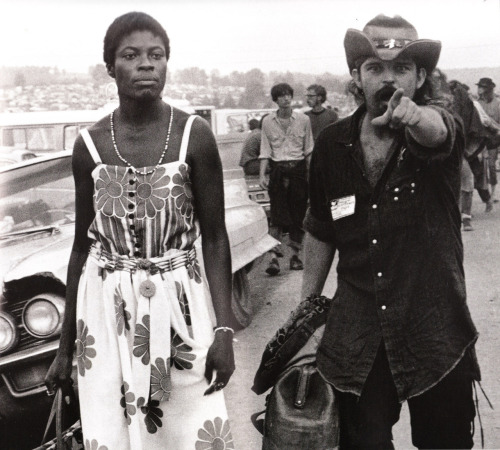
While Pigpen was mild-mannered in private, apparently
he didn't like having his photo taken with his long-time
girlfriend Veronica "Vee" Barnard at Woodstock, 1969.
By all accounts his salty veneer masked his gentle, obedient nature. He was known in local musical circles for his encyclopedic knowledge of the array of black music that spawned rock 'n' roll. While he played harmonica, piano, organ, and occasionally guitar, his biggest talent was not only in singing the blues and R&B, but also his ability to improvise lyrics (again, see 4/14/72).*****

I have heard several interpretations of "Mr. Charlie," but for me the lyrics evoke race relations in the American South. As many readers surely know, Mr. Charlie has historically been one of the outwardly-polite-yet-secretly-derisive terms used by oppressed African Americans in society and in prison to refer to their white, male oppressors. It's similar to "The Man" but truly less respectful. It also alludes to the 1964 James Baldwin play Blues for Mister Charlie, dedicated to the memory of Medgar Evers, the NAACP field secretary assassinated by a White Citizens Council (and later Ku Klux Klan) member.

The narrator begins by filling a shotgun with powder and salt, intending to spare life and limb, yet "take a little skin" in a primitive delivery of less-than-lethal force. Why? "'Cause Mr. Charlie told me so." The lyric then takes an interesting turn towards voodoo mysticism of the bayou (and by extension Haiti and Africa):
Well, you take a silver dollar
Take a silver dime
Mix 'em both together
In some alligator wine 
I can hear the drums
Voodoo all night long
Mr. Charlie tellin' me
I can't do nothing wrong
One of the alternate interpretations is that Mr. Charlie is Charles Manson. While there is a plausible case to be made on that front, the final line suggests to me the narrator is afraid of the repercussions of doing wrong rather than brainwashed to believe whatever he (or she) does is axiomatically right. In antebellum New Orleans - home to slaves, free blacks, and displaced Haitians - Congo Square was a gathering place for blacks and creoles on Sundays to practice commerce, voodoo, music, and dance. The Manson interpretation doesn't account for this rather direct allusion.

In another novel interpretation, the song is about heroin (powder, silver dollar), cocaine (salt, silver dime), and the syringe (shotgun) used to deliver a "speedball." Through this lens, you could easily find different meaning in the lines "scare you up and shoot you" (shoot up), "give you a little warning / before I let you go" (cautionary note on addiction and overdose), and of course "looking high, looking low" (jonesing). While definitely possible, I am somewhat skeptical because - while an overindulgent drinker - Pigpen never partook in the psychedelics or narcotics that much of the rest of the band famously used. Though the accuracy of his book has been questioned, Rock Scully tells a story of Pigpen walking in on Jerry shooting up when they lived in the Haight. Pigpen freaked out to the point that Jerry agreed to refrain from that particular drug, though we know how that one turned out. (May of '77 came with a price....) You can see from Pigpen's opening quotation from this story of the Dead playing Wembley, he was in it for the music, not the drugs. This, along with Pigpen's early affinity and proximity to African American culture, music, and history, lead me to conclude that the "speedball" interpretation would most likely be a secondary one.

In my reading, "Mr. Charlie" is a singular lyric in the Dead's repertoire for its implicitly African American narrator telling a tale of oppression and race violence. The alternate interpretations (brainwashing and addiction) discussed above are plausible because of the control exerted over the narrator, but due to historical factors - both literary and biographical - I believe the simplest interpretation is mostly likely the best: This story, set in the historical American South, is a tale of racial oppression and black-on-black violence at the behest of a powerful white tormenter. Of course, you can never put a multi-pronged pen past a lyricist of the caliber of Robert Hunter.

*     *     *     *     *

Ping Pong Across The Pond: Mirrored Evolution of Rock 'n' Roll & Ale

Originally I wanted to touch on this topic because the show was in Newcastle, home to one of the world's iconic ales, the Newcastle brown ale (as you can guess from the reviews, there are better examples out there, but more on that in the PS). But Pigpen's biography reminds us that, while the majority of Americans came to the blues through the British Invasion, there were definitely homegrown exceptions. So my caveat is that I'll be painting with a broad brush here, so please excuse me for my (many) omissions on this topic.

It's been well documented that the blues spawned rock 'n' roll. The American racial dynamic in the late-1940s through early-1960s made mainstream exposure and appeal for music rooted deeply in African American culture and society nearly impossible. Before the music's wild sensuality could reach TV audiences, it needed to be neutered. (Okay, those links are anachronistic, but the later recording is actually the original version.) In England, young white musicians gravitated to the music of black America, learned the instruments, and made their own music, albeit liberally borrowing or outright stealing songs from the music's original authors. Once the Beatles, the Rolling Stones, the Birds, and others hit America, previously marginalized rock 'n' roll music been sufficiently laundered for mainstream audiences that it even allowed for a return to its original raunchiness.

A similar repurposing process has been happening with the Anglo-American evolution of ales over the past few decades. Ale - beer made at higher temperatures with "top fermenting" yeast (as opposed to lagers) - has always dominated the British Isles, and historically ales were a major part of the American brewing tradition. Following the dark days of Prohibition, the brewing industry consolidated around continental-style lagers. It wasn't until the development (primarily at Oregon State University) of new strains of piney, citrusy, and resinous hops like Cascade, Centennial, and Columbus ("the three Cs") that American craft brewers had their own distinctive ingredient. Due to the clean break in brewing tradition, however, American brewers turned to Anglos for lessons in brewing procedures and ingredient quality to make their own amazing ales.

In 1980 Sierra Nevada pioneered a new style of beer, the American pale ale featuring the Cascade hop, which spawned the American craft beer revolution. It must be noted that Fritz Maytag III saved the Anchor Brewing Company from closing by purchasing it in 1965, running it at a loss until the 1980s. But it was Sierra's aggressive approach to bitterness - not Anchor's traditional California common or Steam Beer - that spawned a revolution that created a market for hoppy beers in America. As American craft breweries have grown and explored new styles, they have helped develop a distinctly American beer palate, one that craves bitter beers, often to the "extreme" by conventional English standards.

Today, the reverberations of the American craft beer revolution are making their way across the pond. Breweries like Scotland's BrewDog, Denmark's Mikkeller, and many more are challenging convention while explicitly exploring American-inspired experiments in alpha-acidity and other extreme concoctions. Will this create a mainstream market for hoppy, extreme beers in Britain (and the Continent) similar to the way the British Invasion paved the way for the Grateful Dead? There is no telling, especially since high-quality ales don't travel across the Atlantic as easily (or economically) as records once did, even with American-inspired hopping rates. Nonetheless, I can still hold onto my hope for an extreme beer tour of America by English brewers one day.

- Morning Brewer


PS (Pairing Suggestion):

I'm building this pairing around the brown ale, of course! Either English or American, would be fine. (The Belgians do brown ales, too - regular or sour - but that's a whole 'nother ball of wax!) The difference is that the English versions showcase a nutty, toasty, toffee-like malt flavor and aroma. American version is slightly hoppier (both in aroma and bitterness), typically stronger, and are more likely to showcase caramel and chocolate in the malt profile. But one thing is for sure - they're all brown!!

Oh, yeah! Here it is:
Jerry with a Newcastle!!!
To pair with the first set, we'll start out with the English version. Track down a Newcastle or a Samuel Smith's Nut Brown. (If you're in D.C., you'll have good options at the Queen Vic.) Both are "sessionable" (relatively low alcohol), but for those of you accustomed to drinking hoppy, American brews either of these may seem a bit subdued. Pair your English brown ale with another English classic: fish and chips! And you've gotta use the malt vinegar, no ketchup (when in Rome...).

For the second set, pick up an American brown ale and pair it with some fish (whatever you can get FRESH), blackened and sauteed to a nice crisp on the outside. The heat and spicy nuance of a good blackening seasoning will have you reaching for that brew in no time! Hops and heat are a fine combo, and the substantial malt body will prep your palate for another bite. Try it with some fresh, julienned veggies - lightly steamed and sprinkled with fresh herbs - to give this pairing an American character.
  • Gotta go with the Indian Brown Ale here in Philly, right? (We can do the Palo Santo Marron for the encore!!)
  • In DC, the Corruption goes with everything (even if it's not a brown ale), just ask Dan and Sam!
  • In the midwest, try the Bender.
  • Out West, if you can find it, grab a Jewbilation 9 (limited release).If not, I have no doubt you can track down Rogue's Hazelnut Brown Nectar.
  • In AK, try a Kodiak Brown, or if you're in Anchorage, stop by the Glacier Brewhouse to see if they've got the Oak-Aged Nut Brown on tap (or cask!). (Sorry, can't vouch for these, but pickin' brews in Alaska is tough!!)
  • If I didn't hit your locale, please let me know where you are and I'll do my best to accommodate.
---------------------------------
* This quotation comes from in an interview with Blair Jackson and David Gans on 4/28/81 and appears on pp 39-40 of Conversations With The Dead, edited by David Gans. The conversation started about Bobby's learning to play slide guitar on stage, to which Garcia quipped, "It still embarrasses me, but luckily it doesn't embarrass him." (p 38)
** Then again, Garcia noted in the same interview from above that the pedal steel is "weird" and "a hard instrument to play." (p 37) Maybe he just decided to bag it in favor of his modified Strat.
*** Paly is the alma mater of such contributors to human civilization as Senator Ron Wyden (D-OR); NFL zealot Jim Harbaugh; billionaire Jon Huntsman, Sr.; Erle Stanley Garner (creator of Perry Mason); actors Dave and James Franco; musicians Billy Kreutzman, Joan Baez, Grace Slick, and the Donnas; a Fluffhead (sorta), Zan, the man formerly known as First Federal, one Toad, and of course Linsanity-turned-Linjury.
**** From pp 35-6 of A Long Strange Trip by Dennis McNally, the Grateful Dead's official historian and biographer.
***** Pigpen started getting noticeably sick in 1971, at which point he was diagnosed with cirrhosis of the liver. Europe would be his last tour with the band. His final performance was in June, less than a month after this tour concluded. He died of a gastrointestinal hemorrhage on March 8, 1973. His headstone in Alta Mesa Memorial Park in Palo Alto reads, "Pigpen was and is now forever one of the Grateful Dead."
****** I wanted to make a case for "Mr. Charlie" being a prison guard using one of the black prisoners as his henchman, but the song debuted about five weeks before Attica.