Showing posts with label Neal Cassady. Show all posts

Wednesday, May 16, 2012

5/16/72 Radio Luxembourg: "The Other One," Pigpen's Foil, and Bourbon


When: Tuesday, May 16, 1972
Where: La Grand Salle Du Grand Theatre, Luxemburg
Setlist: (In order of the released CDs, listen to the show here)
  1. Big River^, Sugar Magnolia^, Bertha, Me & My Uncle, Mr. Charlie, Sugaree, Black-Throated Wind, Chinatown Shuffle, China Cat Sunflower > I Know You Rider, Beat It On Down The Line, Hurts Me Too, Tennessee Jed, Playing In The Band, Promised Land
  2. Truckin' > Drums > The Other One, Sing Me Back Home,  Sugar Magnolia, Not Fade Away > Goin' Down The Road Feeling Bad > Not Fade Away  E: One More Saturday Night
As always, my personal highlights are bolded.
^ Sound check

Luxembourg's Grand Thatre: a modern, intimate
performance space with studio sound.
I can only imagine what a change of pace this show was for the band and the audience. Instead of one of the concert halls, both classic and modern, the band was performing to an intimate crowd of invitees at a glorified recording studio. In the liner notes, David Gans quotes friend-of-the-blog Philipe Sicard remembering the Dead's "tight and flawless" performance to  about 500 people in a small, superbly acoustical auditorium. It was a wet night, and the snugness of the space and the sound must have been something!

Listening to the sparkling recording of this exceptionally consistent show today gives you an appreciation for what Deadhead Britons must have suffered through listening to harsh, fading audio from a poor radio broadcast. But the broadcast facilities were state-of-the-art if you believe Dennis McNally in Long Strange Trip, featuring "three or four diesel locomotive engines... on standby in case of a power failure."

Signalling the beginning of the concert proper, we're treated to one of my favorite band introductions/tributes to this young and already legendary band and explains the broadcast specs:
Good morning in the theatre hall in the Villa Louvigni in Luxembourg. And for the second time in the history of Radio Luxembourg, a three-hour live broadcast. Tonight with one of the pioneer groups that have changed the whole course of contemporary music over their last 7 years in existence. Originally a jug band in 1964, they are today rated as America’s finest. To all you in the theatre hall, good morning, and to those listening on short wave around the world, on 3 FM stations in Germany, on the French long wave, and on the medium band in Britain, 208 meters. Radio Luxomburg, welcomes the GRATEFUL DEAD!!
The show gets off to a pretty good start with a version of "Bertha" that is flawlessly played, though not excellent. Bobby then dedicates "Me & My Uncle" to "the great state of Mexico" before a decent "Mr. Charlie." The next three songs - "Sugaree," "Black-Throated Wind," and "Chinatown Shuffle" - are like the opener, flawless but not superb. The mid-set "China" > "Rider" is the first the band really brings the heat, and all I can think is that, via Radio Luxembourg, the world is getting treated to some very high-quality Dead! Nothing against the rest of the set, but the set reaches new heights with "Playin'" that features Garcia's guitar whirring and whining towards the front of the jam. Overall, "Playin'" is excellent, showcased by an adventurous jam.

The second set gets another Kid Jensen intro, and they jump right in with an excellent "Truckin'" after we miss out on the first line (I can't tell if Bobby just spaced or if his mic wasn't on). As they leave the lyric for the jam, Pigpen's organ is there to escort us across the threshold (haunting, indeed). Towards the end of this energetic and driving jam we hear the unmistakable rhythm of "The Other One" begin to creep in, and then it's all drums. Billy's solo is nowhere near the version from Amsterdam, and Phil quickly joins him for a huge, rumbling intro into "The Other One." Before long, we're taken to a spacey jam that reeks of "Dark Star," but they jump back to the rhythm for a quick return before turning deeply to space. Jerry and Phil battle send chills and shrills across the hall, and then Jerry dials up that screeching tone and starts running his fingers across the fretboard. For a moment it sounds like we may get "Spanish Jam," the amazing combination of tones, rhythms, and chords reminiscent of various pieces of Miles Davis's Sketches from Spain. Alas, Jerry pulls Phil off the kick, heading back to "The Other One," which surprisingly comes to a cadence instead of venturing into something different.


Ok, ok, this is clearly NOT from Europe (Jerry's playing the Wolf), or even from 1972 (Phil's beard and fuzzy bass strap, plus the phase-cancelling double mics), but it's a cool picture. I wanted to use it, and here it is. So there!
(The camera crew indicates it's from the Winterland in October, 1974, filming the Grateful Dead Movie.)


They quickly remedy the pause with a soulful rendition of "Sing Me Back Home" that may as well have come straight out of "The Other One." This is one of the finer renditions of this song from the tour, in my opinion, and it seems like they may have come to a stop between the two songs just to recharge a bit. The initial pass through "NFA" is a bit subdued, but very well played and not at all noodly. As usual, "GDTRFB" shifts the jam into another gear, especially with he gospel bridge, and the "NFA" roars back with a heavy dose of Pigpen on the organ before closing the set with an explosion. Not the greatest rendition of the medley on the tour, but it's still great to hear!!
The scenic city-state of Luxembourg.


Overall this is a tight, well played show that is not remarkable but for "The Other One." But it's international broadcast in such an historic and picturesque location as Luxembourg seems fitting for a performance that impresses but doesn't overwhelm. I can only guess what you do in the wee hours of a rainy night in Luxembourg after a Dead show in 1972!!*


Worth mentioning:
  • The official release includes two songs from the soundcheck. "Big River" is very raw, and you can still hear they are working on their arrangement of this classic Johnny Cash tune, one of my personal favorite cowboy tunes in the Dead's repertoire. The pre-show "Sugar Mags" cuts short.
  • I've heard the song a thousand times, but I've never noticed the line from "Bertha" that goes, "Dressed myself in green." Weird.
  • What's this at the end of the second set? "Promised Land" replaces "Casey Jones," making a rare appearance on the tour. It's well played up until the end, when it sounds like Bobby ends it a bit ahead of Jerry.
  • In the middle of the second set we get your standard, run-of-the-mill 1972 version of "Sugar Magnolia." That is to say, it's energetic, tight, and superbly played from start to finish!
  • Same goes for the "Saturday Night" encore!!

Song of the Day: "The Other One"

In 1972, the Grateful Dead were played "The Other One" frequently, but it was only one section of the original four-part composition released in on Anthem Of The Sun in 1968, known in its entirety as "That's It For The Other One." The first section is the wondrously named folky lament "Cryptical Envelopment." This was followed by a drum break ("Quadlibet fo Tenderfeet" on the album) that rolled with thunderous fury from Phil Lesh's bass into "The Other One" played on the 1972 tour, originally known as "The Faster We Go, the Rounder We Get." The final section, composed by itinerant experimental keyboard player Tom Constanten, was called "We Leave the Castle." While "Cryptical" was played as bookends for "The Other One" for much of 1968-1971, and the rare appearance in later years was heralded by Deadheads for its rarity and heartfelt mourning.

"The Other One" is a rollicking tour de force built about a galloping rhythm. This rhythm is powerful and versatile, with the ability to morph into a subtle and quiet groove. But it keeps moving, irresistibly forward. This is the vehicle in which Jerry Garcia's greatness grew into its own, wrapped around spiraling explosions of guitar lines speeding across the soundscape. Phil Lesh and Garcia consistently push each other and the rest of the band around unknown corners and into the outer atmosphere and beyond.

The lyrics were primarily penned by Bob Weir and are steeped in the lore of the band's roots. They first conjure the image of the Spanish Lady, who "lays on me this rose," the first of many times the Dead employed the rose imagery in their history. From there the lyric mirrors the music: "It rainbow spirals round and round / It trembles and explodes." A bit later, "The head come round and busted me / For smiling on a cloudy day." We learn from a David Gans interview with Weir and Lesh that this refers to a day in the Haight when Bobby tossed a water balloon on a police officer. Apparently the cop didn't get the joke.

From there, we find ourselves at a bus stop. This bus, of course, is Furthur, the technicolor dream bus steered by the trusty Neal Casady, ferrying Ken Kesey and his band of Merry Pranksters across the country on their LSD adventures. You can read a bit more in a previous post.
The bus came by and I got on
That's when it all began
There was cowboy Neal
At the wheel
Of a bus to never-ever land
Ken Kesey explained (via Tom Wolfe in The Electric Kool-Aid Acid Test) the significance of being on the bus:
There are going to be times when we can't wait for somebody. now you're either on the bus of off the bus. If you're on the bus, and you get left behind, then you'll find it again. If you're off the bus in the first place - then it won't make a damn.... You're either on the bus or off the bus."
Weir also tells us that the reference to Casady came to him in a dream, the night that Casady died in San Miguel de Allende in Mexico. Weir had spend several sleepless nights listening to the mad ravings of Casady when he stayed with the band at 710 Ashbury in San Francisco. Once that line came together, explained Weir, the song was complete.

"The Other One" was a cornerstone of the Dead's repertoire for nearly their entire history due mostly to the song's powerful rhythm and the intense jams it spawned. It is also an oral history of sorts, chronicling the band's roots that blossomed out of the Acid Tests.

*     *     *     *     *

Pigpen's Foil: The Soul Queen of New Orleans
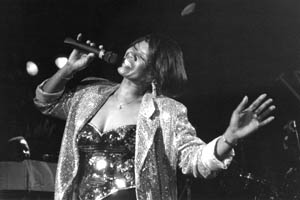
Irma Thomas, the legendary Soul Queen of New Orleans
In addition to these great Dead shows from Europe, I've also been listening to a fair amount of Irma Thomas lately. Later known as the Soul Queen of New Orleans, she began performing at the age of 13, and by 19 she had been twice married and had four children. She was bound by her marriages and by recording/performance contracts for most of her life, and her music tells the story of a strong woman trapped in situations beyond her immediate control. A contemporary of Aretha Franklin and Etta James, she never reached their level of national fame and acclaim, though she is beloved in New Orleans.

In listening to her album The Two Phases of Irma Thomas, I hear the life story of her loves, told with heart-rending emotion and painful triumph, as with the masterpiece "In Between Tears." This story is told in two phases, the first tending closer to straight blues and the other a more modern R&B (even funky) interpretation of the same songs.** As I've listened to the album, I continue to think of the women figures in Pigpen's raps throughout this tour, and I've come to see Irma Thomas's persona on this album as the foil to Pigpen's persona in Europe.*** In a way, I can imagine Pigpen singing about Irma as his "old lady," and - in following from the thrust of an earlier post - attempting to grasp the real-life consequences of the philandering lifestyle Pigpen glorified in his magnificent raps from this tour. To make it interesting, I'm going to pair several of the songs off Irma Thomas's album with classic Pigpen songs, where I could imagine the personas singing their own perspectives of similar situations.
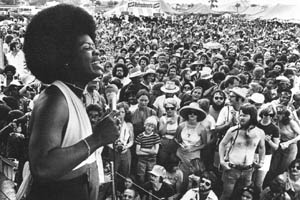
Irma Thomas at the New Orleans Jazz and
Heritage Festival in the late-1970s

  • I'm going to start with Irma Thomas's song "These Four Walls," an entirely sympathetic tale of a woman who makes the most of the little her partner is able to provide. She starts by explaining, "My man breaks his back working every day / Working in all kinds of weather," but he tortures himself because he cannot provide the palace his true love deserves, especially considering that he is married with children to another woman. She, however, is happy to make due with what they have because "These four walls are my palace" and "There's love within these walls." In the refrain she proclaims that she is "happy here with you, babe."

    To me, this song fits with Pigpen's "Easy Wind," a song about a working man, "chippin' them rocks from dawn till doom." While it's never said that he is married, he has a woman who hides his liquor. Wary of women dressed in red, he is searching for a woman who will be good to him. In the end, he hopes to find that woman and show her, "I'm a stone jack baller and my heart is true / And I give everything that I got to you."
  • A similar but different take on the story of the woman in love with a married man is "What's So Wrong With You Loving Me." In this story, both lovers are married to another, but she asks her lover, "If I'm not afraid to love you, and I 'm not free / What's so wrong with you loving me?" Ultimately, the crux of her pain is that society cannot accept their love, causing her to wonder more generally, "What's so wrong when two happy, married people / Fall in love?" In the end, however, she comes painfully resigned to their love in the shadows, her lament from the title.

    I have to pair this song with Pigpen's rendition of the classic Wilson Picket blues song "Turn On Your Lovelight," a passionate song of a man and a woman reveling in one another's love. Told from the man's perspective, the song extols the physical pleasures of the love while ignoring the consequences. For a rare duet with Janis Joplin, listen to the "Lovelight" from this show.
  • One of the common threads in Irma Thomas's songs on the album is of a woman trapped in a man who wants to be with another woman, but she won't release him from their marriage because it is the only security that she (and their children) have. In "She'll Never be Your Wife," she captures the anger of the spurned wife whose husband is begging her for:"She can have you, whenever she wants you, but she'll never, never be your wife." She unleashes all her furor in raging finale:
You've made me such a joke to your friends
Now you and this woman are trying to blow my future up in smoke
Well, after all the years you made me suffer
I'm going to hold onto you for dear life
Tell her: 
I'm not signing any papers, and I don't want ya
And I know how much money you make
So you better bring it on home
And take care of these kids. 
Here, Irma Thomas provides a perspective that we never get from Pigpen: the wife and mother dependent on her husband in a society where she realistically cannot hope for the same luxuries enjoyed by a man in her same class. At the end of the day, she is responsible for their children regardless of what he does, and with limited access to work her fate (and that of their children) is tied to his life.
I will draw a connection to Pigpen's song "Caution" (annotations but no lyrics here). Pigpen's persona knows there is "something wrong with me and my baby," so he goes down to the  fortune-telling Gypsy woman for her advice. After telling his story, of course, she tells him what he wants to hear, "All you need, is just a touch of Mojo hand." Salvation is to be found in magic (or in drugs, if you take the alternate definition). Unfortunately, Pigpen's persona is oblivious to the reality of his lady's life, seeking answers from anywhere else.
  • The most heart-rending song on Irma Thomas's album (and the one that gave me the idea for this post) is "Won't Be In Your Way Anymore," her side of a collect call to her husband. To summarize, she tells him, "Sorry, but I'm leaving your ass and taking the kids. We're going to be all right, so you can go on with your life." The chorus is delivered with soul-wrenching emotion. She even adds an extra syllable to the end of each line for emphasis.
    Me and the kids are gonna be all right-ah
    We'll get a hotel room for the night-ah
    And we'll get a meal at the local drug store
    And we won't be in your way, anymore, no we won't-ah
    The most powerful lyric in the song comes towards the end and provides her undeniable justification for leaving the man:

    The things you hit me for
    When you came home late at night
    In front of our kids
    Don't you know that was not right
    I don't want to make any notion that Pigpen abused women, and I am not aware that he had any children. Therefore, I'm going to match this song with "Operator" (annotations but no lyrics here) and suggest it as a snapshot of an earlier, more joyous point in the relationship. It may seem like a cop-out, but it is what it is.


  • Finally, Irma Thomas has a magnificent medley of her monologue (or rap) "Coming from Behind" and the song "Wish Someone Would Care." In this monologue, she goes on about the common struggles of women, including the assumption that they are subservient: "He thinks anything she does, she has to do it / But it just doesn't go like that, baby.... She gives love, but she expects love in return." She was raised to live by the Golden Rule, "But men don't care / All he think a woman is for / Is whatever he need her, when he needs her, and how he needs her." She flips the script on his philandering, saying that if men go out three-timing, women will do six, "And our back won't be hurting when we're through!" She further insists that women are "born with the most precious jewel in the world," but that doesn't make them angels. "We weren't meant to be angels / We were meant to bring forth angels." In the end, she says she's in love, but it hurts because she "gave him what he wanted / I loved him but he walked out." She finds solace in a smile, explaining, "When you smile, nothing's ever so bad." The song "Wish Someone Would Care" echoes "The Stranger" in tone and message, and she even asks for someone to "come see about me."

    This medley reminds me of Pigpen's rant in "Good Lovin'" from 4/14/72 for its length and its substance. Both are extensive, telling the tale of their respective personas in great detail, following eddies in their stream of consciousness, but always with a point. Pigpen chases women on a four-day creep, is chased by a girl's father, the police, and his wife, and comes home to rest, only to find that his partner has her own needs and desires. From Irma's perspective, "All he thinks a woman is for / Is whatever he need her," and in the end she "loved him, but he walked out." The lifestyle that he glorifies in his opus has real-life consequence that go untold (at least in the Dead's music). Irma Thomas 

Irma Thomas performing at Jazz Fest in 2009.


- Morning Brewer


PS (Pairing Suggestion): 

Exploring Irma Thomas so deeply has left me sad and a little bit angry, so our pairing suggestion for today's post is bourbon. I recommend the Bulleit, the Woodford Reserve, or (if you're looking for something inexpensive) Heaven Hill. If necessary pair with water, frozen or liquid. Or pair with another glass of bourbon.


---------------------------------


* In reality, you probably head back to from where you came, but it's nice to ponder!
** I like both phases, each stressing a different emotional thread in the stories told in the songs. However, I prefer the bluesier Phase One, personally.
*** Let me clarify that I am talking about the persona each vocalist assumes in their art. While I believe that each singer channeled their own lives to a certain extent, I don't know enough about either one personally to make a claim of what they either was/is like as a person.

Thursday, May 10, 2012

5/10/72 Amsterdam: "Casey Jones," Joe Hill, and the Heady Topper


Again, sorry for the late post, but I hope to have tomorrow's up in a timely fashion.

When: Wednesday, May 10, 1972
Where: Concertgebouw, Amsterdam, Holland
Setlist: (In order of the released CDs. I can't find much online, but this show is certainly worth buying.)
  1. Bertha, Me & My Uncle, Mr. Charlie, China Cat Sunflower > I Know You Rider, Black-Throated Wind, Loser, Next Time You See Me, El Paso, He's Gone^, Chinatown Shuffle, Playing In The Band, Big Railroad Blues, Jack Straw, Tennessee Jed, Big Boss Man, Greatest Story Ever Told, Casey Jones
  2. Truckin' > Drums > The Other One > Me & Bobby McGee > The Other One > Wharf Rat, Beat It On Down The Line, The Stranger (Two Souls In Communion), Ramble On Rose, Sing Me Back Home, Sugar Magnolia > Not Fade Away > Goin' Down The Road Feeling Bad > Not Fade Away
As always, my personal highlights are bolded.
^ Appears on Europe '72

Blair Jackson sets the scene perfectly for a magical Wednesday night in Amsterdam in 1972, so I'm going to leave her to it:
Concertgebouw, Amsterdam: exterior, c. 1920s...
... and interior today. Perfect set and settingfor a Dead show!!
When Amsterdam's gorgeous acoustically stunning Concertgebouw symphony hall opened on April 21, 1888, an orchestra and 500-voice chorus performed works by Bach, Handel, Beethoven, and Wagner. When the Grateful Dead played there 84 years later, they performed songs by Haggard, Holly, Parker, Reed, Kristofferson, Garcia, Hunter, McKernan, and Weir (among others). No doubt each show was transcendent in its own way for the sold-out audience of about 2,000, One was a lot louder than the other. And only one had dazed concertgoers searching the canals of Amsterdam looking for their blown minds afterwards. Yup, another skull-fuck of an evening on the Dead's Europe tour!
The performance on this show features fantastic playing throughout. Jackson suggests mentally dividing the second set into three sections: the 62-minute jam that starts the set and ends with "Wharf Rat," the short songs from "BIODTL" through "The Stranger," and the finale-medley-in-lieu-of-encore that closes the show. In addition, Bob Eaton writes a spot-on, no-nonsense review of this stellar show in the Deadhead's Taping Compendium, Vol. 1, which I will refer to most often in the points "Worth mentioning" below. I can only image what a Dead show in Amsterdam must have been like, especially in 1972. I'm sure the entire place was billowing with hash smoke and plenty of other items illegal pretty much everywhere else. The quality and length of this performance seem to bear out these suggestions.

The slowest part of this show is clearly the beginning, but it's just a slow start, nothing embarrassing. Still quite good by profane standards, but the "China" > "Rider" is lackluster in the context of the sublime versions so commonplace on this tour. By the time each of the singers is on his second pass, the band's in full swing and not looking back. I have to mention that this version of "Playin'" features an exceptional jam, intense and melodic. You know by now it takes a lot from this song for me to make special reference to the playin' (excuse the pun). Towards the end of the jam, Billy is swingin' hard on the traps, a taste of what's to come from him. Watch out for Kreutzman tonight, folks, he's a man possessed!! "Tennessee Jed" is a surprising highlight for me, featuring very strong, tight playing and a little extra from Jerry on the vocals. I've also got to mention "Casey Jones" because it's our Song of the Day! Surprise, surprise - it closes the first set. (There, I did it.)

Looks more like '74 to me, but it's tough to find
a good picture of Billy at the kit from 1972.
They really get cookin' from jump in the second set. "Truckin'" is perfectly performed with an energetic jam fading into some of the finest two-and-a-half minutes of drumming you'll ever hear. This nasty barrage took me aback listening to the track, and it puts Kreutzman in the highest class of drummers (in my book): Blakey, Roach, Barr. It's jazzy, with subtle variations spinning into sudden changes in the beat, tempo, and rhythm. Truly phenomenal. Oh, and you know what comes next: *BOOM!* Phil's roll into "The Other One." Billy doesn't let up for a second here, and the jam that ensues is unlike anything I've heard on the tour so far.* First we get an extended, energetic manipulation of the theme, but instead of diving into the vocals, they get drawn off into a bluesy space by Billy's swingin' rides and Jerry's delta tone. The blues fades as the jam loses form, but after a while the song's theme re-emerges, and Bobby finally gets to sing the first verse. Before too long, they're back into another extended space with the drummer playing a crucial role. This one starts off halting and rhythmic feel, but before long it's fallen off the map and into the frightening abyss. Another energetic jam exploring the main theme follows, bringing with it the second verse, and at the end we get another brief space leading into "Me & Bobby McGee." Another unusual, country-ish song in the depths of a dark second-set jam. This one gives way to a very special "Wharf Rat," which Jackson notes is just the fourth of the tour. I'm not one to necessarily abide by the latter-day rule of thumb** that a Jerry ballad at its best finds a moment of complete silence, but this version comes close. There's an organic spontaneity to the stillness that really moves me.

From Jackson's set two, part two, all the songs are beautifully played. "BIODTL" has an enormous number of beats to kick it off (I count 25 total, but the first 15 were just Billy playing around with the beat). The vocals and the playing really inspire that pre-Primal jub-band sound! "The Stranger" phenomenal, but to me Jerry's solo lacks just the tiniest bit of the emotional intensity of the version from Frankfurt, still topping the list. "Ramble On Rose" delivers everything you could ever hope for from Jerry's soulful vocals and Phil's big, bouncing beat. Even the harmonies sound pretty good, in all their throaty splendor. The highlight of this section, however, has to be the "Sing Me Back Home" that reaches incredible heights for a stand-alone version not coming directly out of some deep jamming.

Part three really is an encore without the formality of leaving the stage, showing how firmly in the groove the band managed to get through the course of the night. It starts like a set-closer "Sugar Mags," but instead of Bobby wailing the ending, it all gets quiet for a few seconds. The wandering rhythm suggests "Good Lovin'," but I'm guessing Pigpen wasn't up for it tonight, so Jerry mercifully turns the beat to "NFA." The playing is everything we've come to expect from this jam sandwich on the tour, and I just can't get enough of it!! As the final track fades, you can hear that despite the 300 minutes of music performed that night, the crowd is hardly ready for the end.

I know I used this image already, but it's just so cool!!! Let's pretend this is at the end of "Not Fade Away."

Worth mentioning:
  • Eaton calls "Mr. Charlie" a standard version with "an outstanding Pig vocal." I can't disagree.
  • "Black-Throated Wind" is again a bit slow, but Phil's vibrato is spot-on, at least to my untrained ears.
  • Jerry's guitar fills between the vocal lines of "El Paso" are spectacular.
  • Jackson notes that the vocal interplay at the end of "He's Gone" that appears on the original Europe '72 release are actually from Dillon Stadium, 7/16/72. Europe, indeed!
  • Eaton likes "Chinatown Shuffle" better than I do, but I'm sure he's listened to it far more times than I have. I suggest you take his word for it.
  • "Jack Straw" in excellently played, but Jerry flubs a couple lines.
  • There's a magical moment in "Greatest" where Keith is playing a descending run while Bobby jumps in with a matching ascending run directly in his path. The rest of the song has exceptional energy, as well.

Song of the Day: "Casey Jones"

"Casey Jones" is one of the better known and least understood songs in the Dead's repertoire. It's frequent references to cocaine made it a fan-favorite for those seeking liftoff themselves, but the actual thrust of the lyric is clearly cautionary. Hunter notes, "I said the bad word - cocaine - and put it in a somewhat romanticized context, and people look at that as being an advertisement for cocaine rather than what a close inspection of what the words will tell you." Before we get into that, I need to tell everyone who may not know it the story of Casey Jones.

The historical Casey Jones, working for the Illinois Central Railroad.
From the annotated lyrics, we learn that he was born John Luther Jones, and got the nickname "Casey" from a town (Cayce, Kentucky) nearby where he was born. He ran the "Cannon Ball Express" train from Chicago to New Orleans for the Illinois Central Railroad, where his distinctive method of blowing the engine's steam whistle earned him the name the "Casey (or KC) Moan," but that's another song entirely (listen to track 5). On April 30, 1900, Casey Jones drove his freighter into another train

His friend and fellow railroader Wallace Saunders wrote the first song that memorialized his death, which became popular on the vaudeville circuit. The song was picked up by travelling folksingers, as well, and by the 1920s the story of Casey Jones's fate was a classic meme in American folklore.

I cannot allow this discussion to pass without noting another version of the story of Casey Jones written by the legendary Wobbly songwriter Joe Hill in 1911. In this version, Casey Jones scabbed on his railroad brothers on the South Pacific line, determined to run his load no matter what. After a bit of sabotage, Casey ended up in front of an elated St. Peter at the Pearly Gates:
"You're just the man," said Peter, "our musicians went on strike;
You can get a job a-scabbing any time you like."
As will happen, however, Angels' Union No. 23 finally caught up with him and cast him to Hell, where the Devil greeted him, "Casey Jones get busy shoveling sulfur / That's what you get for scabbing on the S.P. Line." When properly delivered - partly in song and partly in verse - this construction of Casey Jones's story is sure to bring a crowd to cheers, jeers, and laughs!!

The early days, feeling the power.
In this context, the Hunter lyric is another play on the folk theme of Casey Jones. While there is no historical indication that Casey was in any way inebriated (nor that he scabbed on his brothers, at least to my knowledge), the song plays off the cautionary lesson of all Casey Jones tales, this time warning the listener of the dangers of cocaine:
Drivin' that train
High on Cocaine
Casey Jones, you better
Watch your speed.
Trouble ahead
Trouble behind
And you know that notion
Just crossed my mind
When reading the chorus here (as opposed to hearing it screamed by 10,000+ fans), the message is clear that Casey Jones - flying high on cocaine at the levers of a locomotive - needs to check himself. The music is as basic as it comes for a classic rock tune. In fact, Garcia once told an interviewer that the way the song grates on you is by design:
[I]t's got a split-second little delay, which sounds very mechanical, like a typewriter almost, on the vocal, which is like a little bit jangly, and the whole thing is, well... I always thought it's a pretty good musical picture of what cocaine is like. A little bit evil. And hard-edged. And also that sinsongy thing, because that's what it is, a singsongy thing, a little melody that gets in your head.
The bridge verse, even more than the chorus, puts the warning in its starkest terms:
Trouble ahead
The Lady in Red
Take my advice
You'd be better off dead
Switchman sleeepin'
Train hundred and two
Is on the wrong track
And headed for you.
The Lady in Red has always been a literary reference to a prostitute of adulteress (The Scarlet Letter), and it's been said that Anna Sage was wearing a red dress when she dimed on John Dillinger to FBI the night he was murdered. The mark and the reference are again intended as warnings (as in "Easy Wind" as well), but the reference is also to a drug term: Lady Cocaine, reds (downers)***, or all together another upper (barbituates).

FURTHUR - Is that on Hwy. 84?
A comment on the web version of the annotations suggests Beat muse**** and Merry Prankster chauffeur Neal Cassady may be tangentially referenced as well:
  1. Casey is close to Cassady. 
  2. He was, a common user of barbituates and other amphetamines (likely linked to his death in Mexico).
  3. Known as "Speed Limit" to the Pranksters, he drove the bus.
  4. He commonly used the phrase "It just occurred to me...," very close to the ending of the chorus.
Speed Limit in his natural surroundings:
"Cowboy Neal at the wheel of a bus to never, never land."
I would suggest this is a second reference,
an inside joke of sorts, to commemorate a figure who bridged the generations of the mid-century countercultures. I further suggest this is more likely intentional than the pop reference alluded to when discussing "Mr. Charlie."

Considering Hunter's unique twist on a popular history, it's almost fitting that the message is so often misinterpreted. An entire generation (or two) of casual listeners are likely to think of Casey Jones only as Garcia's coked-out buddy, who met is fate with his hand on the throttle in more ways than one. But we know better.

*     *     *     *     *

Joe Hill: "Don't Mourn, Organize"

Born Joel Emmanuel Häggland in Gävle, Sweden in 1879, he emigrated to America with his brother Paul shortly after the turn of the century. He was a migrant worker, and ended up in San Francisco for the 1906 earthquake. In 1910, he became a worker-organizer for the radical union the Industrial Workers of the World (the IWW, or the Wobblies) in San Pedro, California, but he had ties to the local in Portland, Oregon. He gained his fame as a proletarian songwriter for such songs as "The Tramp," "There Is Power in the Union," "Where the Fraser River Flows," and "The Preacher and the Slave," set to the tune of "In the Sweet By-and-By" that coined the term "pie in the sky." His song "The Rebel Girl" highlights the importance of working class women in the movement to build power to combat the industrialists.
Joe Hill's mug shot, 1915.

In January, 1914, there was a double-murder in a grocery store in Salt Lake City, Utah, where a shot was fired in self-defense by one of the victims. Joe Hill was arrested after word got out that he had been treated for a gunshot wound on the night of the murders. He had been shot in a love triangle, and in order to protect his lover's reputation he didn't divulge her identity. Four other people were treated for gunshot wounds that night, but Joe Hill - infamous among the mineral industrialists of the West - was tried and convicted of the murders in what is now considered a massive miscarriage of justice. He never took the stand in his own defense, and many believe he chose to die as he could be of better use to the movement as a martyr than an organizer.

On November 19, 1915, Joe Hill was executed by firing squad by the State of Utah. His last word was, "Fire." Before his execution, Joe Hill wrote a letter to Bill Haywood, one of the heads of the Wobblies, that read (in part):
Goodbye Bill. I die like a true blue rebel. Don't waste any time in mourning. Organize.... Could you arrange to have my body hauled to the state line to be buried? I don't want to be found dead in Utah.
Wobbly lore holds that his cremated remains were sent in 600 envelopes to locals around the world. One of the envelopes containing ashes was confiscated by the U.S. Postal Service, and it contained a note that said, "Joe Hill was murdered by the capitalist class, Nov. 19, 1915." The contents was eventually released, but the envelope remains in the National Archives.


In 1930, Alfred Hayes wrote a poem called "I Dreamed I Saw Joe Hill Last Night" (below), which was eventually set to music by Earl Robinson in 1936. It was famously performed by Joan Baez (among other places) at Woodstock in 1969. You can listen to a version of the song here.
I dreamed I saw Joe Hill last night,Alive as you or meSays I, "But Joe, you're ten years dead,""I never died," says he."I never died," says he. 
"In Salt Lake, Joe," says I to him,
 Him standing by my bed,
"They framed you on a murder charge,"
Says Joe, "But I ain't dead."
Says Joe, "But I ain't dead." 
"The copper bosses killed you, Joe,
They shot you, Joe," says I.
"Takes more than guns to kill a man,"
Says Joe, "I didn't die."
Says Joe, "I didn't die." 
And standing there as big as life
And smiling with his eyes
Says Joe, "What they forgot to kill
Went on to organize.
Went on to organize." 
"Joe Hill ain't dead," he says to me,
"Joe Hill ain't never died.
Where working men are out on strike
Joe Hill is at their side,
Joe Hill is at their side." 
From San Diego up to Maine,
In every mine and mill -
Where working men defend their rights
It's there you'll find Joe Hill.
It's there you'll find Joe Hill. 
I dreamed I saw Joe Hill last night,
Alive as you or me
Says I, "But Joe you're ten years dead,"
"I never died," says he.

- Morning Brewer


PS (Pairing Suggestion): 


Rockin' artwork, Alchemist! And you can pick out
some flavorful floaty funk on the right.
Seeing as this show is the band's all-around best performance since Frankfurt, I'm going to take a hint from that PS to feature another fantastic (imperial?) IPA available in a wondrous tallboy: the Heady Topper. Like the Deviant Dale’s I suggested previously, this is a fantastic canned example at the intersection of the IPA and imperial/double IPA styles. However, they are quite different. Where Deviant Dale’s has huge body, deep color, and ample hopping, the Heady Topper showcases every possible component of the hops with malts solely used to make the delivery palatable. The fact that they both clock in at 8% ABV and utilize the tallboy can for the delivery of a big, bitter brew (and demand recycling on the labeling) makes me again tip my cap to both of these brewers. Keep up the good work, gentlemen!!

“DRINK FROM THE CAN!” the rim of this silver 16-ounce tallboy can demands from us. A bearded, bow-tied cartoon man in profile is pictured below, sipping from a pint glass, with rosy cheeks and the top of his head exploding with hop buds. The back of the can explains (reformatted for easier reading):
Heady Topper is an American Double India Pale Ale. This beer is not intended to be the biggest or most bitter. It is meant to give you wave after wave of hoppy goodness on your palate. Tremendous amounts of American hops will creep up on you, and leave you with a dense hoppy finish in your mouth. 
So drinkable. It’s scary. Sometimes I wish I could crawl right into the can. Freshness and control have always been my main concern when it comes to our beer. We are committed to providing you with an unfiltered and unpasteurized hop experience. 
Why do I recommend that you drink it from the can? Quite simply, to ensure a delightful, hop experience. The act of pouring it in a glass smells nice, but it releases the essential hop aromas that we have worked so hard to retain. If you MUST pour it into a glass, you may find that some of the hop resins have settled to the bottom – leave them in the can when pouring. This beer is perishable, and at its best when it is young, fresh and hazy. Keep it cold, but not ice cold. Drink this beer immediately, we are always making more.
-John Kimmich
The Alchemist
Waterbury, Vermont
DON’T BE A D-BAG, RECYCLE THIS CAN!
I really enjoyed this beer, but in keeping with my dogged determination to ignore directions, I needed to pour the entire thing into a nice, clean glass. Let me be clear about one thing: it wasn’t just hop resins in the can but actual bits of green hop flowers, as well!! The hop particles in the can are like a perpetual dry-hopping that ensures layers of aroma when you pop the can, even if you choose not to pour it out.

Cloudy hop resins (I ate the green hop flakes already)
If you choose to decant this one into a glass, the color is a light and hazy, but if you allow it to settle, you get a clear beer atop a sediment of particulate residue. The flavor is dominated by the hops, both with bitterness and citrusy/floral/piney flavor components, and there is just enough malt to balance this hop-bomb. And The Alchemist is right, the layers of hops unfold from a strong bitterness that stops short of violent, tons of that flavor, and unending aromas. At 8% ABV, it’s not to be trifled with, but with its dry finish and medium body, you can certainly imagine drinking several. Just be sure you’re not getting behind the wheel when you do!

As for food, I suggest pairing this beer with something snack-ish yet flavorful, like chips and guacamole. There isn't much body to the beer, so corn chips will give it a nice, salty complement. The guacamole is substantial enough to cover for the missing malt (if necessary) or soothe taste buds for anyone who isn't used to so much wonderful hoppiness!!


---------------------------------


* I agree with Eaton in the Compendium that this version of "The Other One" contains no less than six separate jams, not including the "Drums." Incredible!
** For those who don't know, once the Dead played more formulaic constructions starting around 1978 or so, there was a dedicated position in the late-second-set
*** I don't need to remind most of you that "Truckin'" brings us these tidings of sweet Jane: "Livin' on reds, vitamin C, and cocaine."
**** Cassady was not only the direct inspiration for Jack Kerouac's protagonist Dean Moriarty in On the Road, but Allen Ginsburg in Howl also referrs to the one who "copulated ecstatic and insatiate," as "N.C. secret hero of these poems."