Showing posts with label Olympia. Show all posts

Friday, May 4, 2012

5/4/72 Paris: "Brown-Eyed Women," Beer Wars, & Mead


When: Thursday, May 4, 1972
Where: Olympia Theatre, Paris, France
Setlist: (In order of the released CDs)
  1. Greatest Story Ever Told, Deal, Mr. Charlie, Beat It On Down The Line, Brown-Eyed WomenChinatown Shuffle, Playing In The Band, You Win Again, Hurts Me Too, He's Gone, El Paso, Big Railroad Blues, The Stranger (Two Souls In Communion), Casey Jones
  2. Good Lovin', Next Time You See Me, Ramble On Rose, Dark Star > Drums > Dark Star > Sugar Magnolia^, Sing Me Back Home, Mexicali Blues, Big Boss Man, Uncle John's Band, Goin' Down The Road Feeling Bad > Not Fade Away  E: One More Saturday Night
As always, my personal highlights are bolded.
^ Appears on Europe '72.

This show is a great example of how the Dead didn't need to play fast to bring a lot of energy and tension to a performance. The beginning of the first set is played very well, but at a much slower pace than the previous night's performances of many of the same songs. The set really gets going with "Brown-Eyed Women," which sounds so similar to the released version (pretty much my favorite version) it's surprising they're not the same. After the song ends, we can hear some interesting crowd banter, with a woman yelling to her friend (apparently across the hall), "I'm over here!"
OK, so I already used this photo (I think).
But I just learned it was actually taken at this show!

The "Playin'" that follows is vigorous, focused, and tight, just the way we've come to expect it on this tour. Again, it's a bit slower, but the tempo seems to provide more room for exploration in the jam - not the frantic, terror-filled excursions we find in some versions but nuanced and interesting nonetheless. The slower pace of "It Hurts Me Too" just makes it even more subtle and emotional, really highlighting the nuance in Pigpen's voice. The tempo picks up a bit on "Big Railroad Blues," and the instrumental performances are as good as they come. Everyone is on the same page, almost expecting one another's ideas before they are played. My personal favorite of the first set is "The Stranger." I don't think this version is quite as soulfully delivered as the version from Frankfurt the week before, but it's still phenomenal. I haven't listened to the two back-to-back, but to my ear it may be a bit slower and the instrumental performance isn't quite as tight.

Again with the "Good Lovin'" that blows the doors off!! Wow, this version is fascinating. It's not played at anything close to the breakneck speed of some recent performances, but it's still got some great jams and new vocal forays from Pigpen. For this one, Pigpen channels his inner grease monkey, saying he's going to "slip a little grease into the transmission." He goes on to explain:
Rockin' 
Fixin' to do a little greasin', do some pleasin'
Shift your gear, mama
...
Slap a little more greast to it
Shift your gear one more time
Time for overdrive
We go a long row to hoe
Amazing how he keeps coming up with this stuff!! Reminds me of something that I remember reading about some of the early Dead shows, like '67 or '68, when Pigpen would take it as his mission to leave the crowd in an orgiastic state after each show.

Maybe it worked this time, as they have a false start on the "Next Time You See Me" that follows. Bobby says they lost electricity to part of the rig (maybe a cord got unplugged during a amorous tussle backstage?), but the interesting thing to me is the limited accompaniment highlights Jerry's lead on the intro. Is it me, or does it sound closer to a slow-bluesy Clapton or Buddy Guy? A little slower, the rhythm with a bit more soul. We get a second listen as they re-start the song, and to me it's different than the rest of the tour. Again, this one is played a bit slower than usual, and I think it draws great attention to Pigpen's vocal delivery.

The "Dark Star" here is adventurous and varied. About eight minutes in, the jam tuns into a melodic/rhythmic juggernaut bearing only the slimmest resemblance to the main theme. After an ample exploration of the newly discovered theme, the jam gives way to the first verse and immediately plunges into space. This space is more than spooky, but less than terrifying. I'll call it paranoia-inducing, for lack of a better term. Billy keeps with the same emotional theme through the brief drum break, after which the band returns to the "Dark Star" with heavy jamming. After a bit, they arrive at a bravely played "Mind Left Body Jam" that suggests (at least to my ears) part of "Uncle John's Band." They leave the realm of structure and arrive at a scorching jam that finds release. The theme from "Dark Star" emerges beautifully, as a glimmer of light breaking through a fog. Really remarkable!

The version of "Sugar Magnolia" that follows is the one that made the record, which you can recognize right away from the ethereal introductory bass chords. It's even hotter in context, coming out of "Dark Star." I think the original vocals sound even better than the re-recorded ones on the record. It's so smokin' hot that Bobby responds to the crowd's cheers after "Sunshine Daydream" by saying, "We're gonna catch our breath here for a minute."

A few songs later, it's almost like they realize they're running out of town, but they still want to do something special for this spectacular crowd. No time to start this one properly, so they jump straight to a soulful rendering of "GDTRFB" before an extremely terse "NFA" finale. The crowd is berserk, and the recording cuts rapidly to a rockin' "Saturday Night" farewell to the rowdy and tuned-in Paris crowd, capping a great pair of Dead shows in the midst of an amazing week of music at the Olympia Theatre.

The marquee of the Olympia Theatre during the incredible first week of May, 1972. A very special thanks to reader Philipe Sicard for passing this along photo and the one above, published in 1972 in the French magazine Rock & Folk.
Worth mentioning:
  • After going on about how faster doesn't necessarily mean better, it's hard to compare this version of "Greatest" after the barnstorming version that started the second set the previous night.
  • "Chinatown Shuffle" is excellent, with the drums really setting the tone throughout. 
  • Jerry is still fooling around with the intro to "He's Gone," alternating the older, flatter line the more nuanced one that ends up taking hold in future performances. Great solo, too. Honestly, it should be a highlight, too.
  • "El Paso" is really hot, particularly Keith's fills between vocal lines, and Jerry, as usual, nails the pirouetting melody that meanders throughout the song.
  • Why is it always a four-day creep with Pigpen? It seems like whenever he talks about getting back from a binge, he's been out for four days. And after four days, his lady-friend isn't pissed that he disappeared. All she wants to do is get him to bed, even though he wants to sleep it off. Maybe four days is his consort's magic window between being pissed he split and totally writing him off. The questions we'll never know now that Pigpen's gone.
  • "Ramble On Rose" and "Jack Straw" are both excellent, squeezed in before the "Dark Star." Both songs are beautifully performed with the extra intensity from the priming the band got over the course of "Good Lovin'."
  • This version of "Sing Me Back Home" is again slow, but very moving. Donna nails the vocals, really pushing this one over the top. Amazing!
  • "Big Boss Man" deep in the second set? It's gotta be a highlight!! It's played slowly but energetically and precisely. My ear is drawn to Jerry's solo, where he perfectly reproduces the entire chorus melody with verve.

Song of the Day: "Brown-Eyed Women"

"Brown-Eyed Women" was one of the first songs off the Europe '72 album that got me thinking about Garcia/Hunter as phenomenal song-writers. The poetry, composition, and delivery of this song thought 1972 never fails to strike an emotional chord with me. As I came to explore the wonderful hobby of homebrewing, I came to an even deeper appreciation of this song, telling an historical tale of a Depression-era bootlegger.

The opening bass notes get the song off to a skipping start, with the beat close behind. The lyrics begin with the narrator yearning for a lost time, when men worked the land with their hands and women told him, "Come to me."

The opening line of the chorus - "Brown-eyed women in red grenadine" - has often and humorously been mistaken for "Brown-eyed women in red leather jeans." But it's the next line when we learn what this song is really about: liquor and the soothing effects it has on dreary days.

We're transported back to Prohibition time, 1920, when all there was to drink was the literal and metaphorical dregs of the whiskey jar - no doubt watered down to stretch the juice. We're then on to "1930 when the Wall caved in" - the Depression that followed the Wall Street crash of 1929 - and "he made his way selling red-eye gin," another term for cheap, rot-gut liquor.

Another pass through the chorus, along with stellar lead play from Garcia and a surprisingly traditional bass line from Phil Lesh, and we're treated to a bit of biographical information on our narrator:
Delilah Jones was the mother of twins
two times over and the rest were sins
Raised eight boys, only I turned bad
Didn't get the lickings that the other ones had
As we arrive at the bridge, we get some more biography, this time of Delilah Jones:
Tumble down shack in Bigfoot County
Snowed so hard that the roof caved in
Delilah Jones went to meet her God
and the old man never was the same again
Apparently, the narrator got his hard-living streak from his mother!! The annotations online provide a tidbit not found in the published volume: a reader suggests that Bigfoot County is another name for Del Norte County on the extreme Northern California coast, bordering Oregon, where the earliest sightings of Bigfoot were reported during the area's mining and logging heyday.

We then learn that our narrator learned the craft of fermentation and distillation from his father, who had him "cut hick'ry just to fire the still." Was it any good? "Drink down a bottle and you're ready to kill."

For me, this song (like "Ramble On Rose") showcases Hunter's remarkably compelling storytelling ability with fine song-writing from Garcia.* The instrumental performance is always straight accompaniment, never venturing far afield into anything resembling a jam, and the combination of tight rhythm, emphatic bass-thumps, glorious piano fills, and stellar lead play and vocals from Garcia makes the versions from 1972 my absolute favorites.

*     *     *     *     *

Beer Wars: The Three-Tier System & the Battle for America's Beers
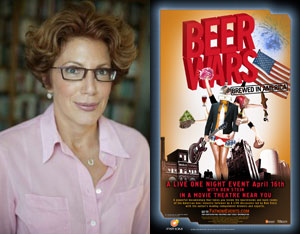
Anat Baron and her film's poster.
Some readers may be familiar with the film Beer Wars, a documentary by Anat Baron (former head of Mike's Hard Lemonade) on the state of the American beer industry. To sum it up quickly, a vibrant and rapidly growing craft beer industry is producing delicious beers of all colors and flavors. Their niche is also growing at an amazing rate (about 10% per year). However, the mind-boggling majority (around 90%) of beers sold in the US is light lager made by one of three giant corporations using a high percentage of adjuncts (rice, wheat, oats, etc.) that give the drink some alcohol but not much flavor, body, or color. The film explores many of the historical reasons why the market is so thoroughly dominated by corporate swill, such as:
  • POLITICAL: 
    1. The American beer landscape didn't always look this way. Before Prohibition, there were nearly 2000 relatively small, largely independent, and almost exclusively regional breweries in the US.** They could not legally practice their craft in those dark years, and many folded.
    2. After Americans were allowed to legally buy beer, the laws regulating it changed. Namely, the federal government put in place a "three-tiered system" to (theoretically) separate the production, distribution, and sale of alcohol. Under this system no company that did one of those functions could do either of the others, and it was designed with the intention of creating checks and balances to protect the consumer.
  • CONSUMER TASTES:
    1. During Prohibition and the wartime rations that book-ended those dark days (as well as the explosion of industrial food production), the American palate moved from distinctive regional and ethnic cuisine towards plain, sweet flavors (sweet ketchup instead of acidic tomatoes, sweet sodas instead of bitter beverages like beer and coffee, even the decline of black coffee!).
    2. From the post-WWII period through much of the 1980s, ales of any sort were hard to come by in America. Most Americans had never tasted an ale's spicy esters, fruity phenols, or bitter hops. They didn't know what they were missing!!
  • THE "INVISIBLE" HAND OF THE MARKET:
    1. Following Prohibition, the brewing industry rapidly consolidated, to the point in the 1980s that well over 95% of beer sold in America was made by some subsidiary of either Bud, Miller, or Coors (BMC). These companies were essentially in a race to create the blandest beer possible to meet the "tastes" of the consumer. 
    2. OH!!! Those beers the Average Joe loves happen to be the cheapest to produce! What fortunate monopolists!! This "lucky" turn allowed these giants to leverage grain and hop producers with their unbelievable market domination. Pretty soon, the only malt you could find had the most boring flavor, and all the grains were identical to be processed by giant brewing machinery.
    3. The distributors naturally became dependent on one of these beer-hemoths, and before long the manufacturers dictated many business decisions made by the distributors, like what to carry, how much, what products to display in what areas of the beer case, etc. What could the distributors do? They were (relatively) small companies begging for scraps from corporate giants!
So, let's imagine it's 1970, and I just got back from a trip to England or Belgium. That flavorful ale I had over there was AMAZING!! Who knew it could be so delicious? Where can I buy some now that I'm home? Nowhere. Where can I learn to make it at home? Nowhere. At least not in the US, because homebrewing was illegal under federal law. That changed in 1978 when innovative homebrewers like Charlie Papazian convinced Congress to follow the lead of the UK (1963) and Australia (1972) and change the law.

Fast-forward to the 1980s, and a few select American beers like Anchor Steam, Sam Adams Boston Lager, and Sierra Nevada Pale Ale changed the consumers' options. That, along with homebrewing, created the first wave of the American craft beer renaissance. Today, we are on the second (or third) wave of that renaissance, but craft beer producers (including the ones listed at the beginning of this paragraph) have continued to struggle for their place in the market with the likes of BMC. Retailers tell the beer reps they don't decide what gets stocked on what shelves, and a quick glance reveals the vast majority of the cooler (particularly the prime spots at eye level) is dominated by light lager of the BMC brands. Meanwhile, the distributors tell those same reps that they need to move a certain amount of one of the big-boys' products or they'll lose the account, and likely their business. The checks and balances of the three-tier system have gone the way of those in our government: dominated by the largest and greediest of corporate interests.

Beer Wars tells a piece of the fascinating story of Sam Calagione and the Dogfish Head Brewery. Sam was a quirky New England prep-school kid who just didn't fit the mold. In his 20s he discovered great beer and brewing, and before long he had the idea (and the loan) to start Delaware's first brewery in decades. Then someone told him state law forbade it. Oops!! Luckily, he found some helpful lawmakers, and now he is one of the most innovative and recognizable independent brewers in the country.

The film also tells part of the story of Rhonda Kallman, co-founder of the Boston Brewing Company, makers of the Sam Adams beers. She left the wildly successful company to invest all her money in starting her own brand around a new idea: beer and caffeine. She called her product Moonshot, a flavorful light lager infused with the peppy chemical found in coffee, tea, and many sodas. There have been coffee beers before, but that was more for flavor than affect. Rhonda's idea was to blend two of America's legal vices into a craft beer. She tells the story of being squeezed by retailers and distributors, while BMC tries to push her out of the adolescent market. Even her former partner, Jim Koch (not one of those Koch brothers), declines her invitation to become a ground-floor investor. The film ends with her carrying another six-pack to another bar after groveling to BMC for a handout, only to be rejected.

Not surprisingly, Moonshot folded in July of 2010 (after the film was released), and my heart goes out to Rhonda and her family. She was a pioneer in my favorite industry (craft beer), and I can only imagine how difficult it must have been to be an attractive, middle-aged woman (and mother) hawking her beer from bar to bar. She (understandably, again) misinterprets Koch's refusal to invest in her company as him sensing a threat to his beer empire. The saddest part is that she doesn't seem to realize that the problem is she's trying to sell a horrible product!! It's not sweet like Four Loco and lacks its high-octane uppers, so it won't appeal to the mass drinker looking for a buzz and some energy. It's trying to appeal to the craft beer drinker, but at its core it's just another thin, boring lager... with a silly marketing ploy!!

The critical piece Rhonda didn't seem to account for in her business plan is that craft beer drinkers are discerning, drawn to quality over gimmicks. If you're going to play a marketing game, you'll need a billion-dollar budget, and even that doesn't always work.*** She found success on the business side of Boston Brewing, and she never claimed to brew Moonshot herself (I assume the recipe was contract-brewed by another brewery). The most successful brands in craft beer come from breweries that have honed their craft and do one of two things (or some combination of the two):
  1. Focus on brewing classic beer styles to perfection (Anchor, Brooklyn, Sam Adams, New Belgium, etc.), or
  2. Blaze trails across consumers' taste buds (Sierra Nevada, Stone, Dogfish Head, etc.). 
But they're all rooted in the creativity of an artist, the reproducible procedures of a technician, and the neuroses of a scientist. Their products succeed in a hostile market first and foremost because of quality, not brand management.

The first wave craft beer renaissance collapsed on itself in the 1990s because the product was seen as a commodity, not a craft. Eventually, the market was flooded with low-quality products, and new consumers stopped flocking to good beer, in large part because it just wasn't that good! The wave passing through the market today has the wisdom of that experience on its side, and many breweries are actually pulling out of some of their more distant markets to focus on the markets where they first found success. Part of the calculus is that they don't want new breweries to erode their base market, but it's also because - like the true purveyors of craft that they are - they aren't willing to sacrifice quality for quantity. They respect the beer, and they respect their consumers' discerning palates.

- Morning Brewer

PS (Pairing Suggestion): 

I'm mixing it up for today's PS, so I recommend tracking down a bottle of mead for this one! Since Paris isn't particularly known for its beer selection, this show begs to be paired with some honey wine. There are several styles of traditional mead (dry, semi-sweet, and sweet; still or sparkling), but they are all made simply with water, honey, and yeast. Since honey lacks the minerals of malt, fermentation is encouraged by the addition of yeast nutrients. Many meads from around the world are also fermented with apple cider (called a cister), other fruits (melomel), hops and malts (braggot), and many other variations.

Mead is also the traditional honeymoon beverage, as honey has long been considered a fertility aide and aphrodisiac. It's also an extremely simple fermentation to do at home, so long as you have a lot of patients. Taking my inspiration from Paris, I suggest pairing your mead with a fresh baguette, some real brie cheese (not that Presidente stuff), and some fresh grapes. By the time the "Saturday Night" encore rolls around, you'll be flipping out with the rest of them!!

---------------------------------

* You could say the same about the Weir/Hunter collaboration "Jack Straw" (and quite a few others), as well.
**This year, the number of breweries in the US surpassed pre-Prohibition levels for the first time.
*** See Bud's American Ale, Zima, or countless other brands of swill you've probably never had more than once or twice.

Thursday, May 3, 2012

5/3/72 Paris: "He's Gone," May Day, & Maibock


When: Wednesday, May 3, 1972
Where: Olympia Theatre, Paris, France
Setlist: (In order of the released CDs)
  1. Bertha, Me & My Uncle, Mr. Charlie, Sugaree, Black-Throated Wind, Chinatown Shuffle, China Cat Sunflower^ > I Know You Rider^, Beat It On Down The Line, He's Gone, Next Time You See Me, Playing In The Band, Tennessee Jed, Good Lovin', Sing Me Back Home, Casey Jones
  2. Greatest Story Ever Told, Ramble On Rose, Hurts Me Too, Truckin' > The Other One > Drums> The Other One > Me & Bobby McGee > The Other One > Wharf Rat, Jack Straw, Sugar Magnolia > Not Fade Away > Goin' Down The Road Feeling Bad > Not Fade Away  E: One More Saturday Night
As always, my personal highlights are bolded.
^ Appears on Europe '72

The Olympia Theatre is a magnificent, historic hall. It was created by Joseph Oller, founder of the Moulin Rouge, in 1888, squeezed into a dense block not far from the Opéra. It was een the home of one of the world's first roller coasters!! By 1972, it had hosted the likes of La Goulu, Edith Piaf, the Beatles, James Brown, Bob Dylan (under a huge American flag at the height of the Vietnam War) and others. The American archetypes of the Dead's music - rough-skinned gamblers and cowboys - must have been reminiscent of Hemingway's decidedly American presence and prose in Paris a half-century before.

Phil Lesh in his element.
This show is a scorcher, and I have no doubt the energetic, perceptive, and vocal crowd had more than a little to do with that. Throughout, there are cat-calls and unison chants in both French and English, not to mention righteous eruptions of applause at all the appropriate junctures. And Phil Lesh owns this show from start to finish, particularly the second half of the second set.

The "Bertha" opener is played exceptionally tight and fast, with great vocals from Jerry and stupendous accompaniment from the rest of the band. The whole first set is fantastic and worth listening to, so don't let my highlights and descriptions limit your listening. I like "Sugaree" particularly for Phil's contributions on bass, and Jerry's stellar vocal performance. Like the rest of the versions on this tour it lacks the huge jam you would find in 1977, but it's very focused and to the point. "Chinatown Shuffle" follows with great playing from everyone, particularly Bill's flurries on the drums.

"He's Gone" is finally starting to settle into the arrangement we're familiar with, as Jerry finds a bit more bounce after a flat opening. His first solo is delivered with the snap we relish from future versions, and overall the playing is focused and a bit more adventurous than previous versions. "Playin'" has fantastic jamming in the middle section, and I am still amazed by the depth and intensity they pack into this song throughout the tour.

The highlight of the first set is clearly "Good Lovin'," played with intensity and sung with passion. The pace is again fast, and Pigpen delivers the opening verse with flair. Phil crashes through the starting gate first, and the rest of the band follows close on his heels. After a forceful and frantic first jam, Pigpen lands on a new rap, patiently singing, "You can hear my baby call / Up and down that hall." The tempo picks up a bit, and the new rap soon morphs into the familiar, "I come every time she calls / With her leg up against the wall." The jam turns dark and spacey - very odd for the typically rhythmic "Good Lovin'" - and Pigpen seems to be grasping for familiarity with his "jump in the saddle and ride" rap. As the beat begins to emerge, Phil seems to tease the breakdown from "Midnight Hour" before Jerry launches the jam into orbit. What a track! The band seems to have adopted "Good Lovin'" as their biggest first-set jam tune, feeling out the room and one another for the deep exploration to come.

We're treated to a surprising and touching version of "Sing Me Back Home," the autobiographical song by Merle Haggard* written about a touching experience in prison. The lyric tells the story of a prisoner's unusual last request while on his way to pay the ultimate price for his crimes: that his guitar-playing friend play and sing the song his mama sang to him as a child. Like most, this version is spectacular, though I have to tip my cap to the version from Veneta 8/27/72 as the best. Still, with Jerry, Donna, and Bobby on the harmonies, it always sends chills up my spine. Obviously, the crowd feels the same, as the end of the song is met with roaring applause from the Parisians. The "Casey Jones" that closes the first set starts a bit slow, but Keith lights a match towards the end, and during the final energetic flurry the organ (I'm guessing that would be Pigpen) puts it over the top.

The second set begins with Bobby and Phil introducing both the Godchauxs, and it sounds like Bobby refers to Keith (or possibly someone in the crowd) as "His Holiness with the bald spot." The ensuing version of "Greatest" picks up right where the "Casey Jones" left off - fast and furious! A  few good version of short-format songs follow, but the "Truckin'" sets the band off on a fantastic frenzy of jamming. It doesn't take long for the jam to fall into "The Other One," which starts with an ethereal intro rather than the furious drop and spiraling lines we've heard so often. It's a nice change of pace, though, and it's fitting because the first iteration of the theme is played at a leisurely pace. Phil sends the jam into a low, slow orbit, which builds into the first verse, over 13 minutes into the track.

Out of the vocals, the jam is played with brief fury, and Keith gives us a ripple (reminiscent of a Kyle run after a SCI climax) that serves as a cue for Bill to take his solo. A couple minutes in, the crowd again erupts in appreciative applause, but Billy K. isn't done yet! Towards the end, Phil joins him for a drum-and-bass duet, which foreshadows the bass solos that graced the following two years. This crowd knows how special this is, and as Phil drops into the rolling intro to "The Other One" they show their love yet again. This time, the band jumps in for a ferocious jam on the theme, but before long it drifts past orbit into the deep space. After a while, I notice Bill isn't playing, then I can't discern any piano or organ. Bobby's rhythm guitar is strangely absent, too, and I realize we're being treated to another duet, this time with Jerry joining Phil.** It's dark and weird, very different from the jazzy rhythmic splash heard just a few minutes earlier.

Once they get back on stage, the rest of the band jumps right into "Me & Bobby McGee," a very unusual choice to be sure. It lacks the mortality theme of "El Paso" or "Me & My Uncle" that were regularly plugged into these deep jams in 1972, but it's got that focused, country twang. It's a far cry from the psychedelic "Uncle" played at Aarhus, but it's an interesting experiment the crowd seems to appreciate. From there, it's back to "The Other One," of course, for another scorching jam and the final verse. The band releases the tension with a fantastic "Wharf Rat," a much-needed conclusion to the frenzied exploration through outer space and two lovers' hitch-hiked ride in a big rig's cab.

Do you know how hard it is to find
a picture of Donna and Pigpen?!?
"Sugar Magnolia" has the feel of a finale, played at a very fast tempo. Towards the end, Phil blows the roof off, and the rest of the band is right there with him. Then they miraculously find another gear and absolutely destroy the tail end of "Sunshine Daydream." Obviously they can't stop there, so everyone quickly regroups around the familiar pulse of "Not Fade Away." They don't let up even a bit from the first bar all the way through "Goin' Down the Road," though the pace and energy throws Jerry off a bit trying to ease off the throttle for the "And We Bid You Goodnight," but we forgive him the stumble considering the amazing jam we just witnessed. He tinkers with the theme a bit, as a drunk dancer trying to play off a stumble as a jig. To close "GDTRFB," Donna and Pigpen grab the reigns (Jerry and Bobby may have lost their voices by now), and the song goes down in a blaze of glory!! But they're not done yet.... They wrap up "NFA" with maybe a bit less energy than they started it with, but it remains one of the greatest versions of this pairing I've ever heard. Of course, the crowd is relentless in demanding more, so the band encores with "Saturday Night." As the music starts, Bobby makes a sales pitch to pick this one, their new single, up after the show. Oh, and it rocks!! The final track fades with the crowd clapping unabated, but there's always tomorrow night.
Worth mentioning:
  • I had to highlight "BT Wind" because like so many versions on the tour, it's a perfectly delivered Bobby tune!
  • There are so many great versions of "China" > "Rider" (pretty much every show to be honest), but this one made cut for the record. In the liner notes, Steve Silberman calls this version "the platonic ideal - a silver locomotive powering through a narrow mountain pass at midnight, showering sparks." However, the transition isn't spotless to my ears, but Jerry fools around with the rhythm an plays it off perfectly. Silberman also provides a great quote from David Crosby describing Bobby's guitar work: "Weir was another lead player, not the rhythm player you would expect. Along with Phil's completely unorthodox bath melody, that's what enable the band to play three running melodies simultaneously It was a completely new way for an electric band to play, and no other group has done it successful."
  • "Ramble On Rose" is excellent, and it sounds nearly identical to the version released on the record.
  • The "Jack Straw" that follows the conclusion of the medley built around "The Other One" is very good, though not spectacular. The ending is particularly strong. It deserves a highlight, but I've already used so many in this show!!

Song of the Day: "He's Gone"

Seeing as the band is finally ironing out its finer points, today's Song of the Day is "He's Gone." After performing this Garcia/Hunter composition for the first time in a Danish TV broadcast just over two weeks previously, the Grateful Dead played this song five times before they settled on this (near) final arrangement. You can find the annotated lyrics here.

The song starts with a loping guitar line over a slow beat, and Garcia quickly starts telling a tale of woe, betrayed by someone close to him:
From the album cover.
Rat in a drain dish
Caught on a limb
You know better but
I know him
Like I told you
What I said
Steal your face
Right off your head
As Deadheads will know, Steal Your Face became the name of the band's most recognizable logo after it graced the cover of an (ill-fated) album of the same name. In this song, however, the image is of being robbed blind. The musical accompaniment raises up with some extra bounce in the rhythm from Phil Lesh on bass, and Jerry takes off on his solo. The lyric develops with images of a steam locomotive and a cat on a tin roof, the unbelievable nine-mile skid on a a ten-mile ride, and of course the Deadhead refrain, "Nothing left to do but / Smile, smile, smile."

Ultimately, the bridge verse - delivered with such longing in the performance from this show - paints a picture of desolation and even despair, with the narrator seeking escape from the reality of betrayal.
Going where the wind don't blow so strange
Maybe up on some high cold mountain range
Lost one round but the price wasn't anything
Knife in the back and more of the same
Same old rat in a drain ditch
Caught on a limb
You know better but I know him 
As with "Jack Staw," the lyric comes full circle, ending where it started. In the best performances of this song, however, the band used the end of the lyric as a springboard into what was often an expansive instrumental jam that capitalized the rhythmic versatility afforded by the slow pace.

This song may be interpreted sorrowfully, mourning a lost comrade, and it was often played as a tribute following the death of someone close to the band. However, it's been well documented that it was written in response to their former manager Lenny Hart absconding with something around $100,000 belonging to the band in March, 1970. This experience was so difficult on his son, drummer Mickey Hart, that he chose to leave the band a bit less than a year later, despite the fact that his band-mates asked him to stay. Lenny was arrested while acting as a reverend in San Diego while "baptizing Jesus freaks" (according to Rolling Stone) in the summer of 1971. Mickey would sit in with the band again in October, 1974, before rejoining the band on a regular basis following their hiatus in 1976.

*     *     *     *     *

May Day

May Day was celebrated around the world just a couple days ago. When I was a kid, I remember leaving flowers on my neighbor's porch, ringing the doorbell, and making a run for it. This tradition has its roots in the European spring festivals celebrated on the first of May, with blossoming of the may tree the raising of the maypole, the anointing of the May Queen, and other merriment.

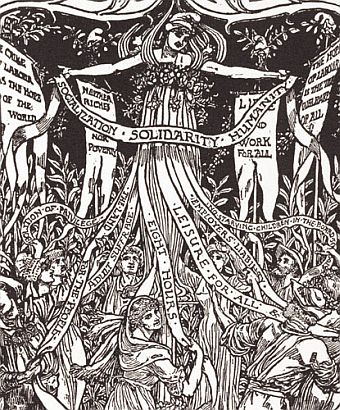
The Worker's May Pole, c. 1894. Read the
accompanying poemby Walter Crane here.
There is another May Day tradition celebrated throughout the world: International Workers Day. Like the struggles of working people around the world, the origins of the holiday are disparate, but they're united in method and purpose. In  1894, Rosa Luxemburg published a history of the holiday What Are the Origins of May Day? in Polish. She notes Australian industrial workers held a general strike on April 21, 1856, protesting for the eight-hour workday. It was planned as a single action, but they continued this as an annual tradition that spread to industrial workers in other countries.

In October, 1884, the Federation of Organized Trades and Labor Unions in America set May 1, 1886 as the target date for establishing the eight-hour workday, and labor unions across the country planned for a general strike on that day. As many as a half-million workers struck on that day, taking to the streets to show their solidarity. In Chicago, as many as 40,000 workers marched, including many of the former scabs who had been called into the McCormick Harvesting Machine Company during the company lockout. However, more scabs remained inside, and on May 3, a crowd of workers from across the city waited to greet them getting off their shift. Union leader Arthur Spies called on the crowd to remain calm and non-violent:, but before long the police and Pinkertons (mercenaries hired by the company to break the union) surrounded the crowd and fired upon them. Two workers were killed by police gunfire.

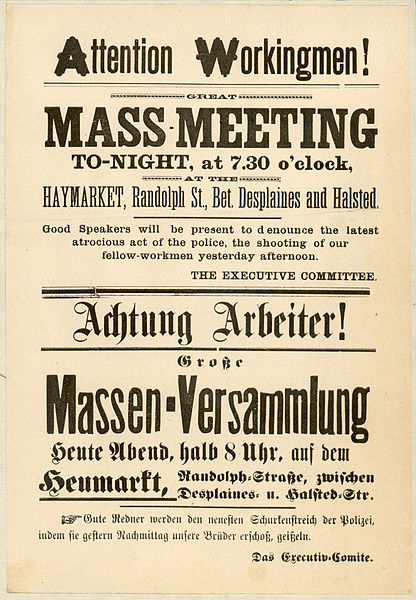
Flyer announcing the rally at Haymarket.
Organizers quickly printed leaflets promoting a rally to protest the murders and continue the call for the eight-hour day (see right). The event was held the following night in Chicago's Haymarket Square. Arthur Spies opened the rally with this statement of purpose:

There seems to prevail the opinion in some quarters that this meeting has been called for the purpose of inaugurating a riot, hence these warlike preparations on the part of so-called "law and order." However, let me tell you at the beginning that this meeting has not been called for any such purpose. The object of this meeting is to explain the general situation of the eight-hour movement and to throw light upon various incidents in connection with it.

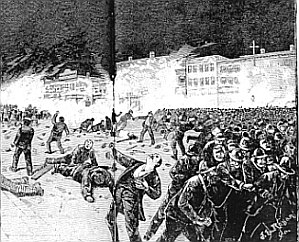
The proceedings went smoothly for quite a while, and even the Mayor had stopped by on his way home, only to leave the subdued rally early. Around 10:30 pm, the police arrived, and the mellow tone quickly turned violent. A bomb was thrown, killing a policeman and wounding six others. As the crowd was fleeing, the police fired on them, killing four and wounding as many as 70 others. The day would live on in infamy as the Haymarket Massacre. A total of eight demonstrators were convicted in 1887 - four (including Spies) were executed, one was sentenced to death but took his own life in prison, and three were pardoned by the state in 1889.

An artist's depiction of the Haymarket Massacres.
Albert Parsons was another of the executed Haymarket martyrs. Born in Alabama, he served in the Confederate Army during the Civil War. He later settled in Texas, where he worked as a progressive newspaper editor and met his wife Lucy, a former slave. As a dedicated Republican, he fought for the rights of freed slaves, and eventually the couple moved to Chicago in 1873. As the two became more involved in urban politics, they soon embraced socialism and then anarchism around 1880 in an effort to ease the suffering of the dis-empowered. After her husband's execution, Lucy continued organizing throughout her long life. She summed up the long view of the anarchist program: "Anarchists know that a long period of education must precede any great fundamental change in society, hence they do not believe in vote begging, nor political campaigns, but rather in the development of self-thinking individuals."

The Second International met in 1889 in Paris, and agreed to commemorate the Haymarket martyrs on the anniversary of the riot in 1890. May Day was officially recognized as International Workers Day at next meeting of the Second International in 1891. It remained a day of rallying for the eight-hour day until laws were passed in the 1930s in the US and much of Europe. Since then, it has remained an international day of worker solidarity and a rallying day for movements on the left.

- Morning Brewer


PS (Pairing Suggestion): 

In honor of May Day, the featured beer is the Maibock, a light-colored, medium-bodied German lager traditionally served in May with the coming of spring.*** As with most lagers, hops provide subtle bitterness to balance for the dominating malt flavor. Like all bocks, the Maibock is relatively strong (above 6% ABV), perfectly suited for the occasionally cool early-spring weather.

So far in May we've been getting some warm weather mixed with cooler, wet days here in Philly, so I'm going to pair this beer with a quinoa salad, easy to serve warm or chilled. To make it at home, cook the quinoa with some broth and water (one part dry, rinsed quinoa to 1.25 parts liquid). Saute some onions and garlic with some fresh, savory herbs. Dice some mushrooms and let them sit in a bit of balsamic vinegar for a  few minutes before tossing them in with the garlic and onions. I like to add some greens (collards, kale, chard, or even spinach) and cook until they're soft. Add some diced sweet peppers just before you're done in order to keep a bit of crunch. Mix the cooked veggies with the quinoa, and mix in a dressing, either sweet or tart depending on your taste. If you want to play with the two, try a vinaigrette with raisins or a sweet dressing with capers.

Never had a great Maibock? Try tracking down one of these:
  • Ayinger makes one of the best German examples, if you can find it.
  • The Munich brewery Hoffbrau does another authentic version.
  • Hacker-Pschorr also is one of the originals.
  • Gordon Biersch does a great job making German styles, so check out their Golden Bock.
  • Rogue's flagship brew, Dead Guy Ale, is actually an ale, but they claim it fits the category. I'm not sure I agree, but I'm including it anyway.
  • Sierra Nevada came out with their interpretation, the Glissade, a couple years ago. Maibock with a twist. For their 30th anniversary, Sierra Nevada included another version of the Maibock in collaboration with homebrewing legends Charlie Papazian and Fred Eckhardt. Track it down if you can find it!
Enjoy your May, everyone. With all these great Dead shows over the next three weeks (or so), I know I'll be enjoying mine!!

---------------------------------


* Unlike Johnny Cash, whose immortal "Folsom Prison Blues" often comes to mind as the quintessential country prison song, Merle Haggard actually served hard time. That this is a true story - a condemned prisoner requested he play and sing him a familiar farewell - adds emotional weight, which the Dead capture, singing the chorus as a soulful derge in decent harmony.
** In the liner notes, Steve Silberman gushes over a similar instrumental duet between Phil and Bobby. I missed that one on first listen, but it seems like Phil got the duet idea in his head and wouldn't let it go!
*** The Maibock (May) is closely related to the Helles (pale) bock, and most consider them to be slight variations on the same style. Since Bock can also mean "goat," the Sly Fox brewery in Downingtown, Pennsylvania holds a goat race at their annual Maibock Festival.