Friday, May 18, 2012

5/18/72 Munich: "Dark Star," Living With The Dead, Cascadian Dark Ale


When: Thursday, May 18, 1972
Where: Kongressaal, Munich, West Germany
Easily my favorite release logo!
Setlist: (In order of the released CDs)
  1. Truckin', Sugaree, Mr. Charlie, Jack Straw, Tennessee Jed, Chinatown Shuffle, Black-Throated Wind, China Cat Sunflower > I Know You Rider, El Paso, Hurts Me Too, You Win Again, Playing In The Band, Good Lovin', Casey Jones
  2. Sitting On Top Of The World > Me & My Uncle, Ramble On Rose, Beat It On Down The Line, Dark Star > Morning Dew > Drums > Sugar Magnolia, Sing Me Back Home  E: One More Saturday Night
As always, my personal highlights are bolded.

This show gets off to a hot start, with a "Truckin'" that sounds like it could be out of the fat part of the second set. The jamming is energetic and relentless, right up until they approach the ten-minute mark, and then it fizzles out quickly, almost as if they realize this is the first song of the show!! They finish the round through the vocalists with strong versions of "Sugaree" and "Mr. Charlie," the latter being one of my favorite versions of one of the most ubiquitous songs of the tour. The "China" > "Rider" is everything we would expect at this point in the tour, and I could listen to this version all day long!

The set really takes off towards the end with yet another deeply jammed "Playin'." Nothing out of the ordinary for the tour, and it picks up just where the "Truckin'" left off. They follow with another stellar "Good Lovin'," and it's clear this is a special night. The jamming is fast and tight, and Billy's drumming seems to push Jerry further and faster. Keith provides superb fills, and - oh, yeah!! - Pigpen is on top of his game. He lets the band jam to their hearts' content, but when he steps up every person in this hall snaps to attention, including the ones on stage. Get it while you can, everyone!!

The second set opens with an extremely rare version of "Sitting on Top of the World." It's great to hear Jerry circa 1972 belt this one out, with a bit more twang than the earliest versions and the same clear voice. As with "Promised Land" the other night, you can tell it's not a regular in the rotation, but the change of pace is noteworthy and welcome. They try to jump right into "Me & My Uncle," and Phil provides just the right energy, but they stumble on entry. Oh well, still an energetic version. The other shorter songs are excellent, as well, so check out "Worth mentioning" below.

Shredding!! (And re-treading)
Now let's get down to the business!! This version of "Dark Star" is spookier than most on the tour, with plenty of free-form, adventurous jamming. It's got is share of space, but overall the jams have rhythm and at least vaguely reference the song's main theme. At one point someone (Phil? Ten years later I'd say it was Mickey, but he's not on the continent!) creates this deep, pounding sound that must be a pick rubbed against a deep bass string. It's jolting because the jam isn't at that scary place yet, but the band certainly responds! The jam is extensive, with the first verse coming halfway through the 28-minute song, and the weird spacey segment after the vocal showcases Phil's aggressive and unorthodox bass voice. He even milks his amp for some harmonic feedback before dropping back down to the depths.* If you love disharmony and arhythmic improvisation, this is the jam for you!!

Out of the deepest depths of "Dark Star" space emerges that familiar ballad of nuclear winter, "Morning Dew." Already primed from their foray through the outer atmosphere (and beyond), the Dead make the most of this one!! Jerry milks the quite moments for every bit of emotion, then casts a clear note into the air before invoking spine-tingling crescendo. This combination - "Dark Star" > "Morning Dew" - captures a timeless, emotional adventurism that moved the Dead in their most inspired performances. After a jam like that, we need a rockin' booty-shaker so bad we can excuse Bobby completely flubbing an early lyric on "Sugar Magnolia." Apparently, Jerry isn't satisfied with the tone of the closing tune, so he rocks another death song - this time "Sing Me Back Home" - to bring the psychedelic life cycle (and the set) to a close.


Worth mentioning:
  • The entire first set is exceptional. Don't skip any of it!!
  • I keep marveling at Jerry's slide work on "Hurts Me Too," very fun!
  • I rarely draw attention to a performance of "Casey Jones" on this tour, but this one is excellent.
  • What a stellar version of "Ramble on Rose." I cannot believe my ears!!
  • "BIODTL" rages from start to finish!!
  • This is a very slow and moving version of "Sing Me Back Home," featuring at times near-silent harmonies from Bobby and Donna that rage towards the end.

Song of the Day: "Dark Star"

"Dark Star" is probably the Grateful Dead's quintessential jam vehicle. It's sparse lyrics and malleable theme provide just enough structure to provide points of reference without in any way restraining the band's improvisational prowess. I remember reading somewhere that Phil Lesh believed the transcendent and trippy lyrics were the inspiration for jams that came to typify the song, but Garcia (who sang the lyrics) dismissed the notion as coincidence. Just goes to show, perception is reality, right? If you've been reading my posts with any frequency, you've come to know that I love the jams this song spawns, and they leave all structure, melody, and rhythm behind, venturing into deep space. Others are energetic, with bass and guitar in intertwining counterpoint continually driven further by the rhythmic fills from drums, guitar, and piano. They are all quite long (15 minutes would be considered very short) and spill into another song, as the jam defies the resolution of a final cadence.


As we learn in the annotations, Phil Lesh and David Gans convinced the band to allow Plunderphonics mastermind John Oswald (who needed convincing himself) to re-create an epic "Dark Star" from the versions in their own vault of live recordings. The result is nearly two hours of "Dark Star" jams manipulated digitally so there are layers upon layers of sound, blending the Dead from different ears into one magnificent, orchestrated, time-travelling musical experience. While not classically the Dead, this is one of the most remarkable pieces of psychedelic music ever created. I strongly recommend the album, called Greyfolded. This website says it's out of print but downloadable. I recommend tracking down the print version, if only for the 16,000-word essay (and you thought I was verbose!) and the fully referenced sonic maps of each disc. You can read much, much more here. Truly amazing!


In Box of Rain, Robert Hunter says this was the first lyric he wrote actually with the band** It's succinct and dripping with lysergic innuendo. When asked to talk about it one time, Jerry responded, "I can't. It talks about itself." There isn't much to explain, but clearly the title is a contradiction, placing it solidly among many other references both scientific and artistic (see the printed annotations for an exhaustive explanation). Also, you will find a reference to the existentialist poem The Love Song of J. Alfred Prufrock by T.S. Elliot. Here are the complete lyrics:
Dark star crashes, pouring its light into ashes
Reason tatters, the forces tear loose from the axis
Searchlight casting, for faults in in the clouds of illusion 
Shall we go, you and I while we can
Through the transitive nightfall of diamonds 
Mirror shatters, in formless reflections of matter
Glass hand dissovling, to ice-petal flowers revolving
Lady in velvet, recedes in the nights of goodbye 
Shall we go, you and I while we can
Through the transitive nightfall of diamonds
There is also another verse that appeared on Long Strange Trip, read by Hunter himself:
Spinning a set the stars through which the tattered tales of axis roll
About the waxen wind of never set to motion in the unbecoming
Round about the reason hardly matters nor the wise through which
The stars were set to spin.
Now that we're clear on that, the magical truths of life and the universe unfold before us.

NOTE: Towards the end of the annotations linked to above, quintessential beer enthusiast and historian, the late Michael Jackson (not that one), noted an English dark old ale called Dark Star that was voted Champion Beer at the 1987 Great British Beer Festival. I can't tell if the brewery is Pittfield or The Beer Shop, but either way it's almost worth a trip to London to find it!!


*     *     *     *     *

Living With the Dead: Cashing In, Gatekeeping, & the Legacy of Jerry Garcia

A year or so after Jerry Garcia died, Rock Scully (along with David Dalton) published Living with the Dead: Twenty Years on the Bus with Garcia and the Grateful Dead. So soon after Jerry died, this book made quite a splash, in large part because Scully co-managed the Dead for a substantial portion of their illustrious career (including their tour of Europe in 1972) and told many tales of their careless lifestyle. I've largely refrained from quoting from this book because, upon release, it was highly controversial amongst the established Grateful Dead hierarchy. However, I've gotten several questions about it, so I thought it would be worth exploring the book and the controversy that has surrounded it through the lens of the 1972 tour of Europe.***

The book contains a significant segment from Scully's "road diary" on the '72 tour of Europe. No one disputes that he was there, playing a critical role as German-speaking co-manager, and I have no reason to doubt most of the brief tales he tells of the tour. In particular, he notes:

  • Flat audience response from the Wembley shows. He implies the Dead's sophistication is out of the league of the London audience, a judgement that I am wary of on the surface. The hall was clearly too big for the show and probably led to acoustical complications.
  • The stellar performance from Newcastle is lost on him; all he remembers is the boomy, concrete venue.
  • Fights in Copenhagen, particularly surrounding crew members who picked them.
  • The Aarhus show fell on Fasching, the Scandanavian Halloween. Fun, fun, fun!!
  • After an off day in Sweden, the return trip to Denmark featured a close call with customs officials and a bus driver convinced he wouldn't see his children until they were grown.
  • Phil flipping out in Dusseldorf over the Nazi history, and the show - again - being lost on the stoic crowd. However, Karlheinz Stockhausen brought a gaggle of students, who were (according to Scully) the only ones who knew what was going on. musically
  • He describes the Olympia Theatre in Paris being "just like the Fillmore East; if anything, a bit more funky. A tradition-riddled place.... Hallowed ground, but with insufficient electricity." Also from Paris, the classic story where they show up to the Le Grand Hotel with the staff expecting a 37-piece orchestra. Surprise!! The psychedelic circus has arrived from America!
  • In Amsterdam, Pigpen gives the house organ a whirl, the one built in 1640 and played by J.S. Back. As a thank-you, the gaffer's tape strips the gold leaf from just about every surface, and the band has to reimburse the hall as much as a quarter-million dollars. Ouch!!
  • The crew convinces the Radio Luxembourg techs to go full power for the show, and Bob Mathews calculates it's the strongest broadcast in world history, covering half the globe. The Deadheads in England may disagree....
The point I want to discuss is the "great drug drought" of Munich (this show), when the band and crew had a massive throw-down the day before that culminated in everyone burning their respective cocaine stashes (except for Scully). The next day, everyone is jonesing and calling Scully for a bump. Instead, he orchestrates a field trip for the band to the Deutsche Museum of German innovation, which houses a comprehensive collection of every item created by a German. He gives them strict instructions to rendezvous before the scheduled soundcheck before turning them loose in the museum. Garcia, of course, is lost when everyone else convenes, and eventually (hours later, supposedly) Scully finds him transfixed by a giant cocaine crystal measuring 15 inches across. "You could start a religion with that thing," is Garcia's tagline.

While I have no reason to doubt that the core elements of this story are true (I wasn't there and I haven't spoken to anyone who was there for their story), Scully's story doesn't match up. The book opens with the details of this story, and Scully insists they are playing at the Olympia Theatre, just twenty minutes from the museum. In 1972, the only Olympia Theatre the Dead played in was in Paris, not Munich. In 1974, the drug-riddled Grateful Dead returned to Europe with their epic Wall of Sound for a quick tour that was by all accounts a shit-show. On 9/14/74, the Dead played Munich's Olympiahalle, but that is clearly another tour entirely. The fact that Scully mis-remembers the location of the concert and/or the year within such a detailed telling of the story is troubling and casts some doubt on its validity in my mind. Could this be a simple mix-up? Absolutely, but this is one of several stories that defy their internal logic, let alone the scrutiny of others within the Grateful Dead Family.


However, I believe that much of the controversy around Scully's book from within the Family may also be attributed to the survivors following the death of their patriarch, Jerry Garcia. It was Scully who turned Garcia onto smokeable Persian heroin that offered a brief, brilliant period in 1977 but ultimately lead to his decline and death. Scully was dismissed from the band's staff in large part because of this, and so soon after his death, I'm sure many in the Family held a grudge. The book is clearly self-serving and riding the wave of publicity following the death of an icon, particularly in light of Scully falling out of favor with the business end of the band.

In addition, I'm sure there was a fair amount of gate-keeping involved in the reaction: Everyone involved knew of Jerry's addiction but depended on his continued performances for their livelihood. But this was an internal secret, one never spoken of publicly, let along PUBLISHED!! For someone who was once inside the circle to break that code of silence at a time when Garcia's legacy was being set in stone was an affront to the Family - all the members of that Family who relied on Garcia and his legacy for their jobs and the financial well-being of their families.

In the end, I have no reason to doubt much of the stories in Scully's book, though some of the internal logic doesn't stand up to scrutiny. However, he's an admitted recovering junkie, so who am I to question his rational processes? Memories get scrambled for all of us, and very few have had the kind of psychotropic adventures that Scully has had. Nonetheless, the book is entertaining as hell, and Dalton does a fantastic job of transforming Scully's colorful memories into fascinating prose. It's worth a read, but I recommend you do so with a healthy dose of skepticism and enjoy the ride!

- Morning Brewer


PS (Pairing Suggestion): 

Inspired by "Dark Star," the featured beer for this show has got to be something adventurous and, of course, dark! In the past several years, a new American beer style has begun to emerge, blending the floral, citrusy, bitter goodness of an American IPA and the dark color of a porter or stout. Some here in the Northeast claim the style originated in Vermont, but I believe brewers in the Pacific Northwest first pioneered the style.****

This style is still in its adolescence (no official BJCP style category, generally entered into competitions under specialty category) and evolving into its own. Therefore, I will describe essentially what I see as the best characteristics, at least to my tastes. Under no circumstances should this ale cut back on the hops at all. In that respect, it's everything an IPA is - bitter, floral, fresh, and flavorful. It's important that the beer has some substantial body to it, as well; none of those skimpy APAs-as-IPAs could qualify. The controversy is just how much body, roast, and color is enough and how much is too much.

To me, the best examples play contradictory expectations against one another. You order your Cascadian dark ale (or black IPA/American black ale) at the bar, and in a clear glass you're delivered a dark-as-night beer capped with a white (or possibly light tan) head. The point of reference is towards a stout or a porter (or a schwarzbier) that highlights roasty aromas and flavors like chocolate, coffee, or even dark fruits. As you raise the glass to your lips, however, your nose is assaulted by the unexpected resinous, piney, citrusy, and tropical aromas of the best and freshest of American hops!! Immediately your mind is in contortions as you take another whiff before diving in for your first taste. At first, you don't know what to expect - roasty malts or flavorful, bitter hops - but you're greeted with no roast and tons of hops!! Moderate maltiness will provide balance for a hefty hop bill (slanted towards late additions for extra flavor and aroma), but it will seem surprisingly light because of the expectation from a black beer.

To me, roasty versions of a Cascadian dark ale are too close to an American porter, and the dark flavors distract from the hop focus of this style. That being said, there are plenty of roasty versions out there, but I'll personally take a pass on those. The next question is the color, as the black color commonly comes from roasted malts that impart a lot of that flavor. Personally, I'd rather have a dark brown or garnet colored example that finishes clean than a black version with a much noticeable roast. The answer? The new(-ish) midnight wheat malt from Breiss, a unionized malster in Minnesota that supplies an exceptional portion of the grain that fuels the American craft beer industry. I'm not sure how they do it,***** but the result is color and some fermentables without the roast, leaving behind a clean, black beer-canvass for brewers to create masterpieces upon!!

And what masterpieces they are!
  • My absolute favorite that is the benchmark for the style (at least in my book) is Stone's Sublimely Self-Righteous ale. If you're only going to try one, this is it!!
  • Not as black, but Yakima Glory (sometimes Yakima Twilight) from Victory is an apt tribute to the valley that provides American craft brewers most of their hops.
  • From Heavy Seas in Baltimore we get an excellent example in Loose Cannon.
  • Deschutes' version is called Hop in the Dark, for those out west.
  • From 21st Amendment, check out the Back in Black, though I can say it's best fresh. Sometimes their cans can taste a bit off, at least to my palate.
  • I haven't had the pleasure of sampling this one yet, but I recently read a review of the Dubhe, an imperial version from Uinta Brewing in Utah. Not sure if I read it right, but I believe they added toasted hemp seeds to this one, too. This is a truly epic brew honoring the State of Utah finally lifting the ABV limit for beers produced and/or sold within the state!
There are plenty other examples I haven't had the pleasure to sample (yet), but as I said it's a burgeoning style that is growing into itself. Find what you like, and let me know when you find others I should seek out!!

As for pairings, anything that goes with an American IPA will work well. I recommend some spicy Thai food (pad Thai or my favorite - massaman curry) or Indian food.

---------------------------------


* I LOVE THE GRATEFUL DEAD!!!!
** I believe there were a few lyrics like "China Cat," "St. Stephen," and "Alligator" that he wrote separately and mailed to the band before he officially "joined" them.
***  Please excuse the lack of references, but I'm short on time. Most of the arguments for or against are fairly well documented elsewhere, but I just don't have the time to review the sources in detail. My apologies.
**** While it is commonly called a black IPA or an American black ale, I prefer to give a nod to is PNW roots and call it a Cascadian dark ale. Besides, how can an India ale be both black and pale? Nonetheless, the region rightfully doesn't have a monopoly on the style, so American black ale is probably the best name. I'm still partial to Cascadian dark ale, so live with it!!
***** If I had to guess, I think they would malt the wheat kernels like they usually do, then roast them at high temperatures for a considerable period of time. Before packaging them, though, they would remove most of the roasty husks, leaving the black color, a bit of fermentables, and next to no roast. From their website, it looks like they planned on this malt being used in schwarzbiers, but to me it's the perfect malt for a perfect Cascadian dark ale!!

Wednesday, May 16, 2012

5/16/72 Radio Luxembourg: "The Other One," Pigpen's Foil, and Bourbon


When: Tuesday, May 16, 1972
Where: La Grand Salle Du Grand Theatre, Luxemburg
Setlist: (In order of the released CDs, listen to the show here)
  1. Big River^, Sugar Magnolia^, Bertha, Me & My Uncle, Mr. Charlie, Sugaree, Black-Throated Wind, Chinatown Shuffle, China Cat Sunflower > I Know You Rider, Beat It On Down The Line, Hurts Me Too, Tennessee Jed, Playing In The Band, Promised Land
  2. Truckin' > Drums > The Other One, Sing Me Back Home,  Sugar Magnolia, Not Fade Away > Goin' Down The Road Feeling Bad > Not Fade Away  E: One More Saturday Night
As always, my personal highlights are bolded.
^ Sound check

Luxembourg's Grand Thatre: a modern, intimate
performance space with studio sound.
I can only imagine what a change of pace this show was for the band and the audience. Instead of one of the concert halls, both classic and modern, the band was performing to an intimate crowd of invitees at a glorified recording studio. In the liner notes, David Gans quotes friend-of-the-blog Philipe Sicard remembering the Dead's "tight and flawless" performance to  about 500 people in a small, superbly acoustical auditorium. It was a wet night, and the snugness of the space and the sound must have been something!

Listening to the sparkling recording of this exceptionally consistent show today gives you an appreciation for what Deadhead Britons must have suffered through listening to harsh, fading audio from a poor radio broadcast. But the broadcast facilities were state-of-the-art if you believe Dennis McNally in Long Strange Trip, featuring "three or four diesel locomotive engines... on standby in case of a power failure."

Signalling the beginning of the concert proper, we're treated to one of my favorite band introductions/tributes to this young and already legendary band and explains the broadcast specs:
Good morning in the theatre hall in the Villa Louvigni in Luxembourg. And for the second time in the history of Radio Luxembourg, a three-hour live broadcast. Tonight with one of the pioneer groups that have changed the whole course of contemporary music over their last 7 years in existence. Originally a jug band in 1964, they are today rated as America’s finest. To all you in the theatre hall, good morning, and to those listening on short wave around the world, on 3 FM stations in Germany, on the French long wave, and on the medium band in Britain, 208 meters. Radio Luxomburg, welcomes the GRATEFUL DEAD!!
The show gets off to a pretty good start with a version of "Bertha" that is flawlessly played, though not excellent. Bobby then dedicates "Me & My Uncle" to "the great state of Mexico" before a decent "Mr. Charlie." The next three songs - "Sugaree," "Black-Throated Wind," and "Chinatown Shuffle" - are like the opener, flawless but not superb. The mid-set "China" > "Rider" is the first the band really brings the heat, and all I can think is that, via Radio Luxembourg, the world is getting treated to some very high-quality Dead! Nothing against the rest of the set, but the set reaches new heights with "Playin'" that features Garcia's guitar whirring and whining towards the front of the jam. Overall, "Playin'" is excellent, showcased by an adventurous jam.

The second set gets another Kid Jensen intro, and they jump right in with an excellent "Truckin'" after we miss out on the first line (I can't tell if Bobby just spaced or if his mic wasn't on). As they leave the lyric for the jam, Pigpen's organ is there to escort us across the threshold (haunting, indeed). Towards the end of this energetic and driving jam we hear the unmistakable rhythm of "The Other One" begin to creep in, and then it's all drums. Billy's solo is nowhere near the version from Amsterdam, and Phil quickly joins him for a huge, rumbling intro into "The Other One." Before long, we're taken to a spacey jam that reeks of "Dark Star," but they jump back to the rhythm for a quick return before turning deeply to space. Jerry and Phil battle send chills and shrills across the hall, and then Jerry dials up that screeching tone and starts running his fingers across the fretboard. For a moment it sounds like we may get "Spanish Jam," the amazing combination of tones, rhythms, and chords reminiscent of various pieces of Miles Davis's Sketches from Spain. Alas, Jerry pulls Phil off the kick, heading back to "The Other One," which surprisingly comes to a cadence instead of venturing into something different.


Ok, ok, this is clearly NOT from Europe (Jerry's playing the Wolf), or even from 1972 (Phil's beard and fuzzy bass strap, plus the phase-cancelling double mics), but it's a cool picture. I wanted to use it, and here it is. So there!
(The camera crew indicates it's from the Winterland in October, 1974, filming the Grateful Dead Movie.)


They quickly remedy the pause with a soulful rendition of "Sing Me Back Home" that may as well have come straight out of "The Other One." This is one of the finer renditions of this song from the tour, in my opinion, and it seems like they may have come to a stop between the two songs just to recharge a bit. The initial pass through "NFA" is a bit subdued, but very well played and not at all noodly. As usual, "GDTRFB" shifts the jam into another gear, especially with he gospel bridge, and the "NFA" roars back with a heavy dose of Pigpen on the organ before closing the set with an explosion. Not the greatest rendition of the medley on the tour, but it's still great to hear!!
The scenic city-state of Luxembourg.


Overall this is a tight, well played show that is not remarkable but for "The Other One." But it's international broadcast in such an historic and picturesque location as Luxembourg seems fitting for a performance that impresses but doesn't overwhelm. I can only guess what you do in the wee hours of a rainy night in Luxembourg after a Dead show in 1972!!*


Worth mentioning:
  • The official release includes two songs from the soundcheck. "Big River" is very raw, and you can still hear they are working on their arrangement of this classic Johnny Cash tune, one of my personal favorite cowboy tunes in the Dead's repertoire. The pre-show "Sugar Mags" cuts short.
  • I've heard the song a thousand times, but I've never noticed the line from "Bertha" that goes, "Dressed myself in green." Weird.
  • What's this at the end of the second set? "Promised Land" replaces "Casey Jones," making a rare appearance on the tour. It's well played up until the end, when it sounds like Bobby ends it a bit ahead of Jerry.
  • In the middle of the second set we get your standard, run-of-the-mill 1972 version of "Sugar Magnolia." That is to say, it's energetic, tight, and superbly played from start to finish!
  • Same goes for the "Saturday Night" encore!!

Song of the Day: "The Other One"

In 1972, the Grateful Dead were played "The Other One" frequently, but it was only one section of the original four-part composition released in on Anthem Of The Sun in 1968, known in its entirety as "That's It For The Other One." The first section is the wondrously named folky lament "Cryptical Envelopment." This was followed by a drum break ("Quadlibet fo Tenderfeet" on the album) that rolled with thunderous fury from Phil Lesh's bass into "The Other One" played on the 1972 tour, originally known as "The Faster We Go, the Rounder We Get." The final section, composed by itinerant experimental keyboard player Tom Constanten, was called "We Leave the Castle." While "Cryptical" was played as bookends for "The Other One" for much of 1968-1971, and the rare appearance in later years was heralded by Deadheads for its rarity and heartfelt mourning.

"The Other One" is a rollicking tour de force built about a galloping rhythm. This rhythm is powerful and versatile, with the ability to morph into a subtle and quiet groove. But it keeps moving, irresistibly forward. This is the vehicle in which Jerry Garcia's greatness grew into its own, wrapped around spiraling explosions of guitar lines speeding across the soundscape. Phil Lesh and Garcia consistently push each other and the rest of the band around unknown corners and into the outer atmosphere and beyond.

The lyrics were primarily penned by Bob Weir and are steeped in the lore of the band's roots. They first conjure the image of the Spanish Lady, who "lays on me this rose," the first of many times the Dead employed the rose imagery in their history. From there the lyric mirrors the music: "It rainbow spirals round and round / It trembles and explodes." A bit later, "The head come round and busted me / For smiling on a cloudy day." We learn from a David Gans interview with Weir and Lesh that this refers to a day in the Haight when Bobby tossed a water balloon on a police officer. Apparently the cop didn't get the joke.

From there, we find ourselves at a bus stop. This bus, of course, is Furthur, the technicolor dream bus steered by the trusty Neal Casady, ferrying Ken Kesey and his band of Merry Pranksters across the country on their LSD adventures. You can read a bit more in a previous post.
The bus came by and I got on
That's when it all began
There was cowboy Neal
At the wheel
Of a bus to never-ever land
Ken Kesey explained (via Tom Wolfe in The Electric Kool-Aid Acid Test) the significance of being on the bus:
There are going to be times when we can't wait for somebody. now you're either on the bus of off the bus. If you're on the bus, and you get left behind, then you'll find it again. If you're off the bus in the first place - then it won't make a damn.... You're either on the bus or off the bus."
Weir also tells us that the reference to Casady came to him in a dream, the night that Casady died in San Miguel de Allende in Mexico. Weir had spend several sleepless nights listening to the mad ravings of Casady when he stayed with the band at 710 Ashbury in San Francisco. Once that line came together, explained Weir, the song was complete.

"The Other One" was a cornerstone of the Dead's repertoire for nearly their entire history due mostly to the song's powerful rhythm and the intense jams it spawned. It is also an oral history of sorts, chronicling the band's roots that blossomed out of the Acid Tests.

*     *     *     *     *

Pigpen's Foil: The Soul Queen of New Orleans

Irma Thomas, the legendary Soul Queen of New Orleans
In addition to these great Dead shows from Europe, I've also been listening to a fair amount of Irma Thomas lately. Later known as the Soul Queen of New Orleans, she began performing at the age of 13, and by 19 she had been twice married and had four children. She was bound by her marriages and by recording/performance contracts for most of her life, and her music tells the story of a strong woman trapped in situations beyond her immediate control. A contemporary of Aretha Franklin and Etta James, she never reached their level of national fame and acclaim, though she is beloved in New Orleans.

In listening to her album The Two Phases of Irma Thomas, I hear the life story of her loves, told with heart-rending emotion and painful triumph, as with the masterpiece "In Between Tears." This story is told in two phases, the first tending closer to straight blues and the other a more modern R&B (even funky) interpretation of the same songs.** As I've listened to the album, I continue to think of the women figures in Pigpen's raps throughout this tour, and I've come to see Irma Thomas's persona on this album as the foil to Pigpen's persona in Europe.*** In a way, I can imagine Pigpen singing about Irma as his "old lady," and - in following from the thrust of an earlier post - attempting to grasp the real-life consequences of the philandering lifestyle Pigpen glorified in his magnificent raps from this tour. To make it interesting, I'm going to pair several of the songs off Irma Thomas's album with classic Pigpen songs, where I could imagine the personas singing their own perspectives of similar situations.

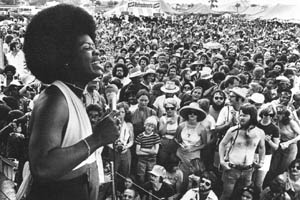
Irma Thomas at the New Orleans Jazz and
Heritage Festival in the late-1970s

  • I'm going to start with Irma Thomas's song "These Four Walls," an entirely sympathetic tale of a woman who makes the most of the little her partner is able to provide. She starts by explaining, "My man breaks his back working every day / Working in all kinds of weather," but he tortures himself because he cannot provide the palace his true love deserves, especially considering that he is married with children to another woman. She, however, is happy to make due with what they have because "These four walls are my palace" and "There's love within these walls." In the refrain she proclaims that she is "happy here with you, babe."

    To me, this song fits with Pigpen's "Easy Wind," a song about a working man, "chippin' them rocks from dawn till doom." While it's never said that he is married, he has a woman who hides his liquor. Wary of women dressed in red, he is searching for a woman who will be good to him. In the end, he hopes to find that woman and show her, "I'm a stone jack baller and my heart is true / And I give everything that I got to you."
  • A similar but different take on the story of the woman in love with a married man is "What's So Wrong With You Loving Me." In this story, both lovers are married to another, but she asks her lover, "If I'm not afraid to love you, and I 'm not free / What's so wrong with you loving me?" Ultimately, the crux of her pain is that society cannot accept their love, causing her to wonder more generally, "What's so wrong when two happy, married people / Fall in love?" In the end, however, she comes painfully resigned to their love in the shadows, her lament from the title.

    I have to pair this song with Pigpen's rendition of the classic Wilson Picket blues song "Turn On Your Lovelight," a passionate song of a man and a woman reveling in one another's love. Told from the man's perspective, the song extols the physical pleasures of the love while ignoring the consequences. For a rare duet with Janis Joplin, listen to the "Lovelight" from this show.
  • One of the common threads in Irma Thomas's songs on the album is of a woman trapped in a man who wants to be with another woman, but she won't release him from their marriage because it is the only security that she (and their children) have. In "She'll Never be Your Wife," she captures the anger of the spurned wife whose husband is begging her for:"She can have you, whenever she wants you, but she'll never, never be your wife." She unleashes all her furor in raging finale:
You've made me such a joke to your friends
Now you and this woman are trying to blow my future up in smoke
Well, after all the years you made me suffer
I'm going to hold onto you for dear life
Tell her: 
I'm not signing any papers, and I don't want ya
And I know how much money you make
So you better bring it on home
And take care of these kids. 
Here, Irma Thomas provides a perspective that we never get from Pigpen: the wife and mother dependent on her husband in a society where she realistically cannot hope for the same luxuries enjoyed by a man in her same class. At the end of the day, she is responsible for their children regardless of what he does, and with limited access to work her fate (and that of their children) is tied to his life.
I will draw a connection to Pigpen's song "Caution" (annotations but no lyrics here). Pigpen's persona knows there is "something wrong with me and my baby," so he goes down to the  fortune-telling Gypsy woman for her advice. After telling his story, of course, she tells him what he wants to hear, "All you need, is just a touch of Mojo hand." Salvation is to be found in magic (or in drugs, if you take the alternate definition). Unfortunately, Pigpen's persona is oblivious to the reality of his lady's life, seeking answers from anywhere else.
  • The most heart-rending song on Irma Thomas's album (and the one that gave me the idea for this post) is "Won't Be In Your Way Anymore," her side of a collect call to her husband. To summarize, she tells him, "Sorry, but I'm leaving your ass and taking the kids. We're going to be all right, so you can go on with your life." The chorus is delivered with soul-wrenching emotion. She even adds an extra syllable to the end of each line for emphasis.
    Me and the kids are gonna be all right-ah
    We'll get a hotel room for the night-ah
    And we'll get a meal at the local drug store
    And we won't be in your way, anymore, no we won't-ah
    The most powerful lyric in the song comes towards the end and provides her undeniable justification for leaving the man:

    The things you hit me for
    When you came home late at night
    In front of our kids
    Don't you know that was not right
    I don't want to make any notion that Pigpen abused women, and I am not aware that he had any children. Therefore, I'm going to match this song with "Operator" (annotations but no lyrics here) and suggest it as a snapshot of an earlier, more joyous point in the relationship. It may seem like a cop-out, but it is what it is.


  • Finally, Irma Thomas has a magnificent medley of her monologue (or rap) "Coming from Behind" and the song "Wish Someone Would Care." In this monologue, she goes on about the common struggles of women, including the assumption that they are subservient: "He thinks anything she does, she has to do it / But it just doesn't go like that, baby.... She gives love, but she expects love in return." She was raised to live by the Golden Rule, "But men don't care / All he think a woman is for / Is whatever he need her, when he needs her, and how he needs her." She flips the script on his philandering, saying that if men go out three-timing, women will do six, "And our back won't be hurting when we're through!" She further insists that women are "born with the most precious jewel in the world," but that doesn't make them angels. "We weren't meant to be angels / We were meant to bring forth angels." In the end, she says she's in love, but it hurts because she "gave him what he wanted / I loved him but he walked out." She finds solace in a smile, explaining, "When you smile, nothing's ever so bad." The song "Wish Someone Would Care" echoes "The Stranger" in tone and message, and she even asks for someone to "come see about me."

    This medley reminds me of Pigpen's rant in "Good Lovin'" from 4/14/72 for its length and its substance. Both are extensive, telling the tale of their respective personas in great detail, following eddies in their stream of consciousness, but always with a point. Pigpen chases women on a four-day creep, is chased by a girl's father, the police, and his wife, and comes home to rest, only to find that his partner has her own needs and desires. From Irma's perspective, "All he thinks a woman is for / Is whatever he need her," and in the end she "loved him, but he walked out." The lifestyle that he glorifies in his opus has real-life consequence that go untold (at least in the Dead's music). Irma Thomas 

Irma Thomas performing at Jazz Fest in 2009.


- Morning Brewer


PS (Pairing Suggestion): 

Exploring Irma Thomas so deeply has left me sad and a little bit angry, so our pairing suggestion for today's post is bourbon. I recommend the Bulleit, the Woodford Reserve, or (if you're looking for something inexpensive) Heaven Hill. If necessary pair with water, frozen or liquid. Or pair with another glass of bourbon.


---------------------------------


* In reality, you probably head back to from where you came, but it's nice to ponder!
** I like both phases, each stressing a different emotional thread in the stories told in the songs. However, I prefer the bluesier Phase One, personally.
*** Let me clarify that I am talking about the persona each vocalist assumes in their art. While I believe that each singer channeled their own lives to a certain extent, I don't know enough about either one personally to make a claim of what they either was/is like as a person.

Sunday, May 13, 2012

5/13/72 Lille: "Truckin'," Mother's Day for Peace, & Grand Cru


Before we get rolling on the post, I want to let everyone know that, as the tour draws to a close, we at the Morning Brewer household are looking to celebrate with you, the readers. We'll be hosting a dance party on the last night of the tour (Saturday, May 26th), serving home-smoked meats and hand-crafted brews. There's a new poll on the upper right section of the blog's web page (not available on the mobile version) for you to let me know if I'll see you there. If you need directions to the party, drop me an email. I know many of you are out-of-towners likely won't be able to make it, but if you're close enough to make the trip, we'd love to have you over!!

When: Saturday, May 13, 1972
Where: Lille Fairgrounds, Lille, France
Setlist: (In order of the released CDs)
  1. Tuning Rap, Bertha, Black-Throated Wind, Chinatown Shuffle, Loser, Beat It On Down The Line, Mr. Charlie, China Cat Sunflower > I Know You Rider, Me & My Uncle, Big Railroad Blues, Next Time You See Me, Playing In The Band, Sugaree, Mexicali Blues, Casey Jones
  2. Truckin' > The Other One > Drums > The Other One > He's Gone, Hurts Me Too, Sugar Magnolia > Not Fade Away > Goin' Down The Road Feeling Bad > Not Fade Away  E: One More Saturday Night
As always, my personal highlights are bolded.

This is the make-up show for the one they missed following Paris, when their equipment truck didn't arrive at the show, and from its absence in the Deadhead's Tapers Compendium (published in 1998), I can only guess recordings of this show haven't been in circulation for very long. In Long Strange Trip, Dennis McNally tells the tale of the lost first show, and its echoed by Nicholas Meriwether in the liner notes to this release and in the GD Comix below (my favorite frame is of the bug-eyed gargoyle as the ice cream flies past!). It started in Paris when a young radical, whose request for a free ticket was turned down, derided the band for their lack of political consciousness, prompting Rex Jackson to dump ice cream onto the jacket he was so proud of. The Parisian's revenge, however, was to sabotage their equipment truck, forcing them to cancel the next show in Lille.


While Jerry and Billy knew better and stayed in the hotel, Bobby and Phil going to the venue to deliver the bad news in person. This was a college town, engulfed in the radicalism of the time, and when it became clear the promoter couldn't refund the ticket price on the spot, Bobby described that the "crowd became very surly." Before long, they were out the dressing room window, shimmying down the drainpipe to the idling truck waiting for them. On his way out the window before the door gave way, Bobby left a rose on the windowsill and promised they would make up the show, and on the 13th, they did just that. McNally recounts, "Stunned by their honesty, the promoter was in tears as they set up in the town's fairgrounds." So the Dead played for real "for workers eating their sausages and baguettes, mothers with children in prams, and some of the students." The day was chilly with occasional showers, but the sun came out and all present enjoyed the show. Phil would later say that for those hours on stage after the rain in the north of France, he lived in a Cézanne. Meriwether closes the liner notes with this passage:
Hunter always said that a rose was one of the ultimate symbols, that when you put a rose in a lyric it will do what it's supposed to do. Lille put the band in a Cézanne. But for the audience it will always be the rose on the windowsill, the thorns of a missed gig redeemed by the stunning, delicate beauty of a day reclaimed and made magic in the way that only the Dead could do.
Thanks for snapping the shots, Philipe Andreiu,
and thanks for passing them along, Philipe S.
The band starts off with equipment problems, as Phil and Bobby show off their best potty-mouths, even with Phil's fake flatulence. Phil remembers to warn the gathered French that this is "NOT an attack. "Bertha" starts out with some feedback, but it's very well played. Each of the songs through the "China" > "Rider" is quite well played, and the only out-of-the-ordinary things are an emotional rest towards the end of "Loser," the false start on "BIODTL" and the notably moderate tempo of "Mr. Charlie." "China" > "Rider" is again excellent with great energy through the transition and a powerful delivery of "I Know You Rider." From there, they continue playing quite well, and we get Donna's Alabama twang introducing "Playin'.", and Bobby saying it's a lady's-choice polka ahead of "Mexicali."

Pigpen with the not-yet ubiquitous Steal Your Face loco on his organ.
The second set starts out with an energetic "Truckin'" full of interesting jams. After a few minutes of nose-down jamming, the band lets billy do his thing for a bit. He brings the solo to a complete rest and starts calling for Phil with the familiar rhythm. Phil drops this one louder and more abruptly than any so far on the tour, with Pigpen's organ adding extra weight to it. The jam that follows has tons of energy, and at one point they ease off the rhythm and begin whirring like a siren as one. Then it's down a spooky space/jam until Jerry erupts with screeching tone and thick, extremely rapid chords. The jam that follows is extremely rapid, but it doesn't quite round up as much as it sounds like it could. Before long they've wandered off into deep space. Phil conjures frightening explosions of sound that turn rhythmic, conjuring "Caution." Jerry responds with a lick that feels like "Dark Star," and the jam stays in space. A little bit later, Jerry plays a melody that reminds me of "Eleanor Rigby," though I never exactly hear the theme. They come back through "The Other One" proper, and again Phil erupts with a flurry, and an another energetic jam takes hold. This final venture is absolutely NASTY, with Phil and Jerry steering each other more and more recklessly. They arrive at the second verse, and I can't even recall if they bothered singing the first*, but they're soon closing the medley with "He's Gone."

The second set's notable finale begins with an excellent "Sugar Magnolia." Bobby starts this one off extremely fast with the opening chords, but Billy settles the groove down quickly once he joins in. The final "Sunshine Daydream" flurry cuts short, and the band is quickly into "Not Fade Away." The first part is unremarkable, getting off to a slow start, and Jerry sounds like he's noodling aimlessly for a bit. By the second half of "GDTRFB, however, they're firing on all cylinders again, and after a soulful rendition of "And We Bid You Goodnight" they jam the final section hard and make up for lost time, wrapping up "NFA" with a bang.


Worth mentioning:
  • I believe this is the first version of "He's Gone" that doesn't stand alone, though they insist upon the rough landing of these early versions instead of finding solace in something like "Wharf Rat" or "Comes a Time."
  • After "He's Gone," Jerry calls the band back from their tuning with a "Teddy Bear's Picnic" riff.
  • Listening to this slow and mournful "Hurts Me Too," I can't help but think this is one of Pigpen's final shows....
  • The encore "Saturday Night" is bursting with energy throughout, but the finish is one of the craziest I've heard, with Jerry not willing to let it go.
Enjoy these fabulous GD Comix telling the true story of Lille! Also, check out this interview of Mickey talking about the importance free concerts played for the Dead.


Pretty good, but unfortunately they didn't rock "Morning Dew" in Lille!

Song of the Day: "Truckin'"

The Dead started performing this song in August, 1970, and a succinct rendition appeared on their studio album American Beauty. It quickly became a classic for its unmistakable opening, autobiographical lyrics, and the energetic jam that became synonymous within a year of its debut. The versions from Europe in 1972 are blistering hot, and often introduced by Bobby, saying the single "reached the top of the charts in Turloch, California, and stayed there for a week or two." As they did in Lille, the band would often follow the jam into "Drums" and eventually give way to "The Other One," so when we hear the opening guitar lick, we know we're in for a ride!!

This is one of the rare times that Hunter focuses on the band as the subject of a lyric ("The Music Never Stopped" was penned by Weir/Barlow), celebrating their lifestyle on the road and the adventures they find along the way. Trucking was another, more vulgar, name for a two-step strut back in the 1920s and 1930s, and of course rhyming slang would conjure images of intercourse. Out of the gate, Hunter aptly describes the traveling circus as "Together - more or less in line." We're then transported from Chicago to New York to Detroit, on to Dallas, not Houston, and back to New York.

Why not Houston? Too close to New Orleans, where the band was busted ("down on Bourbon street / Set up - like a bowling pin / Knocked down - gets to wearing thin") for pot by the cops in January, 1970. They were playing the 30th and 31st at The Warehouse on Tchoupitoulas at Felicity** along with Fleetwood Mac and the Flock on the "Fillmore Circuit" tour, but having spent all their money on bail, they played a much-needed fundraiser again at The Warehouse with Fleetwood Mac on February 1st. Apparently, they were passing around electric Cold Duck (cheap sparkling wine) as a thank-you, and the cops who were swarming the place looking for tokers didn't take notice.

We're treated to some of Hunter's more resonant lines in this song, as well. Beyond , we're treated to these gems:
Most of the cats you meet on the street speak of True Love
Most of the time they're sittin' and cryin' at home
One of these days they know they gotta get goin'
Out of the door and down to the street all alone 
Truckin' - like the doodah man
Once told me you got to play your hand
Sometime - the cards ain't worth a dime
If you don't lay 'em down 
Sometimes the light's all shining on me
Other times I can barely see
Lately it occurs to me
What a long strange trip its been!
The first verse quoted above reminds me of J.R.R. Tolkien's song about the Road, offering a contemporary twist. At a certain point, we all must get out there and live life rather than just sitting back, lamenting its sorrows. The second verse above is steeped in Hunter's familiar gambling imagery, but the message is the same: take the plunge!! No matter how good you think you have it, you have to act on your assets.*** And the third is a bit melancholy, but still looking for positivity. It's punctuated by what has become the unofficial retrospective tagline of a generation: "What a long strange trip it's been."

*     *     *     *     *

Mother's Day for Peace

First of all, happy Mother's Day to my Mom and to all the mother's out there in reader-land. I wish you have a day of leisure surrounded by those you love most. My 8th grade math teacher Mrs. Holding,**** the coolest teacher I've ever had, said the Dead gave out roses to mothers coming into their Mother's Day concerts. But here I want to discuss the history of the holiday.

It was not simply founded to be a mirror to Father's Day, and in fact, the opposite is true.***** In 1870, author, activist, and suffragist Julia Ward Howe called for a "worldwide protest of women against the cruelties of war," specifically the contemporary American Civil War and Franco-Prussian War. As she explains in the Mother's Day Proclamation, Howe intended the holiday to be a protest against war in general:
Arise then, women of this day! Arise all women who have hearts! Whether your baptism be of water or of tears! 
Say firmly: "We will not have questions answered by irrelevant agencies. Our husbands will not tome to us, reeking of carnage, for caresses and applause. Our songs shall not be taken from us to unlearn all that we have been able to teach them of charity, mercy and patience. We, the women of one country, will be too tender of those of another country to allow our sons to be trained to injure theirs. 
From the bosom of the devastated Earth a voice goes up with our own. It says "Disarm! Disarm! The sword of murder is not the balance of justice." Blood does not wipe out dishonor, nor violence indicate possession. As men have often forsaken the plough and the anvil at the summon s of war, let women now leave all that may be left of home fro a great and earnest day of counsel. 
Let the meet first, as women, to bewail and commemorate the dead. Let them solemnly take counsel with each other as to the means whereby the great human family can live in peace, each bearing after his own time the sacred impress, not of Caesar, but of God. 
In the name of womanhood and humanity, I earnestly ask that a general congress of women without limit of nationality may be appointed and held at someplace deemed most convenient and at the earliest period consistent with its objects. To promote the alliance of the different nationalities, the amicable settlement of international questions, the great and general interests of peace. 
In 1908, Anna Jarvis began organizing for national recognition of the holiday, and in 1912 declared the second Sunday in May as Mother's Day. In 1914, President Woodrow Wilson officially enshrined the holiday as a peace initiative that fared better than his Fourteen Points and the League of Nations. By the 1920s, however, Jarvis was upset with the growing commercialism of the holiday, but there has been a contemporary movement to re-connect the holiday to its pacifist roots.

So this year for Mother's Day, call and/or hug you mother, and remember the origins of this holiday. No war.

- Morning Brewer


PS (Pairing Suggestion): 

Belgian and French ales frequently embrace the funk, creating a pair of unique categories of sour beer styles. There are two main styles typical of Flanders (red and brown), and both are noticeably sour, flavors come from byproducts of fermentation by the lactobacillus bacteria.****** Besides the color, the brown (or Oud Bruin) may be a bit stronger and tends to be maltier in flavor, reminiscent of raisins, plums, and figs. The Flanders red, on the other hand, is exceptionally dry and fruity, offering flavor of plums, oranges, and cherries, leaving the overall impression of a medium- to light-bodied beer that is exceptionally acidic and fruity, giving it a vinous quality similar to red wine. The practice of blending ales of different ages (typically one-, two-, and three-year-old brews, aged in oak barrels that are inoculated with lactobacillus). This practice of blending produces a beer that balances rich maltiness with a measured acidity that finishes dry, without overwhelming the palate. As with many Belgian styles, the hops are barely noticeable, as brewers often use aged hops that have lost much of their bittering qualities. They are used to for their antiseptic, preservative traits needed for these beers' extended aging process.

Incomparable.
Grand Cru is an exceptional variety of blended Flemish sour ale, typically served over the winter holidays. Rodenbach, located about an hour from Lille in Roeselare, brews and blends possibly the greatest example. Its acidic flavor borders on vinegar, but there is a fruity complexity featuring both light (think lemons) and dark (think tart currants or cherries) fruits. It sits light on the palate, but there is a malty sweetness that creeps in under the tartness. As it warms, you can pick up vanilla notes from the oak, and when the glass is empty the palate remains refreshed, thanks to the beer's dryness. This range of flavor and perfect balance is only attainable by expert blending of properly aged beers, an art in itself. Rodenbach's Grand Cru embodies the best of this regional tradition, and it's worth the steep price tag here in the States.

Drink this beer with a heavy dessert to lighten the sweetness with the acidity, or enjoy it with sausage and baguette like the workers eating lunch in the fairgrounds when the Dead treated them to this great concert in Lille!

---------------------------------


* Apparently Bobby did sing the first verse, but not until they had been jamming  out of "Drums" for over 10 minutes.
** This may be the club that was called The Venue when I lived there, but either way they're both closed now.
*** This verse was one of many that encouraged me in my courtship of my wife. Thank you, Robert Hunter, for reminding me that if it's that good, it's worth taking a leap of faith!
**** I actually saw her at the one actual Grateful Dead concert I attended, and she managed to siphon of my Mom so my buddies and I could pretend like we were old enough to be there on our own. Did I say she was the coolest?
***** Mother's Day was founded first, and the celebration of Father's Day that follows originally commemorated a West Virginia mining disaster in 1906 that took the lives of 210 fathers, so I guess this note rightfully belongs with the second Wembley post.
****** They other main sour microbiota is the brettanomyces yeast, used in funky, tart styles like lambics and gueuze.

Friday, May 11, 2012

5/11/72 Rotterdam: "Morning Dew," Baseball, & Black Lager


When: Thursday, May 11, 1972
Where: Grote Zaal De Doelen, Rotterdam, Holland
Setlist: (In order of the released CDs)
  1. Playing In The Band, Sugaree, Mr. Charlie, Black-Throated Wind, Deal, Chinatown Shuffle, Mexicali Blues, China Cat Sunflower > I Know You Rider, Hurts Me Too, Beat It On Down The Line, Brown-Eyed Women, Jack Straw, Big Railroad Blues, Good Lovin', Casey Jones
  2. Morning Dew, Me & My Uncle, The Stranger (Two Souls In Communion), El Paso, Tennessee Jed, Next Time You See Me, Dark Star > Drums > Dark Star > Sugar Magnolia > Caution (Do Not Stop On The Tracks) > Truckin', Uncle John's Band
As always, my personal highlights are bolded.

Built in 1966, the ultra-modern ambiance of Grote Zaal de Doelen contrast
the majesty of Concertgebouw or Musikhalle, played in over the fortnight.
Off in Rotterdam, the Dead kept on rockin'! As Blair Jackson writes in the liner notes, "All you really need to know about this Rotterdam concert is that it was former Grateful Dead vault-keeper Dick Latvala's favorite show from the Europe '72 tour." True, but as you know by now, I've got plenty more descriptive words for the music! The hall holds about 2200 people, and it was rebuilt in 1966 after the original hall was destroyed in WWII. In 1966, it was a picture of modernity, and on May 11, 1972, the Dead turned it into a space-ship dance hall with a performance for the ages.

The "Playin'" opener sets the bar high for the first set with some intense, dark jamming. Jerry seems like a man possessed in parts, and the rest of the band is right there with him. The whole first set is quite good, but the band really hits their stride during "China" > "Rider." The jam out of "China Cat" is vibrant and light, and the transition's got all the energy you could ask for. "Rider" feels a bit laid-back, bringing the pairing to a poppin' close. They follow it with a textbook version of "It Hurts Me Too" in which Pigpen delivers the lyrics perfectly, and Jerry's slide guitar is subtle and accurate. "Good Lovin'" is the best part of the set to me, and again it's unique and delightful. Early on the jam has a swampy feel to it, but Jerry's guitar tone is crisp and clean - a very nice juxtaposition! Pigpen also brings his own cognitive dissonance, singing his raunchy hallway rap with a clam, melodic voice. I'll bet you can't guess what song they decided to close the first set with....

Not sure if this one's from Europe, but at least we know that's Jerry and Bobby playing the guitars!!

The second set starts with the first "Morning Dew" of the tour,* and you know the Morning Brewer is excited about that!!! This is one of my top-3 favorite songs the Dead played, and it's sweet but imperfect. Garcia stumbles on the vocal at the end, but overall it's stupendous. I'll take as many versions of this song as I can get my ears on!! It's followed by a very fast rendition of "Me & My Uncle" that rocks hard with great contributions from Keith and Billy. "The Stranger" follows, and Pigpen delivers. To me this version is quite different from the one from Frankfurt, with the band following Pigpen's lead in sounding more forceful than lamenting. He starts with what almost sounds like a lilt to his voice, and while Jerry doesn't push the feedback envelope quite so hard as Frankfurt, he certainly takes it there. I can hear anger creep into Pigpen's voice during the "What is the secret?" verse and explode as he begs to "ride on them wings of love, one more time" and as he asks for some companionship at the tail end. Phil and Keith make excellent contributions on the climax, and all around it's a phenomenal rendition.

If Bickershaw's "Dark Star" was right out of 1969, Rotterdam's is all 1972!! The tempo is moderated a bit, and Jerry's tone is a bit more refined, with depth and clarity from the start. Phil challenges him early to take the jam deep - as Keith and Bobby seem to musically whisper, "Do it, do it" - but Jerry pulls up a bit and Phil responds with a new melodic theme, and they're off!! They rarely stray back to the theme of "Dark Star" in this one, but there's no question where this jam originated. Jerry flirts with terror with his tone, but overall the first jam is very melodic, with Jerry and Phil periodically referring to Phil's first idea as a secondary point of reference. The interesting melodic avenues they explore exemplify the era. Almost as soon as they come back to the "Dark Star" theme, Billy takes over and plays an interesting, though measured solo that runs on the longer side for the tour. Phil joins him for a duet that we'll hear plenty of through 1973, but when Jerry steps back into the conversation it's back to business, flirting with the edges of "Dark Star" proper. Jerry's thick tone gives an air of dangerous vulnerability, and the band coalesces around a momentary eruption before Jerry steps up for the first verse about 25 minutes from the beginning of the song. Did I mention this is the longest version of "Dark Star" on the books?

From the same show as the shot above.
Let's pretend they're both from Rotterdam.
After the vocals, they're ready for a spacey jam that pushes away structure and embraces haunting tones and rhythms. At one point, Bobby asserts himself like a dagger in a dark alley, waking up Billy and sending the entire jam on a frantic chase through the canyon between dissonance and melody. The band reaches the plateau, frantically trying to keep up with Phil and Billy. The jam from here on out is a serious of suggestions for the next song coming from all corners, mixed with intense jams both fast and slow. Please excuse me if the rest of this paragraph reads like a beer (or wine) review, but listening to it is as fascinating as drinking a Within the next two-and-a-half minutes, I hear different instrumental voices suggesting "Sugar Magnolia," "I Know You Rider," "GDTRFB," "Lovelight," "Playin'," "Bird Song," and "Caution." Phil bounces along, sticking with the up-tempo jam, and Pigpen's organ plugs along as a they sink into a new melody where Jerry's tone and quick playing remind me of "El Paso.," but he quickly takes it on a dangerous run down to the precipice. Soon, the rugged, rhythmic playing sounds like they're about to return to "Caution," but Phil pulls up. Jerry's guitar screams his disapproval, and they seem ready to turn full-on into "Truckin'," but Phil won't let the jam go!! More suggestions of "Wharf Rat," "Bird Song," "Comes a Time," maybe even "The Other One" (but that's probably a reach). No one can deny Bobby's loping introductory chords to "Sugar Magnolia," though, and we're finally out of "Dark Star!!"

"Sugar Mags" is fantastic, with Jerry rocking some clean tone that screams during the exceptional climax. Before long, they've come back to "Caution" with that thumping, charged rhythm. Just to mix up the intro a bit, Jerry finds a pleasant space to tease the melody from "There's a place in France..." (or something equally silly). By the time Pigpen works through the vocals, Jerry hints at "The Other One," but Pigpen jumps into a new rap, turning Jerry back to the blues (though still in the Other rhythm). We're then treated to a message from Pigpen's inner wandering workingman:
I got so many chil'n I don't know what to do.
I did a good job on my old lady
Man I don't know about you.
But if you need it, get movin',
If you need it, get movin'.
A few more hints of "The Other One," but the jam signals that "Caution" is here to stay. And it's a classic: funky and bluesy with a hard, hitting beat. Before long, Pigpen is back at his organ, painting shades in the sonic landscape. Billy breaks it down as the guitars and piano go quiet, and Pigpen steps back up to the mic.  The band swells behind his wanderings, and after a bit Pigpen proclaims, "Expeditionary, folks, it's on a four-day creep." After some more "Caution" jamming, they turn the corner for the final performance of "Who Do You Love?" Just as short and nasty as Copenhagen! The jam returns to "Caution," but it's short-lived.

From there, however, they're off to the land of "Truckin'." Bobby's voice sounds fatigued, but the band is energetically bounding around the room, with great contributions from Pigpen on the organ. The jam is excellent, but it ends rather abruptly. But can we blame them? They've been jamming hard for 82 minutes straight!! They seem to know they won't make it back to the stage for an encore, so they just jump right into "Uncle John's Band" to extend the show and say farewell. Incredible!!

Worth mentioning:


  • This is easily the fastest version of "Mr. Charlie" I've ever heard, and I like it!!
  • "Deal" on the other hand is quite slow, but it's still really well played.
  • I would have talked about the "Brown-Eyed Women" in the show review, but Jerry flubbed the opening lyric. Too bad because otherwise it's perfect.
  • Great versions of "Jack Straw" and "Big Railroad Blues," too. Nice vocals, very good guitar licks, especially on the latter.
  • I could say everything I said for "Me & My Uncle" (played hard and fast) in describing "El Paso." I've got to tip the cap to Jerry in particular here, though Keith and Billy are excellent, as well.

Song of the Day: "Morning Dew"

The Dead's rendition of "Morning Dew" appeared on their eponomously named debut album, played far faster than the version from Rotterdam. Mostly, the Dead's arrangement has focused on Jerry's vocal delivery and the slow, steady theme erupting into a mad crescendo towards the end. As noted above, this is one of my favorite tunes the Dead played, and my absolute favorite versions from their respective eras are from Barton Hall 5/8/77, MSG 9/18/87, and Harpur College 5/2/70.

The song was written by Canadian folkie Bonnie Dobson in 1961, after a particularly moving late-night conversation she had with friends in L.A. about nuclear war. She describesthe story like this to Blair Jackson in a letter for her book Goin' Down the Road : "It took the form of a conversation between the last man and woman - postapocolypse - one trying to comfort the other while knowing there's absolutely nothing left." A critic described its first public performance as "a mournful dirge," but it was recorded numerous times before the Dead sunk their axes in it.

The resulting turns of phrase - about a baby that can't be crying, the people who are all gone, a young man mourning, and of course an impossible walk through the morning dew - contrast some of the most intense images of human life with the impossibility of their continued existence. In some of the Dead's versions you can hear Jerry's voice crack with the strain of emotion, but the way he fans the strings of his guitar as the climax builds into an unfathomable explosion is what sets this one apart from all the other Jerry ballads.

Dobson made this additional note of the Grateful Dead's version:
I always like the Dead's version of "Morning Dew." My one regret is that when they first appeared in Toronto - was it in 1967 or 1968 at the O'Keefe Centre? - they didn't sing "Morning Dew" in the concert I attended. I also regret that i was too shy to go backstage and meet them.
Don't we all.... But at least you can claim credit for the genesis of this stirring and incredible piece of songwriting. We Deadheads thank you!

*     *     *     *     *

Alternate Topic

I haven't been able to follow baseball very closely due to work and travel, but I've been trying to catch up a bit after hearing of all the craziness this past week or so. Before I do a quick rundown, though, I need to say that for the first time since I moved to Philly, I now expect the Phillies to give up late leads to lose ballgames. I know this has been a standard Philly thing for much of the lives of most of the city's residents, but it's a first for me. Do I wish I hadn't expected them to win 93 games? Of  course, but that comes with the territory of making preseason predictions! That being said, I think they'll be getting Chase Utley back in the foreseeable future, they'll pull it together enough to be in the conversation down the stretch. How prominently they feature in that conversation is another story. With that, play ball!!

  • After pitching 10 scoreless innings the week of my last baseball rundown, Cliff Lee went on the disabled list with a strained oblique. He's back and pitched well against New York the other night. But the bullpen gave it up, just as I expected!
  • Cole Hamels knows better now, but just in case any readers didn't, here it is in black-and-white: Pitchers throwing at batters is acceptable, but there has to be a reason. It doesn't have to be a good reason, you just have to think it's a good idea. That means you'd better be ready to throw down, or suffer other consequences (good for you Bryce Harper, way to learn from your mistakes). If the pitchers' obvious the umps will give you a warning before they do anything, but try not to make it obvious. So unless you already got tossed/suspended you never say you wanted to "welcome him to the league." Your just asking for a suspension.
  • Two no-hitters again this year?!?! Surprising, but I had no idea how rare Josh Hamilton's 4-HR game was. More rare than a perfect game!! Josh Hamilton is as good as it gets, folks.
  • Elvis Andrus was on base for each of Hamilton's homers. That's why it's ok to take a strike; unless you're Josh Hamilton, it's easier to score from one of the bags.
  • The same day as Jared Weaver's no-no, AJ Bernett posted an absolute stinker when he threw 72 pitches to retire just 8 batters, earning him the following line: 2 2/3 IP, 12 H, 12 R, 12 ER, 1 BB, 2 K, 2 HR. OUCH!
  • Baltimore Orioles first baseman Chris Davis didn't do much at the bat to support his pitchers with his bat (4 Ks and a double play) over 17 long innings, but his two innings of scoreless baseball to earn the win is a feat!! (Even if it was the first time in over a century a position player from each team ended up with the decision.)
  • Baltimore is 7.5 games up on Boston in the first half of March?!?! Is Jim Palmer pitching?
  • Congrats for Jamie Moyer for getting his first hit as the oldest-dude-ever-to-be-able-to-pick-up-a-baseball.
  • It's still early out West in the NL, but those Dodgers are playing good baseball. And Clayton Kershaw can pitch!
  • Angels 7 games behind the Rangers? Wow!! And you thought Pujols's contract looked big over the winter!!
  • Pujols went 31 games in without hitting a home run after hitting 3 HRs in a game. The last to go so long was the immortal Roberto Clemente in 1969, and he ended up going 49 games before his next bomb. 
  • First the Marlins started spending big money on free agents. Now Nats are in first and the Mets have won 5 in a row coming off bringing their brooms to Philly. It's a new day in the NL East!

- Morning Brewer


PS (Pairing Suggestion): 

I had been planning to pair this show with the fantastic Belgian/French style, the Grand Crü, but I came across a fascinating article today about the beers of Rotterdam during the German occupation. That being said, the "Dark Star" from this show inspires me to feature a dark beer, so please read on. For the commentor who had suggested the funky brew from Rodenbach, don't despair! I will be featuring the Grand Crü shortly, as I've been drinking a few examples by way of research.

An article by Ron Pattison (beer historian and Rotterdam resident) in the most recent issue (#64) of the print magazine of Beer Advocate chronicles the "Dark Days for Rotterdam," when Holland was under German occupation. Serious restrictions on grain drastically decreased the potency of beer, and brewers insisted upon retailers serving only the unpopular dark lager (instead of pilsner and light lager) one day of the week. Pattison puts the crisis in perspective:
Dark days? I'd have thought having the city center blown to buggery was slightly worse than having to drink Dark Lager one day a week. [Note (from Pattison): I'm not sure how to translate "eenheidsbier" - "standard beer," perhaps. Literally, it means "unity beer."]
However, many people live their lives through beer, so dark days indeed.


Which brings me to the beer.... There are several varieties of dark lager, but they're all significantly dark with varying levels of roasty, chocolatey, and nutty flavors.
  • The American versions tend toward the medium-bodied side and range from dark brown and mild (Shiner Bock) to dark and roasty (Dixie Blackened Voodoo) to strong and hoppy (Seventeen).
  • The Munich Dunkel version features the bready and caramel-icious flavors of Munich malts, giving authentic versions (Ayinger, Paulaner, or Hoffbräu) more heft than their American counterparts above. However, Americans have made excellent examples, though they're hard to find (Gordon Biersch or the oak-aged version from Harpoon are worth a try).
  • The Bavarian Schwartzbier is very dark (though rarely jet black) and typically has a moderate roasty flavor that is not prominent. It's body and dryness is reminiscent of a pilsner, but the color is darker than the Munich Dunkel version. Authentic versions from Bavaria (Köstritzer, Mönchschoff, or Einbecker) are relatively easy to track down, but American versions (Sam Adams, Black Radish and Sprecher Black) are a bit easier to find.
These are all easy-drinking beers, so pair this show and a dark lager with some delicious mussels and crusty French bread to dip in the broth.


---------------------------------


* In fact, the last time the Dead played "Morning Dew" was nine months prior on 8/6/71 at the Hollywood Palladium, the night of the incredible "Hard to Handle." That would also make this Keith's first performance of the song, as he made his GDebut on 10/19/71 at Northrop Auditorium in Minneapolis at the University of Minnesota.