Showing posts with label Lyceum. Show all posts

Saturday, May 26, 2012

5/26/72 Strand Lyceum: "Saturday Night," Smoked Pork, & Barleywine

Sorry for the late post, but it's been four posts in four days, and it took me a while to finalize this one. I'll be posting a wrap-up in the coming days, so please check back next week. Thanks for reading, everyone, and it's been a lot of fun writing this blog.

When: Friday, May 26, 1972
Where: Lyceum Theatre, London, England
Setlist: (In order of the released CDs, stream the show on dead.net here)
  1. Promised Land, Sugaree, Mr. Charlie, Black-Throated Wind, Loser, Next Time You See Me, El Paso, Dire Wolf, The Stranger (Two Souls In Communion), Playing In The Band, He's Gone, Cumberland Blues, Jack Straw, Chinatown Shuffle, China Cat Sunflower > I Know You Rider, Not Fade Away > Goin' Down The Road Feeling Bad > Not Fade Away
  2. Truckin'^> The Other One > Drums > The Other One > Morning Dew^ > The Other One > Sing Me Back Home, Me & My Uncle, Ramble On Rose, Sugar Magnolia, Casey Jones  E: One More Saturday Night
As always, my personal highlights are bolded.
^ Appears on Europe '72

This show is hands-down one of the hottest of the tour (quite possibly the hottest). How fitting that it's the last show of the tour!! To be perfectly honest, much of the following review of the show is colored by my intense desire for the tour to continue!! This era of the Dead is truly a special thing to behold, especially when listening in such close detail to such spotless recordings. As a result, my personal highlights are largely colored by my listening experience over the past eight weeks, and for the first time I've been listening to the show for flaws instead of perfection. And there isn't much along the lines of flaws in this show (or many others, for that matter). I've noted a few times that I've been reticent to highlight entire sets, but I'm breaking the rules on this show. I can't find a flaw in the entire thing, but for a minor vocal flub in "China" > "Rider." Does that mean this show is getting the benefit of the doubt in a way other shows haven't? Absolutely, but it's the last show of one of the greatest tours in GD history, and I find no reason to apologize.*

Sam Cutler, in the liner notes to the first show at the Lyceum, remembers stumbling on the streets of London at 5 am, remembering all the professional promoters that took a leap of faith on an American band they had never seen perform - based solely on the Dead's reputation - to help them pull off one of the most magical tours in their history. No band could have been prepared to pull off a tour of such epic proportions in all the right halls in all the right towns on their own, without the assistance and guidance of the pros that knew the terrain.** Several of these promoters came to London just to see a bit more of the band that brought their unique brand of rock 'n' roll across the pond. It just goes to show how incredible this tour is that so many people who had never been directly involved with the Dead before March, 1972, were invested enough to make special accommodations to see them off at the end of the tour.

The first set is nearly flawless, and as close as we could reasonably expect from any group of mere mortals. Bobby starts out by begging the crowd's patience for waiting for the band to reach "an unequivocal state of readiness," to the point that "Pig is polishing his organ" (but not like that!). The show kicks off with a phenomenally energetic and tight version of "Promised Land" in which the band makes clear that this train is rolling hard out of the station. Hop on if you want a ride because this train cannot be stopped!!

"Sugaree" is exceptional, with a somewhat longer instrumental section that is typical for the year, and Pigpen's organ brings an unusual flavor to the early minutes. The song features a strong finish from Jerry  on vocals and the guitar. "Mr. Charlie" follows with an up-tempo, energetic rendition that would prove to be Pigpens' last. "B-T Wind" is played at a moderate temp and is stellar all round. To me is's flawless and emotional, one of the best on the tour and ever. Next up, "Loser" cranks out the desperation and turmoil, culminating in Pigpen's final version of "Next Time You See Me." The ensuing line, "Things won't be the same," only makes me think he's speaking the truth. Very different next time, my friend. Both "El Paso" and "Dire Wolf" are amazing: the first because of its longevity on tour, and the second for its rarity. Both are death-songs, but with a certain lightness and humor (at least at times). But the highlight of the first set is Pigpen's amazing "The Stranger." It definitely rivals any version we've heard so far, as much for the collective effort as for anyone's individual contribution. To me, this is Pigpen's farewell to his fans, and he's moved that the English crowd is so tuned in.

Thank you, Pigpen, for gracing us with your talent. May your soul find communion with another.....
Scanned from the program provided at the Lyceum, 1972.


The "Playin'" that follows is a remarkable piece of music.*** Longer than most of the many versions played in Europe, this one has plenty of room to explore. And explore it does!! At times it's spacey, and at other times it's slow and introspective. It moves from one to the other - and back and through the theme and lyrics - seamlessly, with passion and purpose. This is a second-set quality jam, folks, and we've still got quite a bit of the first set to go. "He's Gone" is stellar, with Bobby fooling round with the reverb early, and the jam continuing to grow late. It's so fantastic, featuring rumbling Jerry vocals coming out of the jam, it's puzzling to me when the jam ends with a cadence instead of flowing into the next song.

"Cumberland Blues" reminds me of how far we've come from that early post about the song and how far we've all come. WALSTIB, my friends. I can, again, find no argument about the following songs: Jack Straw" is precise, "Chinatown Shuffle" swings, and "China" > "Rider" is phenomenal. The latter (or lattest) is far mellower than most of the renditions on this tour, but they have a feeling of authenticity and introspection that is admirable and unique. Following "Rider," however, we are treated to most synergetic moment of the tour. The audience begins to clap the rhythm of "NFA" quietly at first, but in the end the band is compelled to succumb to the power of the groupmind. What follows is one of the finest versions of "NFA" > "GDTRFB" > "NFA" on the tour and in recorded history. Owing not just the fact that it's played at the end of the first set (not the second),**** this is a remarkable feat by the Dead to pull this off. You tell me, what could I possibly afford not to highlight from this set?


It's the second set that shines above and beyond on this show. From the jump, "Truckin'" is relentless, and it's been called "the standard by which all other... [versions] must be judged."***** I don't need to go into detail, since it graces the final section of the album, but from the beginning through the "Prologue" jam is a spectacular creation. Bravo, gentlemen. It rests a bit differently in the context of the show rather than the (edited) album release, but it leaves nothing to the imagination: with lucidity, touch, and gravity, the band is clearly dominating their final set before returning home. In the words of Jeff Teidrich in the Compendium:
Here's where things get interesting, and where it becomes apparent that we're in fo r some truly spectacular improvisation. Telepathy must have been in high gear on this evening, for every musical idea thrown out by any band member is immediately picked up and built upon. not a single note is wasted and not a single avenue goes unexplored. Complex polyrhythms and tonalities coalesce out of nowhere, live and breathe for half a minute, and then the band will turn, en masse, on a dime and head off in another direction. And it's all gold\. not one sour note, not one uninteresting tangent. This is pure improvisation at its finest.
Phil's solo before "The Other One" drop is a bit unusual, replacing a straight drum solo with Phil-bomb chords that present the main theme. I had always heard "The Other One" was left off the album due to its recent inclusion on the on the Skullfuck album, but in comparison to other (and recent) performances it falls short of the energetically high bar. However, you've never heard the drums feature so prominently in a jam on this theme, and it has the feel of a jazz trio, with bass and guitar merely adding color and light to a jam featuring an all-time drummer. In short, it's notable for its atypical constitution. The jam eventually falls into a fantastic drum solo, in which Billy shows just what he's capable of, blowing minds out onto the Strand. After substantial and fascinating solos, duets, and trios, we're treated to a rare second rolling Phil intro, followed by Bobby belting the first verse of "The Other One.' Keith jumps into the fray for an insane jam that appears on the album as "Epilogue," and I don't need to tell you what an amazing jam that one is!
As heard on Europe '72, the jam falls seamlessly into an over-the-top "Morning Dew" that takes the energy to yet another level. This rendition is one of the Mighty. It's always been immortalized at the end of the album, but listening to it in complete context brings another level of emotion and chaos. In Tiedrich's words, "Just as tension reaches its highest point - as you start to grind your molars into dust - the band releases the latch on the intense feedback and, once again turning on a die, creates some breathing space, a great collective musical exhale. Garcia, mindful of the delicate moment, opens "Morninig Dew" not, as usual, with a power chord, but rather with some gentle fretwork that gradually builds into the song.
Like "Truckin'" before it, this is the benchmark "Morning dew," the version against which all others must be compared. Each band member manages to build a delicate framework around this song, with (here's the collective mind at work again) very little overlapping of musical ideas. As one instrument makes a  tonal point, it recedes into the background and another steps forward.  
This is why we love the Grateful Dead!! The meltdown at the end is complete, and the rebirth rapid. Before you know it, the Dead are back into "The Other One" deep!! I cannot believe that a jam like this could survive the death-song shocker of "Morning Dew," but clearly the band isn't ready to say goodbye. Instead, after a brief break "to give us some time [to] scrape our brains off the ceiling and pour them back between our ears...," they decide to give the death-song a second whirl with an emotionally compelling "Sing Me Back Home." I'm surprised to say it continues to drive the show deeper, considering that I could imagine absolutely no conceivable way the "Morning Dew" could be topped. The clarity, melody, and soul-wrenching precision of this songs, on the most blessed of nights, leaves me tingling! Jerry's voice in the quite moments seem to be following Pigpen's organ (or vise versa), lending added LuSiDity to the entire experience. If you had any doubt to this point, you have to admit it's time to succumb.

Bobby buys time by telling how Billy vetoed this one last time, so it's up to him! "Me & My Uncle" scorches, leaving me wondering how, at this point in to such a phenomenal show, the band can continue to impress with a short freaking cowboy tune!! It's beyond me. I could listen to this "Ramble On Rose" every day and be happy about it. Everything you ever wanted the song to be, and then some. JERRY!!!!

We can't have another show without "Casey Jones" making an appearance, so we get a crazy  double set-closer before a great-as-usual "Saturday Night." I have so much to say about all this, but there are no words left.


Worth mentioning:
  • I discussed every song of this remarkable show in my initial review.
  • Check back in the next couple days for a tour recap and next steps.
  • Beer and pork (and the Grateful Dead) are a blessed combination.

Song of the Day: "One More Saturday Night"

At this point in the blog, I'm emotionally drained and have little to give by way of insight or eloquence. There must have been countless versions of "Saturday Night" when the band felt that way, and so much more. But they managed, throughout the tour, to rock this show-stopper hard, giving their audiences one last chance to dance hard before the end of the show. As you can see from the annotations, the lyric is relatively simple, about partying hard on a Saturday night. A good omen, don't you think?!

Bobby sets the scene of a raging party in a fully stocked armory. It doesn't take long for him to make a call to the audience, singing, "Temperature keeps rising / Everybody getting high." One of my favorite lines has always been, "Turn on Channel 6, President gets on the news / I get no satisfaction, that's why I sing the blues." It's funny to think how many horrible things occurred, in part, because world leaders couldn't get their rocks off. So sad.

The brief instrumental interlude features the rhythm section, particularly Keith's piano pounding out the rhythms. Before long, Bobby's back at it, taking the extremely big-picture view:
God way up in heaven, for whatever it was worth,
Thought he'd have a great big party,
Thought he'd call it planet earth
By the end, the band is in full rock-out mode and the crowd is in a frenzy: guitars screaming, four-on-the floor drums, rockin' piano chords, a start-and-stop rhythmic build towards the peak, Bobby's raging vocals, a return to rhythmic stops for emphasis, a bit of boogie-woogie, and the final push RAGES!! Yes, it just makes you want to shake your bones before the night is through!!

*     *     *     *     *

Final Cookout! Smoking Pig Parts

Just sharing with folks the smokehouse secrets. Come on by the festivities today for a taste and let me know what you think!

BBQ Pulled Pork
I'm starting out with two bone-in pork shoulders, rubbing them down with more than a half-cup of rub with salt. I allow them to rest a room temperature for a half-hour while I prepare the grill for smoking over indirect low heat.

Once the grill hits the target temperature, I put the shoulders on, smoking it for three hours until the internal temperature reaches 190 degrees. The meat is so soft at that point that the bone slides right out. I continue smoking the shoulders for a total of 8-10 hours over indirect low heat. By the time the meat's done, the meat is falling apart, and it takes a bit of finesse to get it off the grill and into a large roasting pan. I cover it with tinfoil, and let it rest for 30 minutes before pulling it into shreds and serving it on hamburger buns with some of that mustard-vinegar Carolina BBQ sauce. Delicious!!


Glazed Baby Back Ribs
Seeing as today I will be hosting a phenomenal BBQ, I'm going to give some insight into the plan. Part of the menu includes BBQ baby back ribs, in which ribs need not be smoked. They may, of course, but the dish features a sweet and spicy glaze that sets up perfectly over a slow roast. This recipe makes 3 racks of ribs, so adjust as you see fit

First of all, the marinate:

  • 1 cup sweet chili sauce
  • 1 cup water
  • Grated zest of 3 limes
  • 1/3 cup fresh lime juice
  • 4 large garlic cloves
  • 1/4 cup soy sauce
  • 3 tablespoons roughly chopped ginger
In a blender or food processor, combine all the ingredients, blending for at least a minute. Set aside 1 cup for basting.

Trim membrane off of back of ribs, and season the meaty sides with salt and brush marinade over those sides. Let rest for 30 minutes at room temperature, prep grill for indirect cooking over low heat.

Brush grates clean and stack the ribs on top of one another (bone sides down) over indirect, low heat for 45 minutes.
Undo the stack and brush meaty sides with marinate. Re-stack ribs, reversing order. Cook over indirect, low heat for 45 minutes.

Repeat above process, cook for 60-90 minutes over indirect, low heat. Re-position ribs (after basting with marinade when moving them) so faster-cooking ribs are in the center of the stack. 

When the meat is tender and the meat has shrunk back from the bones, cook ribs over indirect, low heat for 10-15 minutes, turning occasionally to prevent burning.

Transfer racks to a sheet pan, cover with foil, and let rest for 15 minutes before cutting into individual ribs. Server warm.

Sorry for the short alternate topic, but it's party time!! Thanks to all the friends and family who came from out of town and/or brought contributions that make any party a success!!


- Morning Brewer


PS (Pairing Suggestion): 

The most epic of shows certainly deserves the most epic of brews!! I present to you, the barleywine!! These are the strongest and most potent of beers, featuring heavy doses of hefty malts that mask all alcohol and drown out even the most generous of hop additions. Ranging well above the normal limit of earthly brews, this transcendent ale seemingly combines all others under its breadth. The style grew out of the English old ale, an aged ale with the malt-heft to stand up to the ravages of time in an era devoid of a clear understanding of basic biochemistry. Since they were aged in barrels, it's not uncommon for old ales to exhibit some tart or sour flavors from wild yeasts and bacteria. This isn't a tight, narrow style, and strength will range from 6-9% ABV with a broad range of colors, usually to the darker end of the spectrum. The flavors favor malt, as hops will fade as the beer ages, and these beers are often quite full-bodied and their sweetness may linger. Older versions may exhibit vinous, or even port- or sherry-like characteristics. Many beers calling themselves winter warmers would fall into this category. According to famed international beer writer, the late Michael Jackson, "It should be a warming beer of the type that is best drunk in half pints by a warm fire on a cold winter's night." English examples almost always have "Old" in their names, like the Gale's Prize Old Ale, the Olde Suffolk English Ale, and Winter Warmers from Samuel Smith's and Young's. Wonderful American versions include the Old Stock Ale from North Coast, the Curmudgeon from Founders, and of course Adam from Hair of the Dog in Portland.

The English barleywines that grew from these old ales tend to the darker side, with incredible depth to the malt flavors. The dark color usually comes from a lengthy boil rather than the use of roasted malts, so chocolate and coffee flavors are unusual. While quite strong (8-12% ABV), they shouldn't exhibit the "hot" flavors of alcohol but rather strike a balance between sweetness and strength. Usually these are the strongest beers a brewery produces and a bit hoppier than the old ale. Barleywines age exceptionally well, and many breweries now distribute bottles stamped with the beer's vintage. For authentic English versions, try the Bass No. 1 or Thomas Hardy's Ale (if you can find them, but neither are brewed any longer), the Thomas Sykes Old Ale from Burton-on-Trent (birthplace of the pale ale and the barleywine), of the amazing J.W. Lees Harvest Ale (fortunate enough to try a ten-year-old bottle of this at a recent homebrew meeting). American brewers also make quite respectable English-style barleywines such as the Old Foghorn from Anchor, the Blithering Idiot from Weyerbacher, and the Brooklyn Monster, to name a few. Of course, one of my favorites is my own brew #7 that is closing in on three years in the bottle. It's been interesting to enjoy this beer's development over the years, and I certainly should have been more judicious in saving bottles early in this beer's life.

American barleywines, on the other hand, are quite strong and exceedingly hoppy. There is a fine line between some imperial IPAs and some American barleywines, but it comes down to a matter of emphasis between the hops and the malts. Brews that swing more towards featuring hops will be imperial IPAs and those with dominant malt flavors are more likely to be American barleywines. Since hops are the first flavor to degrade, however, a brew that began its life as an imperial IPA could taste more like an American barleywine five or more years into its bottled life. Citrusy and resinous hop aromas and flavors are the tip of the iceberg, with plenty of bitterness to balance the biggest of malt bills imaginable. These beers are often lighter in color than their English counterparts, but there's plenty of pale and caramel malts to enjoy here! Mirroring the English history of Burton-on-Trent, American pale ales and barleywines both find their roots in Chico, California's Sierra Nevada Brewing Company, this time with the incomparable Bigfoot Ale. Some of my other favorites are the obscene Olde School from Dogfish Head (15% ABV), Hog Heaven from Avery (9.2% ABV), Great Divide's Old Ruffian (10.2% ABV), the Old Horizontal from Victory (11% ABV), last year's winner at Great American Beer Fest the Flying Mouflan (9.3% ABV), and Rogue's Old Crustacean (11.5% ABV). My new favorite is by own brew #50, which I'm calling the Morning Dew, a red-hued banger clocking in at 9.8% ABV. It's very young and quite sweet, but there are plenty of hops to bring balance to the brew. It will age quite well, and based on my lessons learned from #7, this one will be around for quite some time. These beers may be overly bold for many people, but if they taste too sweet at first, give them a good five or ten years to grown into themselves. You won't be disappointed!!

What food goes with a barleywine? Honestly, this is an after-dinner (and after-dessert) beer for me. No pairing necessary, just let your taste buds succumb to the intense flavors as you've let your mind succumb to this epic concert!!


---------------------------------


* Not to mention the fact that this is the fourth show in four days, and in case you haven't noticed, my posts are rather involved. I give immense thanks to my supportive and understanding wife for all of her patience. I promise, we're almost done with this project (at least for now!). Future endeavors will be somewhat less ambitious.
** Cutler gives special thanks to the European Promoters Group, in particular John Morris and Tony Smith in England, and Fritz Rau, Knud Thorbjornsen, Norbot Gamson, Berry Visser, and Claude Nobs (haha!) on the mainland. Well done by all, and thanks for your part in making these recordings possible!
*** In the Deadhead's Taping Compendium, Vol. 1, Jeff Tiedrich makes mention that this is "one of the first to break through the 7/4 beat an diffuse into a free-form jam. The Dead had begun, over the previous months, to stretch this song out but had always kept things within the confines of the 7/4 time." Sounds good to me, but I can't count that high right now. I'll take your word for it, Jeff!
**** Tiedrich also notes this is the Dead's only version of "NFA" > "GDTRFB" > "|NFA" to appear in a first set.
***** Again, Tiedrich.

Friday, May 25, 2012

5/25/72 Strand Lyceum: "Comes a Time," "Wharf Rat," Justice Part II, & Porter


When: Thursday, May 25, 1972
Where: Lyceum Theatre, London, England
Setlist: (In order of the released CDs)
  1. Promised Land, Brown-Eyed Women, Big Boss Man, Black-Throated Wind, Tennessee Jed, Mr. Charlie, Jack StrawChina Cat Sunflower > I Know You Rider, Me & Bobby McGee, Good Lovin', Playing In The Band, Brokedown Palace, Casey Jones
  2. Me & My Uncle, Big Railroad Blues, Chinatown Shuffle, Ramble On Rose, Uncle John's Band > Wharf Rat > Dark Star > Sugar Magnolia > Comes A Time, El Paso, Sitting On Top Of The World, Goin' Down The Road Feeling Bad > One More Saturday Night
As always, my personal highlights are bolded.

Not a bad spot for a Dead show in 1972, eh?
The show opener of "Promised Land" is a bit choppy, with a few flubbed lyrics and a halting ending where not everyone is on the same page. However, that's picking nits because this show is hot, hot, hot!! I really enjoy Jerry's vocals on "Brown-Eyed Women," a classic from the tour that I haven't raved about nearly enough. Along with "Ramble On Rose," it's among my favorite "short" songs on the album, and this version is a stellar performance. The versions of "Mr. Charlie" and "Jack Straw" leave nothing to be desired: flawless vocals, tight instrumentals, and very to-the-point. On another tour, these could be show highlights!

As we get into the meat of the first set, the "China" > "Rider" stands out - despite its uncharacteristic mellow energy level - for stellar melodic jams and delivering high-impact emotion in a subtle manner. We get another fantastic version of "Good Lovin'" a couple songs later, which gets the crowd (and myself) frothing at the mouth. The "Playin'" shows how versatile this song is. After listening to it from each show on the tour, it's still fresh and the jams interesting. Well done, fellas (and lady)! We're then treated to a very rare and beautiful "Brokedown Palace." The emotional depth of the vocals make this one a special treat, even if they had played it more frequently. Between the harmonies and the simple yet emotional instrumental performance, however, this song rests upon a separate plane with the likes of "Attics of My Life" and the a-capella versions of "And We Bid You  Goodnight."

The second set starts off with several shorter songs, each of which is well played. The best is "Ramble On Rose," with Keith stepping up big during the intro with some inventive chords and solid throughout. Everyone turns in fantastic performances in a playful and loose rendition of this classic. But the set really takes off on from there with an unusual (for the tour) mid-set "Uncle John's Band" that sets up an amazing jam sequence, featuring the heavily jammed bridge/reprise that doesn't stop with the final vocal. It drops directly into a superb version of "Wharf Rat." Again, the song has a fantastic instrumental and vocal performance from Jerry. He delivers the "I'll get up and fly away" section with remarkable anger to cap off an epic version. 


"Wharf Rat" segues seamlessly into a beautiful "Dark Star" that is dominated in the first half by fascinating and light melodic jamming. Even the spacier jams are devoid of screaming terror, but the entire song is as intense as any, just without the darkness. About 15 minutes in, the theme emerges with clarity, dropping into the vocals. In the 19th minute, an amazing rhythmic sequence emerges with Billy seemingly at the helm. This one gives way to a fabulous "Feeling Groovy Jam" filled with joyous emotion. At one point, Phil almost sends it into "Good Lovin'," but they stick with the theme. Jerry also plays with a bit of tension, but the rest of the band is having such a fun time exploring the "Felling Groovy Jam" he has to return. He sticks around just long enough to grab Phil and leap of the deep end into what becomes a dark and weird space. By the 32nd minute, the whole band reaches a dissonant and cacophonous meltdown, and "Sugar Magnolia" rises from the ashes shortly afterwards. This version is smoking hot, with a bit of leftover chaos and feedback towards the beginning.


From there we get my favorite "Comes A Time" of the tour, a bit slower than the wonderful version from Frankfurt. The raw emotion comes through with intensity throughout this exceptional version, inspiring me to feature the song in a special second edition of the BONUS SONG OF THE DAY, PART II!! Again, this has been a very special and meaningful song in my life for quite some time, and listening to it here brings back memories.... It's followed by "El Paso," a relatively mellow interpretation the death-song conclusion to the incredible jam sequence. What a ride, and the set isn't even over yet!


Jerry decides to go old school, kicking the band into an incredibly energetic "Sitting on Top of the World." Great rendition of this unusual song!! From there, it's time for another great "GDTRFB" that gets the crowd (and the band) fired up before a scorching "Saturday Night" finale. I can't say enough about this show, and the second set is as good as you can get. The Dead are making the most of their final stand across the pond, and it makes me a bit melancholy to think there's just one more show left.


Worth mentioning:
  • I haven't mentioned "Big Boss Man" enough on this blog. One of the most over-played blues songs in the catalog, the Dead do a respectable but unremarkable job with it regularly, especially on this tour. Pigpen pays homage to the fans and the scene by changing one of the lines to "sure get stoned at night" (instead of "sure gonna sleep at night").
  • "Black-Throated Wind" is played quite slowly, and Bobby again misses a couple lyrics. Sounds to me like he's a bit off, at least so far.
  • I can't help but think that "Tennessee Jed" is a bit ironic. They seem to be having so much fun on this tour (and at this show), but Jerry's still singing about heading back to Tennessee!


Song of the Day: "Wharf Rat"

Today's Bonus Song of the Day, Part II, comes to us as the Dead delivered at the Lyceum on 5/25/72: a rare and special second Jerry ballad!! This song signaled the dawn of a new era, debuting on 2/19/71 at the Capitol Theatre in Port Chester, New York, the band's first show without drummer Mickey Hart. It indicated a new level of craftsmanship in the band's songwriting and performance, conjuring emotion and showing their ability to nimbly changing directions in an instant. 

Hunter tells us the story of a man who encounters an elderly, down-and-out drunk by the docks. When asked for a dime for a cup of coffee, he responds, "I got no dime / But I got some time to hear your story." The story the old man tells him is moving, sad, and a lesson to the audience:
My name is August West
And I love my Pearly Baker best
More than my wine
... More than my wine
More than my maker
Though He's no friend of mine
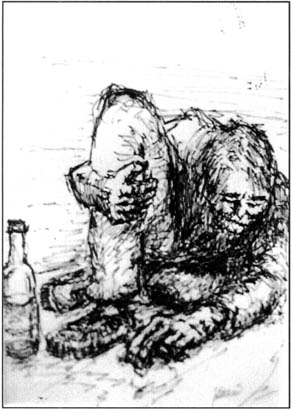
Jerry Garcia drew this picture, calling it August West,
his only piece of visual art connected to his music.
There was an historical figure in the temperance movement named Purley Baker, who headed the Anti-Saloon League for roughly two decades starting in 1903. August West continues his tale:
Everyone said
I'd come to no good
I knew I would
Pearly believed them 
Half of my life
I spent doing time for
Some other fucker's crime
Other half found me stumbling around
Drunk on burgundy wine.
They take us to the bridge, literally and figuratively, as we hear the old man recount his story. To me it is the story of his survival in the face of his greatest enemy: self-doubt.
But I'll get back
On my feet someday
The good Lord willing
If He says I may
I know that the life I'm
Living's no good
I'll get a new start
Live the life I should
He's conquered that doubt with hope, against all odds and in the face of certain failure. His hope is his salvation, and his refrain of, "I'll get up and fly away," recalls the similarly named folk song. As with most down on their luck, his mind returns to his greatest memory - Pearly Baker - and he's convince she's been true to him. With that, the narrator is struck with his faith in his true love, turning introspective:
I got up and wandered
Wandered downtown
Nowhere to go but just to hang around
I got a girl
Named Bonny Lee
I know that girl's been true to me
I know she's been
I'm sure she's been
True to me
The old drunk's story, whether based in truth or delusion, clearly resonated with the man. Is he convincing himself of that Bonny Lee has been true? Will he call her? Go to her? Or will he get a drink instead?

BONUS: Song of the Day, Part II: "Comes a Time"

As I noted in a previous post, "Comes a Time" has long been an incredibly moving song for me. It's a relatively simple lyric, the imagery is stark and the message is moving. The chorus sums it all up:
Comes a time
When the blind man
Takes your hand
Says: Don't you see?
Gotta make it somehow
On the dreams you still belive
Don't give it up
You've got an empty cup
Only love can fill
Only love can fill
As we find in the annotated lyric, the powerful image of the blind man asking if you can see alludes to Tiresias in Sophacles's Oedipus, Dylan Thomas's poem "Was There a Time," Raymond Carver's "Cathedral," and no doubt other literary works. But it's the message of following your dreams through darkness and light that is resonant for me. A fellow traveller once told me early on my path fighting for justice that it is critical that we surround ourselves with others in the struggle because we will fail more than we succeed. We need comrades to catch us when we fall if we're to continue to fight.

The other stirring image from the song is that of the empty cup, also employed by Hunter in "Ripple." Again, we learn from the annotations that the image echoes the W.B. Yeats poem "The Empty Cup," and that the Cups in tarot signify emotions. The empty cup reference from this song is later followed by the moving lines:
You can't let go
'Cause you're afraid to fall
Till the day may come
When you can't feel at all
This song is sad and stirring, but it's not hopeless. That is why it has always been such a resonant song for me. To me, the finest versions were played later in the 70s at a much slower pace. Check out my absolute favorite from the Boston Music Hall on 6/12/76. Listen to the full jam starting with "Let It Grow" for the full effect.


*     *     *     *     *

Civic Duty: My Week as a Juror in the Philadelphia Court of Common Pleas, Part II

Calling my previous post on my experience as a juror "Part I" tied me into revisiting it before the end of the tour. My initial thought was that it was emotionally taxing being on the jury, and I wanted to sit on it for a bit, and in the back of my head I wanted to discuss it when I explored "Wharf Rat" for the Song of the Day, as it contains one of the Dead's few references to the justice system.*

Overall, the experience was emotionally exhausting. As I mentioned previously, the charges were for murder and conspiracy in what was essentially a turf war between two groups of drug-dealers. Regardless of the criminal activity that underlay the murder, listening to the details of a crime that caused a tragic loss for one family inspired self-reflection about my own life and my place on the jury. It's a tough thing to stand in judgement of another person, weighing the facts to make an incredibly serious decision, made tougher by our instructions not to discuss the trial with anyone in our lives or even with other jurors.

The attorneys were both quite good, building their respective cases around their professional strengths. The prosecutor relied on emotion and oratory, telling the story from the perspective of the killer and the aftermath from the perspective of a grieving mother. However, her delivery was occasionally choppy, a feeling we can all identify with in some way. The defense attorney questioned details and testimony, using incisive cross-examination and a conversational ease of delivery in making his case as strongly as possible. At times, he came off a bit too slick, though, in part because of his fine suit and flashy watch.** In all, both lawyers did an excellent job making their cases and carrying out their charges.

We listened to three days of testimony and closing arguments before we were left to deliberate as a jury at about 3:30 pm on Friday. We chose a jury fore-person by "consensus," however the decision was made when I was out of the room. The person who volunteered would have been the very last person I would have chosen, and upon opening the deliberation it became clear that he wasn't interested in  (or capable of) steering a healthy discussion to build consensus. However, I had already identified a number of jurors who shared many elements of my own worldview, particularly with regards to building consensus through the respectful exchange of ideas. Together, we were able to help direct the discussion and keep the foreman in check.

I'm not interested in recounting the details of the case or of the deliberations, but there were several questions about the validity of some of the evidence. The judge was clear that as jurors, we were each to weight everything we had heard and arrive at a conclusion based on her explanations of the law. There were a few jurors who were not immediately convinced of the facts, and we ended up carrying the deliberations into Monday.

The backgrounds and experiences of the various jurors played out a bit in the discussion, and it took a bit of effort to ensure that everyone could speak their minds. As you may expect, the difference between the more aggressive members of the jury and those who were more reserved was generally found along gender, race, and class lines. In addition, the majority of jurors never questioned the testimony of police personnel and other witnesses in positions of authority in any way. Their reasoning was that they would have so much to lose if they offered misleading or limited testimony, but these jurors did not consider the manner in which the system protects those individuals, evidenced by the rarity of consequences of those with authority. Unfortunately, there is little time for consciousness-raising during a jury deliberation.

After a lengthy discussion, we arrived at a consensus, convicting the defendant on all counts. In the end, the judge came to talk with the jury and answer any questions we had. Apparently, the topics of our discussion were hotly contested before the trial, as well. We also learned that there were a number of defense witnesses that did not answer their court summonses, not surprising in a neighborhood drug case. In the end, it was an instructive experience, and I'm glad I won't have to sit on another jury for several years.

Here are a few more lingering thoughts before I put this one to bed:
  • When you're given the opportunity to choose your own authority figure, it's best not to choose the old white dude - and that applies to me as well.
  • If you're ever in a situation where someone in authority is not carrying out his/her responsibilities, your best bet is to identify allies and take control of the situation. Don't ask for permission, just do what needs to be done. There is strength in numbers, and allies allow any negative reaction to be more easily deflected and redirected.
  • I don't believe it's any coincidence that we were left to deliberate with an hour left in the work week. Everyone in that room had their own work to tend to, and a conviction is more likely with a quick deliberation. With a consensus decision as important as this, it's critical that everyone involved arrives at a conclusion they can live with. The defendant more than anyone deserves the benefit of a complete deliberation.
  • At the end of the day, if you weren't there you don't know what happened. Depending on who or what they believe, the jurors could have come to any of a number of different 
  • Upon serious reflection over time, I have concerns about a legal system that allows confessions to be used in court. Despite the legal protections in place, there is a basic imbalance of power in any interrogation. Interrogation techniques are aimed towards getting a specific answer, not finding the truth.
  • I believe the verdict in this case really only affected one man - the defendant - and his family. To some extent, I could see it as a relief for the family of the deceased, but ultimately nothing will change in the neighborhood. The drugs are still being sold, and for all I know there are still murders happening between these same two crews. None of that would be affected by the outcome of this trial.
  • I can't say enough about the staff in the courtroom. They listen to all the details we heard as jurors, plus more information that isn't part of the testimony. This courtroom only hears homicide cases, and as emotionally draining an experience as it was for a week of my life, I can only image what it must be like when that is your entire work life. It take a certain type of person who can leave the work at work and come back every day.
  • I look forward to staying in touch with several other jurors I got to know through the trial. It's always great to meet interesting, good-hearted people who love Philadelphia like I do.

- Morning Brewer


PS (Pairing Suggestion): 

Where the pale ale was favored by the upper classes of English society, the porter was historically the beer of the English working class, favored by laborers after a day of their toils. It was the precursor to the stout, and today there are several distinct sub-categories. All are some grade of dark in color, featuring some degree of roasty flavor and an overall malty profile. However, the style (particularly the American versions) may feature quite a bit of hop bitterness and flavor, but all are build upon a malty foundation. Outside of the States, brewers are far less likely to attempt to define the line between a porter and a stout, but it's often recognized as a degree of roastiness and/or color, with porter usually showing some ruby or garnet highlights against the light. However, a range of these qualities appear within the style, as well.

The least dark sub-category is the brown porter, which may be quite dark indeed, but it always falls shy of black. It is malty and often displays some degree of roast with a moderate body and restrained hops. Relatively few American versions are produced, but be sure to check out the London porter from Fuller's and the Taddy porter from Samuel Smith's, both fine examples that are readily available. The Steelhead from Mad River is a notable American version. Pair any (or all) with a shepherd's pie for a hearty meal.

The robust porter is just that, flavorful and moderately full-bodied. Again there's plenty of malt, particularly roasted malt, that contribute a sweetness behind a strong chocolatey flavors. There may be quite a bit of bitterness from hops, but also benefitting from acrid qualities of roasted malts. Most American porters fall into this category, so some may be quite hoppy (and pretty strong). There are plenty of fantastic examples, but the benchmark for me is the Walker's Reserve from Firestone Walker, a heady brew to be sure!! If you've never had it and like porters even a little bit, track this amazing beer down. Some of my other favorites are the Black Butte porter from Deschutes, the porter from Anchor Brewing, the porter from Bell's, and the Edmund Fitzgerald out of Cleveland's Great Lakes B.C. For a different (and fantastic) take on this style, try the smoked versions from Stone or Alaskan Brewing or the vanilla porter from Breckenridge; they're all delicious!! I could drink these beers all night, but to me they go really well with a bacon cheeseburger.

Finally, the Baltic porter is quite similar in history to the Russian imperial stout, as the English style drifted eastward, gaining strength, body, and flavor along the way! While often quite dark, this beer is rarely (if ever) truly black. It is often brewed with lager yeast, and in that respect it can be compared to a strong version of a schwartzbier. These beers occasionally flirt with 10% ABV, but they most commonly fall in the 7-8% range. The BJCP succinctly summarizes the style:
A Baltic Porter often has the malt flavors reminiscent of an English brown porter and the restrained roast of a schwartzbier, but with a  higher OG*** and and alcohol content than either. Very complex, with multi-layered flavors.
For excellent Baltic examples, check out the Finnish Sinebrychoff, the Polish Okocim, or the Russian Baltika #6. American interpretations are often "imperial porters" (supercharged robust porters), but a couple I've enjoyed are the Gonzo from Flying Dog, Victory's Baltic Thunder, or the fantastic version from the dark-beer experts at Duck Rabbit. Worth noting is the uncharacteristically mild Carnegie from Carlsburg, Sweden, that clocks in at 5.5% ABV. Try pairing the strong, clean versions with a fruit sorbet or gelato, but for the giant American versions I suggest a spicy curry.

Again, I will be serving a delicious London porter in honor of the Lyceum shows at my party tomorrow. Hope to enjoy a pint with you!!


---------------------------------


I can think of the jail break in "Jack Straw," getting busted by the heat in "The Other One," and the New Orleans references in "Truckin'" as other justice-system references. If you can think of any more, please leave them in the comments section below.
** After the trial was over, we learned from the judge that the defense attorney had previously been a judge and that he had taken the case on a pro bono basis.
*** OG = original gravity, or density, i.e., more sugars before fermentation

Thursday, May 24, 2012

5/24/72 Strand Lyceum: "Sugar Magnolia," MLB, and the ESB


When: Wednesday, May 24, 1972
Where: Lyceum Theatre, London, England
Setlist: (In order of the released CDs, stream the show from dead.net here)
  1. Cold Rain & Snow, Beat It On Down The Line, Mr. Charlie, Deal, Me & My Uncle, Hurts Me Too^, Dire Wolf, Black-Throated Wind, Chinatown Shuffle, China Cat Sunflower > I Know You Rider, Playing In The Band, You Win Again^, Jack Straw, Casey Jones
  2. Rockin' Pneumonia & The Boogie Woogie Flu, Mexicali Blues, Black Peter, Truckin' > Drums > The Other One > Sing Me Back Home > Sugar Magnolia > Turn On Your Lovelight > The Stranger (Two Souls In Communion)  E: One More Saturday Night
As always, my personal highlights are bolded.
^ Appears on Europe '72; final version of "Hurts Me Too" and final Pigpen performance of "Lovelight"

Is that a fish-lens effect, or is it the Dead?
Stellar recordings of this blistering show have been in wide circulation for many years, making it a Europe favorite of many Deadheads.* The performance is above average from start to finish, reaching incredible heights at times. Truly a show for the ages! In the liner notes, we learn from attendee Chris Jones that in 1972 the Lyceum was a ballroom, not the theatre arrangement we see in the photo to the left. He also reminds me that the New Riders of the Purple Sage opened these shows

The "Cold Rain & Snow" (just the second on the tour) that opens the show as a rarity, is very well played, with stellar lead play and vocals from Jerry. We're clearly off to a special start tonight, folks!! A few songs later, "Me & My Uncle" scorches from start to finish, with great drums, bass, guitars, and piano. Yes, that's everyone. This is yet another fantastic version of "Playin'" that stretches a bit longer than most on the tour. The jamming is excellent and weird throughout, and you can tell we're in for a treat for set two!

And what a treat it is! The "Rockin' Pneumonia" that opens the second set is very good and a bit smoother than the one the previous night. It's great to hear the band having so much fun up there!! The "Black Peter that follows is the first for the tour (and first for the whole year, in fact), and it is incredible. This Jerry ballad that has really grown on me over the years for its lyrical strength, and I wish I could have featured it in Song of the Day. It's a story of a coal miner dying of black lung disease, and there is wisdom in the koan-like lines, "It seems like everything, leads up to this day / And it's just like every other day, that's ever been." Well, this version is a magnificent, stand-alone performance that really shakes the soul, another example of the Dead taking advantage of their Lyceum residency to explore some songs they haven't played much (if at all) on the tour so far.

The rest of the set is absolutely epic. "Truckin'" is a hot start, even with a flubbed lyric from Bobby, and the jam is as they all are on this tour - stellar!! We're then treated to one of Billy's best solos of the tour, which Phil caps off by ripping the roll into "The Other One." What this segue lacks in tone and delivery, it makes up for in volume!! The jam that follows is everything you want from "The Other One," pure energy and chaos!! The spacey section in the second half features one of the most remarkable guitar screams I've ever heard from Garcia, fanning away at the strings while toeing the wah to create a blood-curdling effect. Amazing!! I'm not going to get into too much detail, but this is one of the finest jams of the tour, and that's saying a lot!! They cap it off with another spectacular version of "Sing Me Back Home," making me wonder what ever happened to this song after 1972? It's moving and interesting, and it fits the death-ballad spot that tends to cap off these epic jams to complete the psychedelic life cycle.

The "Sugar Mags" is a great rockin' version, well worth a listen - and not just for bridging the gap to the Pigpen portion of the set. And what a healthy portion it is!! Diving right into a raging "Lovelight" gets it off to a great start, with Phil and Jerry dueling and Bobby doing a great job keeping up with the extremely rapid pace. Pigpen finds some new and interesting raps ("I know you got it, I've been in your door before," "You took your love, and you left my door," etc.) we're also treated to a very brief "Caution" tease with an ominous howl of "All you need...." It's just a tease, and Pig and the band all finish the song strongly, falling directly into a particularly measured version of "The Stranger." Pigpen provides some of his own accompaniment with a soulful whirring of the organ to go with his sorrowful vocal delivery. Jerry's solo is less angry screaming than pensive and sad on this night, but it nails the whole feel of the song. It's amazing how varied the delivery of this song was considering how few versions we have to enjoy. Pigpen gets all worked up into an angry, howling mess in the final vocals. What a fantastic song to close out a fantastic set!!


Worth mentioning:
  • "BIODTL" is a bit on the slow side, but very well played.
  • Another fantastic "Mr. Charlie," get it while you can. So sad that there are so few left....
  • "Deal" is a played in measured tempo, and you can tell from the vocals that Jerry is totally dialed in tonight!! According to Bobby, this rendition is "respectfully dedicated to the memory of Reverend Gary Davis," the legendary bluesman who died several weeks before. Davis was born in 1896 in South Carolina and lost his sight as an infant. Singing and playing ragtime, blues, and gospel songs, he developed a finger-picking guitar style that was hugely influential on American music, including the Grateful Dead. He died on May 5th in Hammonton, New Jersey at the age of 76.
  • Seeing as this is the "Hurts Me Too" from the record, it's a highlight. Same goes for "You Win Again."
  • I can't remember where, but I think there was a "White Rabbit" tease somewhere in the first set.
  • This is a very hot version of "Mexicali Blues," but again I don't want to highlight an entire set. Short straw, sorry.
  • Following "Black Peter" there is a well-formed "Beer Barrel Polka" tuning that Jerry tries to segue directly into "Truckin'." Unfortunately, the rest of the band doesn't jump on it with him.
  • Bobby dedicates the "Saturday Night" encore to "the key of C." What a showstopper, can't wait for tomorrow night!!

Song of the Day: "Sugar Magnolia"

This classic rock song became a show-stopper and Deadhead euphemism for "the woman of my dreams." It's a simple, adoring lyric is filled with blooming blossoms, color, sunlight, and a river. The opening chords are as characteristic as the opening notes of "Truckin'" (both appeared on American Beauty), but this one came to signal the last chance to really shake your tail feathers before the end of the night.

David Dodd points out in the annotations that this song is deeply rooted in American music, not surprisingly for a Hunter classic. The magnolia tree is native to the Americas (and Asia), showcasing fragrant white and purple/pink flowers signalling the beginning of spring. I first came to admire them while living in New Orleans (there was one in the lot behind my apartment), and here in Philly one of my favorite spring gardens features several magnificent trees. The opening verse, much like "Playin'" and other care-free songs of this era, celebrates the pleasures of a careless life:
Sugar Magnolia blossom's blooming
Head's all empty and I don't care
Saw my baby down by the river
Knew she'd have to come up soon for air
From there, the narrator takes us under the willow, where he begs his lover, "We can have high times if you'll abide." Ladies and gentlemen, that is how you "discover the wonders of nature." The annotations make comparison to the nymph-like creature Goldberry from J.R.R. Tolkien's epic trilogy, particularly for the "rolling in the rushes" line at the end of the second verse.

The woman who is the subject of this song fills all the narrator's needs, desires and wishes, by driving when he's too blitzed to see straight, paying his speeding tickets,** diligently waiting backstage, and dancing the zydeco. But it's the sensory descriptors that paint an emotional sketch that is as much about the feeling behind the love as it is about the person so cherished.

In Phil Lesh's autobiography Searching for the Sound, he describes that Bobby adding the line "jumps like a Willys in four-wheel drive" was the last straw for Hunter's songwriting partnership with him. When i first heard the song, I was always puzzled by that line until my mom explained it's basically a Jeep.

The finale of the song is "Sunshine Daydream," little more than a refrain of supplication that the band played with over the years. At first, it was played straight, but by the mid-'70s each line was preceded by a single beat before jumping into the final rage. As Dodd explains in his published version of the annotations,
The space between these parts ["Sugar Mags" and "Sunshine Daydream"] could be as brief as the space of several beats; could frame a set, as in the closing of Winterland [on 12/31/78]; or could be as long as a week, the case of the performance occurring in the week of Bill Graham's death, on October 25, 1991, when "Sunshine Daydream" came during the Polo Field concert in Golden Gate Park a week after the band opened a show with  "Sugar Magnolia" (Graham's favorite Grateful Dead song) at the Oalkand Coliseum Arena.
However they were arranged, the two are clearly born of the same kernel of inspiration. Hearing them, while at times a bit wearisome, never fails to bring a smile to my face, even on the toughest of days.

*     *     *     *     *

One More Trip Around the Bases

I know I did a sports post yesterday, but I want to get one more baseball post in before the tour ends.
  • I was watching MLB network late on the night of 5/18, the night Justin Verlander got 25 outs without surrendering a hit. He had called into the broadcast earlier, and I caught the replay of his phenomenal interview. The retired players asked him to walk them through specific at-bats (including the one that resulted in a hit), and it was incredible to hear his thought process and his reflections on execution. He described how he got one slider to break at 50 feet ("a 50-footer"), and the next pitch - also a slider - was a 55-footer. What incredible control to be able to execute those similar but subtly distinct pitches, and what a nightmare to try to hit either of those pitches, let alone back-to-back. Doc Halladay - another master pitcher at the height of his powers - doesn't talk in such detail (though I'm sure he's thinking the same thing), and it goes to show what a special modern, professional athlete Verlander is. When asked when he started thinking he had a chance for another no-no, he interrupted the question to interject, "The third inning." WOW!! That dude's got brass... and brash! On top of all that, he said he had started to get a blister on his finger after his last start, so he changed his grib a bit. I guess it worked!! No one is supposed to mention the possibility of a no-no when it's working, but apparently Verlander can tell you all about it once it's through!!! Two more outs without a hit, and Verlander would have joined a very small club (of six) of pitchers to throw at least three no-hitters in a career. Hats off to you, JV! After watching those highlights and listening to his thoughts, I think he's got at least one left in that unbelievable right arm....
  • The Phillies were starting to put it together, winning six straight recently behind major contributions from Cole Hamels and surprisingly Joe Blanton. However, it turns out they were just playing the Padres, the Astros, and the Cubs. The Nationals have their number, taking six of their last eight games.
  • Long-suffering Cliff Lee has a jaw-dropping 0.76 WHIP and an 0-1 record to show for it. No worries, Cliff, we know you're killing it!
  • Phillies catcher Carlos "Chooch"* Ruiz has been raking, hitting right around .348, moving up from hitting seventh to sixth, arriving at fifth on 5/14. In his first four games in the five-hole, he was 10-for-15 with 7 RBI and 5 runs. Not bad for a defensive catcher. (Of course, he went hitless until they moved him to the 4-hole last night, when he went 3-for-4.)
  • When it became clear that Chase Utley was going to miss a chunk of time for the Phillies, the concern was whether Freddy Galvis could hit well enough to not sink the team. He's only hitting .235 overall, but in May he's hitting a serviceable .279 with2 HR, 12 RBI and slugging .810. Pretty good for a defensive rookie who's not quite ready for the bigs!!
  • The defending world-champion Cardinals were killing it for a stretch, but after slowing down a bit they're looking mortal. Good thing, because when you lose your best player to free agency and one of your top pitchers to injury you should really struggle a bit. Good team, though; keep an eye on them!
  • I see the NL Central coming down to a dogfight between the Reds and the Cardinals. Both teams are built to win now and playing solid baseball.
  • Reds pitcher Aroldis Chapman is pitching phenomenally. He breaks the 100-MPH barrier regularly, but the really impressive thing is the movement he milks out of it. They're handling him with kid gloves, pitching once or twice a week, but he's got the goods, folks.
  • Speaking of coming down to earth, Matt Kemp slowed before heading to the DL for a bit, and the Dodgers slowed with him. That's why you build a big lead, especially in a winnable division. Don't freak out yet, Giants fans; it's early, yet.
  • The AL East looks upside-down, with the Orioles and Rays at the top and the Red Sox and Yankees at the bottom. Crazy....
  • Despite captain Derek Jeter hitting like a younger version of himself, the Yankees are struggling big time. They lost 6-0 to the Royals earlier this week. Ouch!
- Morning Brewer


PS (Pairing Suggestion): 

Today's beer is the extra special bitter, or ESB, a stronger version of the typical London session ale, the bitter. In general it is a bit on the malty side with ample hops to balance the flavor, and because of it's strength (5-6% ABV or more), a bit of the alcohol flavor is commonly present. English versions will feature a toasty malt profile and an Anglo hop balance, often from Goldings or Fuggles hops. In geeky beerbars in the states, you will often find these ales served traditionally from casks that are hand-pumped or gravity poured from a "firkin" resting on the bar. Cask-conditioned ales are naturally carbonated by being sealed before fermentation is complete. As the yeast completes its charge, the carbon dioxide byproduct has nowhere to go but into solution as the pressure builds. This is an example of what English beer geeks call "real ale," as opposed to the commercial (or American) practice of forced-carbonating the beer with pressurized carbon dioxide gas. To experience a traditional English version, try one of these fantastic brews, either in the bottle or on cask: Fullers is the gold standard, Wells Bombardier and Hobgoblin are closely tied for second, and Young's Special London Ale is also quite special. Export versions you can find in the States are typically different from the traditional versions in England, which tend to be a bit stronger and more malty. When in England, be sure to sample a wide variety for comparison!!

American-brewed versions are about the same strength or stronger. The malt profile will commonly leave the toasty, English corner to venture towards the caramel end of the spectrum, and it's more common for these styles to utilize American hops like Cascade or the like, alone or in combination with English hops. Here are a few respectable examples produced in the U.S.: even though they are now owned by a mega-brewery, Redhook makes the version that first turned me onto the style***, but be sure to check out Sawtooth from Colorado's Left Hand Brewing Company and Boont from Anderson Valley Brewing in California. A big shout-out to southeast Pennsylvania's own Scarlet Lady from Stoudt's and the Extra Special Ale from Yards.


The ESB is today's pairing suggestion because it's one of London's typical styles, but it's also one of the fantastic brews that will be on tap for Saturday's party. I've conditioned the brew in the keg, but it'll be pushed through the tap and into your glass with carbon dioxide because I don't have a hand pump or a proper firkin. Pair this one withe BBQ baked beans we'll be serving at the party.


---------------------------------


* Interestingly, this show is missing from the Deadhead's Taping Compendium, Vol. 1, which I can only guess was an inadvertent error. Ouch!!!
** This line ("pays my ticket when I speed") is one of the most commonly mis-heard in all of Dead-dom, mistakenly understood by some as, "bakes my chicken when I sleep."
*** It was after a crazy week on tour with SCI, and after the last show I was double-fisting a Sierra Nevada Bigfoot barleywine and a Redhook ESB. The combination was sublime!!