Showing posts with label MLB. Show all posts

Thursday, May 24, 2012

5/24/72 Strand Lyceum: "Sugar Magnolia," MLB, and the ESB


When: Wednesday, May 24, 1972
Where: Lyceum Theatre, London, England
Setlist: (In order of the released CDs, stream the show from dead.net here)
  1. Cold Rain & Snow, Beat It On Down The Line, Mr. Charlie, Deal, Me & My Uncle, Hurts Me Too^, Dire Wolf, Black-Throated Wind, Chinatown Shuffle, China Cat Sunflower > I Know You Rider, Playing In The Band, You Win Again^, Jack Straw, Casey Jones
  2. Rockin' Pneumonia & The Boogie Woogie Flu, Mexicali Blues, Black Peter, Truckin' > Drums > The Other One > Sing Me Back Home > Sugar Magnolia > Turn On Your Lovelight > The Stranger (Two Souls In Communion)  E: One More Saturday Night
As always, my personal highlights are bolded.
^ Appears on Europe '72; final version of "Hurts Me Too" and final Pigpen performance of "Lovelight"

Is that a fish-lens effect, or is it the Dead?
Stellar recordings of this blistering show have been in wide circulation for many years, making it a Europe favorite of many Deadheads.* The performance is above average from start to finish, reaching incredible heights at times. Truly a show for the ages! In the liner notes, we learn from attendee Chris Jones that in 1972 the Lyceum was a ballroom, not the theatre arrangement we see in the photo to the left. He also reminds me that the New Riders of the Purple Sage opened these shows

The "Cold Rain & Snow" (just the second on the tour) that opens the show as a rarity, is very well played, with stellar lead play and vocals from Jerry. We're clearly off to a special start tonight, folks!! A few songs later, "Me & My Uncle" scorches from start to finish, with great drums, bass, guitars, and piano. Yes, that's everyone. This is yet another fantastic version of "Playin'" that stretches a bit longer than most on the tour. The jamming is excellent and weird throughout, and you can tell we're in for a treat for set two!

And what a treat it is! The "Rockin' Pneumonia" that opens the second set is very good and a bit smoother than the one the previous night. It's great to hear the band having so much fun up there!! The "Black Peter that follows is the first for the tour (and first for the whole year, in fact), and it is incredible. This Jerry ballad that has really grown on me over the years for its lyrical strength, and I wish I could have featured it in Song of the Day. It's a story of a coal miner dying of black lung disease, and there is wisdom in the koan-like lines, "It seems like everything, leads up to this day / And it's just like every other day, that's ever been." Well, this version is a magnificent, stand-alone performance that really shakes the soul, another example of the Dead taking advantage of their Lyceum residency to explore some songs they haven't played much (if at all) on the tour so far.

The rest of the set is absolutely epic. "Truckin'" is a hot start, even with a flubbed lyric from Bobby, and the jam is as they all are on this tour - stellar!! We're then treated to one of Billy's best solos of the tour, which Phil caps off by ripping the roll into "The Other One." What this segue lacks in tone and delivery, it makes up for in volume!! The jam that follows is everything you want from "The Other One," pure energy and chaos!! The spacey section in the second half features one of the most remarkable guitar screams I've ever heard from Garcia, fanning away at the strings while toeing the wah to create a blood-curdling effect. Amazing!! I'm not going to get into too much detail, but this is one of the finest jams of the tour, and that's saying a lot!! They cap it off with another spectacular version of "Sing Me Back Home," making me wonder what ever happened to this song after 1972? It's moving and interesting, and it fits the death-ballad spot that tends to cap off these epic jams to complete the psychedelic life cycle.

The "Sugar Mags" is a great rockin' version, well worth a listen - and not just for bridging the gap to the Pigpen portion of the set. And what a healthy portion it is!! Diving right into a raging "Lovelight" gets it off to a great start, with Phil and Jerry dueling and Bobby doing a great job keeping up with the extremely rapid pace. Pigpen finds some new and interesting raps ("I know you got it, I've been in your door before," "You took your love, and you left my door," etc.) we're also treated to a very brief "Caution" tease with an ominous howl of "All you need...." It's just a tease, and Pig and the band all finish the song strongly, falling directly into a particularly measured version of "The Stranger." Pigpen provides some of his own accompaniment with a soulful whirring of the organ to go with his sorrowful vocal delivery. Jerry's solo is less angry screaming than pensive and sad on this night, but it nails the whole feel of the song. It's amazing how varied the delivery of this song was considering how few versions we have to enjoy. Pigpen gets all worked up into an angry, howling mess in the final vocals. What a fantastic song to close out a fantastic set!!


Worth mentioning:
  • "BIODTL" is a bit on the slow side, but very well played.
  • Another fantastic "Mr. Charlie," get it while you can. So sad that there are so few left....
  • "Deal" is a played in measured tempo, and you can tell from the vocals that Jerry is totally dialed in tonight!! According to Bobby, this rendition is "respectfully dedicated to the memory of Reverend Gary Davis," the legendary bluesman who died several weeks before. Davis was born in 1896 in South Carolina and lost his sight as an infant. Singing and playing ragtime, blues, and gospel songs, he developed a finger-picking guitar style that was hugely influential on American music, including the Grateful Dead. He died on May 5th in Hammonton, New Jersey at the age of 76.
  • Seeing as this is the "Hurts Me Too" from the record, it's a highlight. Same goes for "You Win Again."
  • I can't remember where, but I think there was a "White Rabbit" tease somewhere in the first set.
  • This is a very hot version of "Mexicali Blues," but again I don't want to highlight an entire set. Short straw, sorry.
  • Following "Black Peter" there is a well-formed "Beer Barrel Polka" tuning that Jerry tries to segue directly into "Truckin'." Unfortunately, the rest of the band doesn't jump on it with him.
  • Bobby dedicates the "Saturday Night" encore to "the key of C." What a showstopper, can't wait for tomorrow night!!

Song of the Day: "Sugar Magnolia"

This classic rock song became a show-stopper and Deadhead euphemism for "the woman of my dreams." It's a simple, adoring lyric is filled with blooming blossoms, color, sunlight, and a river. The opening chords are as characteristic as the opening notes of "Truckin'" (both appeared on American Beauty), but this one came to signal the last chance to really shake your tail feathers before the end of the night.

David Dodd points out in the annotations that this song is deeply rooted in American music, not surprisingly for a Hunter classic. The magnolia tree is native to the Americas (and Asia), showcasing fragrant white and purple/pink flowers signalling the beginning of spring. I first came to admire them while living in New Orleans (there was one in the lot behind my apartment), and here in Philly one of my favorite spring gardens features several magnificent trees. The opening verse, much like "Playin'" and other care-free songs of this era, celebrates the pleasures of a careless life:
Sugar Magnolia blossom's blooming
Head's all empty and I don't care
Saw my baby down by the river
Knew she'd have to come up soon for air
From there, the narrator takes us under the willow, where he begs his lover, "We can have high times if you'll abide." Ladies and gentlemen, that is how you "discover the wonders of nature." The annotations make comparison to the nymph-like creature Goldberry from J.R.R. Tolkien's epic trilogy, particularly for the "rolling in the rushes" line at the end of the second verse.

The woman who is the subject of this song fills all the narrator's needs, desires and wishes, by driving when he's too blitzed to see straight, paying his speeding tickets,** diligently waiting backstage, and dancing the zydeco. But it's the sensory descriptors that paint an emotional sketch that is as much about the feeling behind the love as it is about the person so cherished.

In Phil Lesh's autobiography Searching for the Sound, he describes that Bobby adding the line "jumps like a Willys in four-wheel drive" was the last straw for Hunter's songwriting partnership with him. When i first heard the song, I was always puzzled by that line until my mom explained it's basically a Jeep.

The finale of the song is "Sunshine Daydream," little more than a refrain of supplication that the band played with over the years. At first, it was played straight, but by the mid-'70s each line was preceded by a single beat before jumping into the final rage. As Dodd explains in his published version of the annotations,
The space between these parts ["Sugar Mags" and "Sunshine Daydream"] could be as brief as the space of several beats; could frame a set, as in the closing of Winterland [on 12/31/78]; or could be as long as a week, the case of the performance occurring in the week of Bill Graham's death, on October 25, 1991, when "Sunshine Daydream" came during the Polo Field concert in Golden Gate Park a week after the band opened a show with  "Sugar Magnolia" (Graham's favorite Grateful Dead song) at the Oalkand Coliseum Arena.
However they were arranged, the two are clearly born of the same kernel of inspiration. Hearing them, while at times a bit wearisome, never fails to bring a smile to my face, even on the toughest of days.

*     *     *     *     *

One More Trip Around the Bases

I know I did a sports post yesterday, but I want to get one more baseball post in before the tour ends.
  • I was watching MLB network late on the night of 5/18, the night Justin Verlander got 25 outs without surrendering a hit. He had called into the broadcast earlier, and I caught the replay of his phenomenal interview. The retired players asked him to walk them through specific at-bats (including the one that resulted in a hit), and it was incredible to hear his thought process and his reflections on execution. He described how he got one slider to break at 50 feet ("a 50-footer"), and the next pitch - also a slider - was a 55-footer. What incredible control to be able to execute those similar but subtly distinct pitches, and what a nightmare to try to hit either of those pitches, let alone back-to-back. Doc Halladay - another master pitcher at the height of his powers - doesn't talk in such detail (though I'm sure he's thinking the same thing), and it goes to show what a special modern, professional athlete Verlander is. When asked when he started thinking he had a chance for another no-no, he interrupted the question to interject, "The third inning." WOW!! That dude's got brass... and brash! On top of all that, he said he had started to get a blister on his finger after his last start, so he changed his grib a bit. I guess it worked!! No one is supposed to mention the possibility of a no-no when it's working, but apparently Verlander can tell you all about it once it's through!!! Two more outs without a hit, and Verlander would have joined a very small club (of six) of pitchers to throw at least three no-hitters in a career. Hats off to you, JV! After watching those highlights and listening to his thoughts, I think he's got at least one left in that unbelievable right arm....
  • The Phillies were starting to put it together, winning six straight recently behind major contributions from Cole Hamels and surprisingly Joe Blanton. However, it turns out they were just playing the Padres, the Astros, and the Cubs. The Nationals have their number, taking six of their last eight games.
  • Long-suffering Cliff Lee has a jaw-dropping 0.76 WHIP and an 0-1 record to show for it. No worries, Cliff, we know you're killing it!
  • Phillies catcher Carlos "Chooch"* Ruiz has been raking, hitting right around .348, moving up from hitting seventh to sixth, arriving at fifth on 5/14. In his first four games in the five-hole, he was 10-for-15 with 7 RBI and 5 runs. Not bad for a defensive catcher. (Of course, he went hitless until they moved him to the 4-hole last night, when he went 3-for-4.)
  • When it became clear that Chase Utley was going to miss a chunk of time for the Phillies, the concern was whether Freddy Galvis could hit well enough to not sink the team. He's only hitting .235 overall, but in May he's hitting a serviceable .279 with2 HR, 12 RBI and slugging .810. Pretty good for a defensive rookie who's not quite ready for the bigs!!
  • The defending world-champion Cardinals were killing it for a stretch, but after slowing down a bit they're looking mortal. Good thing, because when you lose your best player to free agency and one of your top pitchers to injury you should really struggle a bit. Good team, though; keep an eye on them!
  • I see the NL Central coming down to a dogfight between the Reds and the Cardinals. Both teams are built to win now and playing solid baseball.
  • Reds pitcher Aroldis Chapman is pitching phenomenally. He breaks the 100-MPH barrier regularly, but the really impressive thing is the movement he milks out of it. They're handling him with kid gloves, pitching once or twice a week, but he's got the goods, folks.
  • Speaking of coming down to earth, Matt Kemp slowed before heading to the DL for a bit, and the Dodgers slowed with him. That's why you build a big lead, especially in a winnable division. Don't freak out yet, Giants fans; it's early, yet.
  • The AL East looks upside-down, with the Orioles and Rays at the top and the Red Sox and Yankees at the bottom. Crazy....
  • Despite captain Derek Jeter hitting like a younger version of himself, the Yankees are struggling big time. They lost 6-0 to the Royals earlier this week. Ouch!
- Morning Brewer


PS (Pairing Suggestion): 

Today's beer is the extra special bitter, or ESB, a stronger version of the typical London session ale, the bitter. In general it is a bit on the malty side with ample hops to balance the flavor, and because of it's strength (5-6% ABV or more), a bit of the alcohol flavor is commonly present. English versions will feature a toasty malt profile and an Anglo hop balance, often from Goldings or Fuggles hops. In geeky beerbars in the states, you will often find these ales served traditionally from casks that are hand-pumped or gravity poured from a "firkin" resting on the bar. Cask-conditioned ales are naturally carbonated by being sealed before fermentation is complete. As the yeast completes its charge, the carbon dioxide byproduct has nowhere to go but into solution as the pressure builds. This is an example of what English beer geeks call "real ale," as opposed to the commercial (or American) practice of forced-carbonating the beer with pressurized carbon dioxide gas. To experience a traditional English version, try one of these fantastic brews, either in the bottle or on cask: Fullers is the gold standard, Wells Bombardier and Hobgoblin are closely tied for second, and Young's Special London Ale is also quite special. Export versions you can find in the States are typically different from the traditional versions in England, which tend to be a bit stronger and more malty. When in England, be sure to sample a wide variety for comparison!!

American-brewed versions are about the same strength or stronger. The malt profile will commonly leave the toasty, English corner to venture towards the caramel end of the spectrum, and it's more common for these styles to utilize American hops like Cascade or the like, alone or in combination with English hops. Here are a few respectable examples produced in the U.S.: even though they are now owned by a mega-brewery, Redhook makes the version that first turned me onto the style***, but be sure to check out Sawtooth from Colorado's Left Hand Brewing Company and Boont from Anderson Valley Brewing in California. A big shout-out to southeast Pennsylvania's own Scarlet Lady from Stoudt's and the Extra Special Ale from Yards.


The ESB is today's pairing suggestion because it's one of London's typical styles, but it's also one of the fantastic brews that will be on tap for Saturday's party. I've conditioned the brew in the keg, but it'll be pushed through the tap and into your glass with carbon dioxide because I don't have a hand pump or a proper firkin. Pair this one withe BBQ baked beans we'll be serving at the party.


---------------------------------


* Interestingly, this show is missing from the Deadhead's Taping Compendium, Vol. 1, which I can only guess was an inadvertent error. Ouch!!!
** This line ("pays my ticket when I speed") is one of the most commonly mis-heard in all of Dead-dom, mistakenly understood by some as, "bakes my chicken when I sleep."
*** It was after a crazy week on tour with SCI, and after the last show I was double-fisting a Sierra Nevada Bigfoot barleywine and a Redhook ESB. The combination was sublime!!

Saturday, April 21, 2012

4/21/72 Beat-Club: "Playin'" Baseball, Drinkin' Kölsch

When: Friday, April 21, 1972
Where: Beat-Club, Bremen, West Germany
Setlist: (In order of the released CDs, can't find an AUD stream, but looks like you can get the .shn files here. I linked to the songs that were broadcast below.)
  1. Bertha, Playing In The Band, Mr. Charlie, Sugaree, One More Saturday Night, Playing In The Band, Beat It On Down The Line, Truckin > Drums > The Other One
As always, personal highlights are bolded.

This 80-minute set was recorded for the German rock 'n' roll TV show Beat-Club, which aired one or two songs from the set just after the Europe tour ended. The fact that the Dead played an entire set indicates to me that they were thinking, "If we're going to make the trip all the way to Bremen, and the crew is going to set up all our equipment, we're going to give them a show so they feel like it was worth the effort!!" The result is a compact set with vast exploration in more than a few parts, and the nearly unheard-of mulligans and a total repeat. Like a studio session, but different. Way different!

At the Beat-Club in Bremen, 4/21/72.
The "Bertha" is very strong, despite Jerry missing on a few vocal lines. "Mr. Charlie" is as good as it gets, and the "Sugaree" is succinct and inspired. It better be: Jerry has to start over after someone plays the wrong changes! Then comes a second version of "Playin'" that Bobby takes issue with, introducing it as a "600,000-watt, clear-channel voice of treason." When he opens the lyric with, "Some folks trust in treason," it's too much for someone (I'm guessing Jerry), and they end up taking another mulligan.*

They end up re-starting the "Truckin'" as well because Bobby can't remember the words (surprise!), but Jerry leads us in an incredible instrumental section that falls into a quite interesting and energetic jam. Billy treats us to a quick drum break, and then the goods get delivered, courtesy of Mr. Philip Lesh. He drops the intro like a ton of bricks and proceeds to juggle the lead in perfect counterpoint to Jerry. This one is FAST for about five minutes until the jamming eases up long enough for Bobby to squeeze in the first verse. About 12 minutes out of "Drums," the band is exploring the mellow hinterlands of jam, bringing it back for a hard-rockin' jam with scorching leads from Jerry and power-chord bombs from Phil. Several minutes later, we get the ethereal release, and eventually a melody emerges. They play around with it as if to consider another song ("Uncle John's Band?" "Wharf Rat?" "Sugar Mags?"), but alas they are out of time. They stop playing for a few seconds before returning to their instruments for a cacophonous farewell to the studio in Bremen, surely leaving the recording techs scratching their heads, wondering what these Americans were up to, exactly. Surely they couldn't really believe we could air any of that rambling rubbish!

Worth mentioning:
  • There was no audience at this performance, only the recording studio employees. Considering the band's track record in the studio, they must have brought a bottle of magic for this performance. 
  • Either that, or their nearly 40-person entourage made it feel like they had an audience....
  • Or both.

Song of the Day: "Playin' In The Band"

"Playin'" grew out of the instrumental exploration aptly called "The Main Ten" for its unusual time signature. Only played five times over twelve months starting on November 8, 1969, "The Main Ten" emerged as a minimally structured theme squeezed into a larger jam that usually grew out of a song like "Uncle John's Band," "Good Lovin'," or "Dark Star." It was a part of Mickey Hart's album Rolling Thunder, released while the Dead were on tour in Europe.

Starting in early 1971, Robert Hunter's lyrics were added to the Weir/Hart collaboration, and "Playing In The Band" was released in September of that year on the live record Skull & Roses (aka Skullfuck).** This version is played "straight" despite the unusual beat, with a very restrained instrumental break. It was almost like they were trying to stretch the confines of commercially palatable song structure, but at just over four-and-a-half minutes it was Dead on arrival. Within a few months of the debut of "Playin'," the band routinely pushed the instrumental section well beyond even the initial, amorphous theme of "The Main Ten" into the depths of space.

The song itself has an ethereal quality, in part due to the continuous, recursive beat in an unusual time signature, typical of Bobby and Mickey. At times the emphasis is on the halting quality of the ten-beat, but at other times the emphasis makes it sound more like a waltz, and at still other times it is closer to a rock 'n' roll standard. This song works because the whole band is comfortable "finding the one" when exploring odd time signatures, but it's Phil Lesh's bass that is most impressive to me. His classical and experimental background in composition comes out when playing this song, as he is able to explore the beat with the rhythm section while still providing melodic counterpoint to the lead once the jam leaves the confines of the song. It's quite an accomplishment to do all of this while never leaving the ten-beat structure. Ladies and gentlemen, the Grateful Dead!!

As the lyrics go, they mesh with the music to bring a joyous expression of youthful enthusiasm. The opening invocation can be interpreted as the Dead's commentary on the political upheaval of the late-1960s and early 1970s:
Some folks trust in reason
Others trust in might
I don't trust in nothing
But I know it come out right
With a few exceptions (like the free concert at MIT on 5/6/70 following the Kent State shootings), the Dead avoided making political statements, particularly in their early years. However, this existentialist expression should not be confused with nihilism; trusting in nothing is not the same as believing in nothing. As the verses progress, the philosophy comes more clearly into focus.
I can tell your future
Look what's in your had
But I can't stop for nothing
I'm just playing in the band
Again, it's the joy and youthful enthusiasm that shines through in this verse. Your destiny rests in the palm of your hand, and all you must do is keep doing what you love. From controlling your own destiny, the next verse describes controlling the whole word. Worrying about the details would just distract you from - you guessed it - playing in the band. Oh, and someone's got a problem with this?
If a man among you
Got no sin upon his hand
Let him cast a stone at me***
For playing in the band
In his own mind, the narrator is beyond reproach by virtue of the nifty syllogism that no one is without sin; in a land full of sinners, there is no moral high-ground from which to loft criticisms.

Taken on its own, the philosophy espoused in this lyric could be troubling: pure hedonism with a willful disregard for the tenets of morality or any semblance of duty to society or individuals. As my explorations of the "Song of the Day" throughout this tour have indicated, the larger philosophy (or philosophies) to be gleaned from the Grateful Dead's songs - and Hunter's lyrics in particular - is far more nuanced that merely that.

I interpret this as a snapshot of a moment of excitement and freedom I remember experiencing particularly in my youth, a feeling that is so commonly held to make it nearly universal. This makes sense considering the song evolved over the time when the Grateful Dead were extensively touring college campuses across the country in 1970-1971 and they were musically exploring new genres, song structures, and vocal harmonies. Nowhere is this "snapshot" more evident than deep in second set of the epic show at the Fox Theatre in Atlanta, Georgia on 5/19/77 (released as Dick's Picks, Vol. 29). As Tom Van Sant describes in his concert review in Deadbase IX (p 319):
[T]here is something mysterious and other-worldly about this song cycle ["Playin'" > "Uncle John's Band" > "The Wheel" > "China Doll" > "Playin'"]. Perhaps it has to do with the vision of Robert Hunter, who wrote all the lyrics in each of these songs. The journey begins normally enough, "Playing in the band, daybreak on the land..." but soon the structure dissolves, the space jam begins, and we arrive at a song evoking images of growth and celebration (Uncle John's), one symbolizing maturity and acceptance (The Wheel), and one describing decay and death (China Doll), making the cycle a microcosm of the life cycle itself. In the aftermath the formless space jam returns, and eventually were [sic] back to reality, the mundane fact that it's just a bunch of singers and musicians Playing in the Band. But, as we all know, it's more.
Well said, Mr. Van Sant! By 1977, "Playin'" was used as an invocation and beginning of the life cycle, owing to the combination of the beat, the lyrics, the song structure, and jam segment that evolved within it. In these seminal performances in Europe, '72 (they played it during the first set of every show on the tour), we can hear the band pushing the limits of the song to both feel out one another and the crowd in anticipation of the second set. These versions also serve as practice for the often-frightening, always-marvellous version from Veneta 8/27/72.

*     *     *     *     *

MLB Catch-Up

I've been out of the loop on the baseball season, so I spent a bit of time perusing the happenings around the league so far. Before I get into some impressions, I want to call attention to the retirement of Pat Summit, who led the Lady Volunteers to eight national championships in her 38 years as head coach of the University of Tennessee women's basketball team. She has been an incomparable leader and competitor in the game, and she won more college basketball games (1098 to just 208 losses) than Coach K, John Wooden, or any other coach in NCAA history. She was diagnosed with early onset Alzheimer's disease a little over a year ago, and she has chosen to be an outspoken advocate for herself and others suffering from the condition. Stanford coach Tara Vanderveer - who battled her for supremacy in the college ranks for decades before the rise of UConn - called her "a model of class and courage" in a statement trying to capture how she elevated the women's game. Pat Summit is a legend whose departure from the head of the most successful program in college women's basketball history comes all too soon. I wish her and her family all the best in coping with an incredibly challenging disease.

Now play ball!!
  • I watched the Phillies at Giants the first half of this week, a very fun early-season series. You can tell from the atmosphere in the ballpark that the Giants fans feel they still have something to prove against the incumbent best-team-in-the-NL visitors, even when they're missing their two best hitters. Both teams are offensively anemic and will be relying on their stellar starting pitching to be competitive down the stretch and into the postseason.
    • However, Tim Lincecum did not look like his old self pitching against Roy Halladay on Monday night. He gave up four earned runs in the first inning, and his fastball topped out around 92 mph. He was throwing a lot more change-ups than in years past, which is likely related to his fastball's velocity in one way or another. Scouts have long expressed concerns over his durability considering his "violent" motion, so keep an eye on him this season. I still expect him to work out the kinks and have a good year, though he isn't likely to win the Cy Young Award after his shaky start.
    • Roy Halladay is a machine once he finds his groove, and he had an RBI single in the 4th on Monday. If you're going to score, you better do it in the first inning and hope it holds up.
    • Going into Monday's game, the Giants had committed 14 errors in just nine games. In addition, on Monday there were three more that could have been ruled errors that ended up being scored as hits. On Tuesday, Brandon Crawford committed two errors in the first inning (one charged to the pitcher). Tough to win when you can't catch and throw the ball consistently....
    • Madison Bumgarner can pitch!! And since he's all that, he better win a matchup with Joe Blanton. And the Giants better hope he's as durable as they expect, or else they have a mini-Zito contract to deal with for years to come.
    • On Wednesday they played the first six full innings in an hour and wrapped up the ninth in well under two hours. The pitchers averaged a combined 20 pitches per inning through nine, allowing no runs. Flat-out dealing!! Cliff Lee ended up throwing ten scoreless innings on Wednesday night without surrendering a walk (or a run). The Giants took the game (and the series) in the bottom of the 11th, but both starters deserved the win considering the way they pitched.  
    • During the local broadcast on Tuesday, the announcers said Chase Utley was placed on the 14-day disabled list and may rejoin the team as early as late next week or the Phillies. Weird thing is, I can't find any mention of it from any other sources. I'm thinking CSN-Philly dropped the ball on that one.
  • At the beginning of the week, Matt Kemp of the Dodgers was leading the National League in every offensive category except stolen bases (his teammate Dee Gordon leads that one). It's early yet, so we shouldn't give too much weight to his numbers. However, he was darn close to the elusive triple crown (lead league in homers, RBIs, and batting average) last season. The last player to do that in the NL was the Cardinals' Joe Medwick in 1937, and in the AL it was Boston's Carl Yastrzemski in 1967.
  • Keep an eye those Dodgers. Hot starts don't always last all season long, but their 9-1 start was pretty hot!! And while we're at it, what about those Washington Nationals? Can they keep this up? Hard to think such a young team will be able to perform like this through the dog days and into September, but their starting pitching is very impressive!
  • The Rangers are on a tear! Their lineup has been dangerous, but they've come out of the starting gate looking like a well-oiled hitting machine. With the pitching staff they've assembled, they're going to be tough all year if they can stay healthy, and they're deep enough to absorb a couple injuries, too.
  • Boston still looks like they're dealing with the fallout from last season's September collapse, and I'm not sure if Bobby Valentine has helped his team much so far. On Tuesday against the Rangers, they looked sluggish - particularly Jon Lester on the mound - and they didn't give him much help in the field. 
  • It's hard to imagine, but I think Cody Ross made the fans on the Monster at Fenway wish JD Drew was still shagging fly balls in left when Ross missed a routine pop-up in the second inning, allowing a run to score. YIKES!!
  • Happy 100th birthday to Fenway Park!! I will never forget when my grandparents brought my sister and I there for a ballgame when I was about 13. Cecil Fielder hit a homer to right-center in a Tigers win.
  • After embarrassing the Red Sox on Monday, the Rangers broke out their brooms at Fenway. Then it was on to Detroit. Runs, runs, runs for those Rangers. Looking forward to how they handle Verlander tonight (unless last night's rain out impacts the rotation).
  • I am a huge Roy Halladay fan (and not just because I get to watch him regularly here in Philly), but anyone paying attention would agree: Justin Verlander is the best pitcher in the game. Despite a rocky ninth inning on Monday, he managed to get the complete game win on 131 pitches. Four of his final five pitches hit 100 mph.
  • I'm not surprised Ozzie Guillen found controversy and headlines in Miami, I'm just surprised the situation blew up so early in the year. I had expected them to get off to a hot start, only to be derailed some time after the All-Star break. It's just been a few days since he's been back with the team, but they're playing well. So far, it doesn't look like the players are too distracted by what we can assume is a very vocal group of Cuban ex-pats shouting their displeasure. The cacophony should continue through most of the season, so we'll see how the team handles it.
  • Tip your cap to Jamie Moyer, who became the oldest pitcher in league history to win a game at age 49. He signed a minor league deal in the off season, a year after Tommy John surgery, and asked for 20 innings on the mound in spring training to fight for a roster spot. Not just on the roster, he earned a spot in the big league rotation and won his start on Tuesday. If he can hold on a few more years, he may be able to pitch against his own son, a college freshman this year. Unlikely, but I wouldn't put it past the guy. I heard him on NPR explaining that his most effective strategy is using the hitter's ego against him. Priceless!!
  • Congrats on a great career, Pudge. I hope your numbers can stand up to the PED scrutiny they're sure to get in five years when you're eligible for the Hall of Fame. From Jayson Stark: "Our favorite Ivan Rodriguez tidbit, from ESPN Stats & Info's Jeremy Lundblad: All active catchers in baseball combined have won nine Gold Gloves. Meanwhile, Gold Gloves won by Pudge all by himself: 13." Impressive, to be sure. Too bad the surprisingly credible Jose Canseco fingered him on the 'roids.


- Morning Brewer


PS (Pairing Suggestion): 

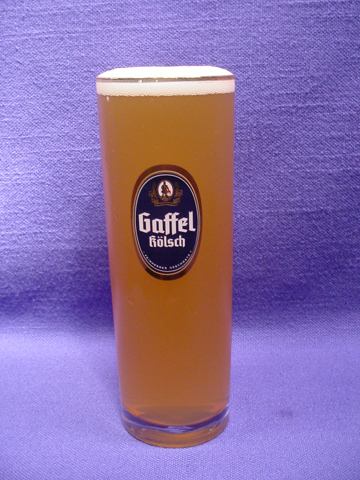
Gaffel Kölsch in it's natural
habitat: the Stange
So, Bremen is not very close to Cologne, Germany, but the Dead didn't play there in 1972, so I'm taking liberties. Cologne (Köln) is home to a very interesting style of beer (one of my favorites), the Kölsch****, the demonym for all things and people from the region of Cologne. A true Kölsch is brewed at one of 20 or so breweries in the region, and it is typified by its clear golden-blonde hue, high carbonation, white billowy head, and crisp, dry finish. Light malts are featured along with more hops than many European beers (though not many by modern American craft standards), and a particular ale yeast provides some mild fruity characteristics. Overall, however, the Kölsch has a very clean profile, owing to the cool fermentation temperatures and cold-aging (lagering) that make this a "hybrid" style. This is a refreshing, low alcohol (by modern American craft standards) beer meant to be enjoyed amongst friends and in large quantities over an extended period of time. See why it's a favorite?!?!

Two modern Köbesses serving Kölsch at the pub.
In its native environment, Kölsch is typically served in a pub associated with or attached to the brewery where it was produced. The servers at the pub, called Köbesses, are typically male and have traditionally worn a blue knit waistcoat, a blue linen apron, and a leather money pouch worn like a fanny-pack. Kölsch is properly served in a thin-walled, cylindrical glass called a "Stange" that holds just 200-mL of beer. Since you'll probably enjoy several while at the pub, the server marks each customer's coaster with a notch for each beer ordered.

Through the Middle Ages, the brewers of Cologne formed guilds to gain some measure of political power in the face of their two sources of taxes: the King and the Pope. Closer to a manufacturers' association than a labor union, the guilds had economic, religious, and community functions all involving beer. The various iterations of the guilds maintained their presence through centuries' of the ebbs and flows of dominance in their region between the Germans, the French, and the religious powers that be to represent the brewers' interests in the grain and hops markets, regulation and taxation, and their consumer market, ensuring quality products at a fair price. In turn, this benefitted the farmers producing barley and hops, as well as the consumers and citizens, as the brewers understood that holidays and festivals were for the drinker, not the brewer! Following World War I, the immediate precursor to the current style began to emerge through industrial technology, taxation, grain restrictions, and economic depression under the Third Reichthe. After WWII, the guilds established the Kölsch style as their very own. In the global age, the Association of Cologne Breweries (alongside the Cologne Brewers Corporation) asserted exclusive ownership of the style by signing the 1986 Kölsch Konvention. Today, no brewer outside of the region can legally market a beer under the name of Kölsch, and none of the regional brewers can add descriptors such as "premium," "special," etc. to any of their Kölsch products.

I suggest you seek out a real Kösch to enjoy this show with an authentic and unique German taste. In and around Cologne, of course, you'll have plenty of options, but in the States your options are limited primarily to Gaffel and Reissdorf. (American copycats struggle to get it right, and tend to properly fall into the American blonde ale category discussed at the end of a previous post.) Pair your authentic Kölsch with the classic pub cuisine of the region like bierzupp (it's just what it sounds like), jestuvte murre met brodwoosch (braised carrots with bratwurst), the gourmet Kölsch caviar (actually fried blood sausage crumbs), or leading up to Lent, try the buttery, rich, almond-infused Muuzemandeln cookies. Delicious. Zum Wohl!!


---------------------------------


 I agree with Blair Jackson in the liner notes that this is the hotter version of the two, but I can't call it a highlight if they took to shots at it!!
** Bob Weir's solo album Ace, which was recorded with the entire band backing Bobby on songs he wrote along with either Robert Hunter or John Perry Barlow, also included a version of "Playin'." Ace was released the same month as Rolling Thunder, while the Dead were touring Europe.
*** The allusion, of course, is to Jesus's Sermon on the Mount.
**** Information in this section comes primarily from Eric Warner's wonderful addition to the Classic Beer Style Series, Kölsch.

Saturday, April 7, 2012

The Opener: 4/7/72 Wembley and the Greatest (Baseball) Story Ever Told

When: Friday, April 7, 1972
Where: Wembley Empire Pool, London, England
Setlist: (stream an audience recording here - warning: it's notoriously poor quality)
  1. Greatest Story Ever Told, Sugaree, Chinatown Shuffle, Me & My Uncle, China Cat Sunflower > I Know You Rider, Big Boss Man, Black-Throated Wind, Loser, Mr. Charlie, Beat It On Down The Line, Tennessee Jed, Playing in the Band, Casey Jones*
  2. Truckin' > Drums > The Other One > El Paso > The Other One > Wharf Rat, Ramble On Rose, Sugar Magnolia, Not Fade Away > Goin' Down The Road Feeling Bad > Not Fade Away  E: One More Saturday Night
I've bolded my personal highlights. BTW, the released recordings are SPARKLING!!
^ Casey Jones was not recorded on the 16-track equipment, and the final minute of Big Boss Man is cut off. These CD case claims these are the only recording issues of the tour, though the setlists don't line up with the ones in Deadbase IX and The Deadhead's Taping Compendium, Vol. 1. For this blog, I use the song order on the released CDs because I believe they are most reliable, though it is possible they moved some of the songs around to fit them onto CDs efficiently.

I learned from Gary Lambert's liner notes that the Dead had planned the whole tour for "intimate, acoustically excellent concert halls." However, a few weeks before they arrived for shows scheduled April 5-8 at the 3,000-seat Rainbow Theatre, the venue closed due to financial issues. A smaller venue, the Commodore, was booked and publicized as a replacement, but co-manager Sam Cutler vetoed the space for financial reasons. Instead, he booked two shows at the Wembley Empire Pool, a venue that could accommodate 12,000+ people (roughly 8,000 attended each night), with the tradeoff that the band would return to London at the end of May for what turned out to be an epic run of four shows at the Strand Lyceum Theatre. And everybody wins!! (Except for those folks at the Rainbow Theatre... and the Commodore. Sorry, dudes... er, blokes.)

I'm keeping this review short (a few notes below), but the highlight is clearly the huge jam to start the second set. "Truckin'" starts tight and energetic, but it doesn't take long for the band to dive into weird, energetic improvisation. "Drums" inevitably drops (hard) into "The Other One" for an awesome version of this memorable pairing. After "Wharf Rat" concludes, co-manager Rock Scully spews some thoroughly bummer-inducing drivel into the mic about hall management, dancers in the aisles, and fire codes. Thankfully, Sam Cutler saves the buzz by quipping, "Y'see, the thing is, the cops haven't got enough room to dance." Classic when-the-circus-comes-to-town stuff. England more than Germany, but I'm not sure how prepared the European authorities were for this freak parade circa 1972!!


Song of the Day: "Greatest Story Ever Told"

This post is about openers, so I want to write a bit about "Greatest Story Ever Told" (if you're curious, see the annotated lyrics). For those who aren't familiar it, this song is a four-on-the-floor rocker with characteristic GD flair of scorching guitar leads and Bobby's typical flair and showmanship. Phil's bass pumps the intro, and though it starts out a bit sloppy, it tightens up as they work off the jitters (courtesy of Lady C, certainly) in the changes as Keith pounds out the rhythm on the piano, and Jerry lets fly with the envelope filter (or is that a Wah?). Donna jumps in for the chorus but the band doesn't really get going until the final, "Cool clear water where you can't never tell," at which point the song screeches to a halt. Certainly not a stellar version, so be sure you check out the one from 4/11/72 for comparison (sorry, can't find a link, but it's worth seeking out).

I'll be sure to note hotter versions of this song (there will be plenty before May is over), but I've always thought this song showcases Hunter's adaptability, allusion, and absurdity. The music was written (and the song named) by Bob Weir to go along Robert Hunter's rock-'n'-roll-gets-Biblical lyrics.* The narrative includes Moses and Gideon trading truisms about an open door, while Abraham and Isaac do all the grunt work. Hunter spins such unforgettable lines as "the one thing we need is a left-hand monkey wrench" and "I asked him [Moses] for mercy, he gave me a gun." Compound that with the image of the narrator kickin' back with Moses (the size of Malone**) pounding bottle after bottle of wine, and it definitely earns the title "Greatest Story Ever Told."
Phil Lesh.jpg
Phil Lesh, 4/7/72. (from David Botterell)
Worth noting:
  •  
  • I'm VERY excited for a "Chinatown Shuffle" on nearly every show of the tour! Can't wait for "The Stranger"... PIGPEN!!
  • I love these succinct (~10 min) versions of "Playin!" They waste no time diving off the deep end, and they bring it back before you know it.
  • Amazing what Billy Kreutzman pulls off on the drum solos from this tour, almost makes me think he feels liberated with Mickey on hiatus. Did I mention the drop to "The Other One" hits hard!!
  • I love sandwiching "El Paso" (or some other cowboy tune) into the middle of a tour-de-force "The Other One" exploration (or deep "Dark Star" jam). Plenty more of those to come!!
  • For another post, but this "NFA">"GDTRFB">
  • "NFA" reminds me of unsettled business, Dan and Liam. I haven't forgotten.
  • They certainly got geeked up before the "Saturday Night" encore.
Bob Weir & Garcia.jpg
Jerry Garcia and Bob Weir, 4/7/72. David Botterell.
*     *     *     *     *

Opening Day: Not Just For US Anymore

This may not be entirely timely at posting, but it follows my theme of the day of openers. There has been plenty of talk about Opening Day of baseball season this year, in light of the Athletics and the Mariners playing the first meaningful game of the season over a week ago in Japan. I've heard people taking issue with a couple teams starting earlier than the rest, and other people taking issue with the fact that the games were overseas. Really, I see them as the same issue: if you're going to play a meaningful MLB games in Japan, it has to be a week or so before the rest of the league starts for logistical reasons. The travel schedule is grueling enough; the players need travel time, jet-lag time, and rest. No one can dispute the fact that the premier players won't see much action in an exhibition/pre-season game, so in order for the game to be meaningful, it must count. Therefore, I see the issues as opposition to playing the game in Japan. A few notes:
  1. American interest in baseball has waned over the past decade or two (IMO, largely due to the rise of the NFL and niche sports gaining creditable followings as cable coverage expands, as opposed to collateral damage of work stoppages and PED scandals). Can you see them selling 50,000 regularly priced tickets per game in Oakland or Seattle?
  2. Over a quarter of MLB players are foreign-born (see the stats for 2009, 2010, 2011, and 2012)***, with even more in the minors. There is a clear consumer market for the game in Japan, as the country hosts their own major professional league that has given MLB Hideo Nomo (1995 RoY, two MLB no-hitters), Hideki Matsui (2009 World Series MVP), and of course the legendary Ichiro Suzuki (2001 RoY and MVP, first-ballot Hall of Famer in my eyes), all of whom left Japan at or before their peaks to play in MLB (granted for vast sums of money).
    • CAVEAT: There are far more players from Latin America than there are from Japan (or Asia overall). In much of Latin America, baseball is seen more as a job than a pastime. I would be strongly in favor of meaningful MLB games being played in Latin America, but can you see the league selling 50,000 regularly priced tickets in Santo Domingo or *gasp* Havana? (Maybe some day, Val.)
  3. They sold 50,000 regularly (and premium) priced tickets to each of the two games played at the Tokyo Dome.
  4. Ichiro deserves his own point - he's the Michael Jordan of Japan. The guy has been better than anyone at not getting out over the past decade. He holds the record for most hits in an MLB season (262 in 2004, breaking a record that stood for 84 years), and he ran off an incredible ten consecutive years of 200+ hits and .300+ batting average (for stats geeks, his WAR came in just under 59 in that span). He has also had one of the strongest arms in right field and has never stolen less than 50 bases in an MLB season. Considering his fall-off last season, just giving him a chance to start the season 4-for-5 with two infield hits in the Tokyo Dome is worth it for what he's done for the MLB and for the game as a whole. Realistically, he can't keep this up for much longer.
  5. The Mariners are owned by Nintendo of America, with deep roots in Japan. They tried playing the 2003 opener in Japan but were forced to change plans when the United States invaded Iraq.
  6. In case you forgot, Japan suffered an unimaginable triple disaster just over a year ago, reminding the nation of their dubious distinction of being the only people in history to be on the receiving end of a surprise nuclear bombing. Even if you don't believe we owe them anything for our role in that (all's fair in love and war, I guess), you can think back to September, 2001. For many (certainly not all) Americans, the return of baseball and the NFL provided a distraction and certain release from the horrible emotions following 9/11. MLB can't do much to ease the suffering of those in and around Fukushima, but if getting their national hero to play a freaking baseball game in Tokyo helps anyone in any way, I think it's worth it.
There may be perfectly good reasons for not wanting to play the first Opening Day game in Japan, but most of what I've heard in opposition has been troublingly jingoistic. Plus, when in the forseable future can we see the A's and the M's battle for the best record in baseball?

Now that my rant is done, who's excited for baseball season?!?!?! I am. Here are my predictions (written after the Japanese opener, but before the rest). As TMQ says, all predictions guaranteed to be wrong or your money back (because the blog is free, not because I'll back all bets against my predictions):
  • NL: 
    • Giants win the West with 87 wins (tight race with Arizona, goes to the final day)
    • Reds take the Central with 89 (right, Ben?)
    • Phillies win the East and the top seed with 93 wins (thanks, Terry, I like that number)
    • Wild Cards are the Marlins with 90 wins and the Cards with 87 (I didn't forget about you, Corey!)
  • AL: 
    • Rangers take the West with 99 wins
    • Tigers have the best record in baseball with 103 wins
    • The Rays take the East with 98 wins
    • The Yankees win 95 and the Angels win 97 and square off for the Wild Card round in Anaheim. (That's right folks, BoSox miss the playoffs again, even after they add an extra Wild Card.)
Hope Springs Eternal on Opening Day!!

- Morning Brewer (but my friends call me catacea)

PS (Pairing Suggestion): 

In honor of baseball season, take in a ballgame at the park or at home (with the first Wembley show on in the background, of course!), and enjoy a hot smoked sausage with sauteed peppers/onions and spicy mustard. Beer? I'll take an American blonde ale, please!

Crisp, dry, and light, this is what beer geeks like myself affectionately call a "lawnmower beer," and (fitting for my first PS) it's a style that is more accessible than most for people who aren't into craft beers in their many forms. As with any beer style deemed "American," this one is hoppier than its Anglo and continental cousins, the paler pale ales and the German Kölsch.
  • Kenzinger will do until Summer Love is released here in Philly.
  • In DC, the Corruption goes with everything (even if it's not a blonde ale), just ask Dan and Sam!
  • In Chi-town, go with the Gossamer Golden Ale (can't vouch for it personally, but I like the brewery and this offering's been well received).
  • Out West, if you can't get your hands on some Happy Hops, ease yourself into the Ballast Point Pale Ale (they call it a Kölsch, so I'm counting it!) or dig up some Poleeko Gold.
  • In AK, go with the Alaskan Pale (ditto on the style).
  • In Tel Aviv, I have no idea if you can get a sausage let alone this brew, but there's an outside chance you can find the He'Brew Genesis Dry-Hopped Session Beer. If not, someone tell Noam to get his cousin on it!!
  • If I didn't hit your locale, please let me know where you are and I'll do my best to accommodate. (Unless you're Maddog or anyone in Portland, in which case you send me the suggestions!!)
---------------------------------

* Mickey Hart gets a credit, too, as Hunter explains in Box of Rain that he wrote the lyrics to the rhythm of the water pump at Mickey's (in Los Trancos, I believe?), and Moses is also known as "Pumpman."
** While eventually six-foot-ten and inducted into the Naismith Memorial Basketball Hall of Fame, Moses Malone was not yet 16 when this song debuted (along with Bertha, Johnny B. Goode, Loser, Playing in the Band, and that incredible jam leading into the first Wharf Rat) on 2/18/71 at the Capitol Theatre in Port Chester, NY (also Mickey's last show before his hiatus).
*** From ESPN.com writer Tom Caple: "When baseball officially opened its 2012 season in Japan last week, there were players from five continents on the field: South America (Felix Hernandez and Jesus Montero), Europe (Alex Liddi), Australia (Grant Balfour), Asia (Ichiro, Munenori Kawasaki and Hisashi Iwakuma) and North America (too many to mention)."